
People bring expectations from previous experiences when they use an interface. A mental model is their understanding of how something works, which may differ from the system’s actual behavior. Designing with that difference in mind can help a team identify where explanations or behavior need to change.
A mental model is more than a preference or desired feature. It shapes what a person expects an action to do and how they interpret the result. The same label can therefore create different expectations for different people.
You cannot directly inspect someone’s internal model. You can investigate it through what they predict, explain and do in a relevant task, while recognizing the limits of those observations.
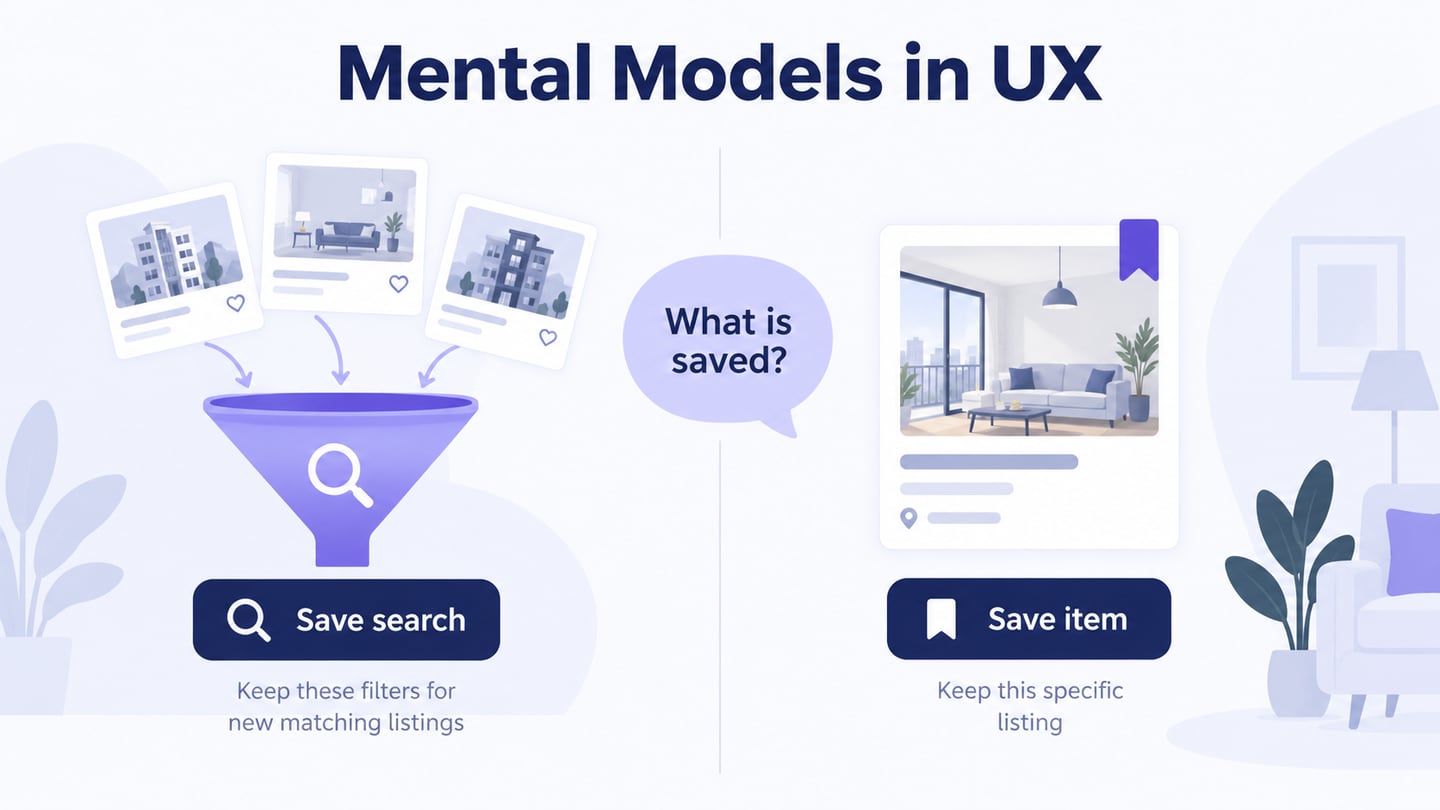
This guide uses a saved-search example: does “Save search” preserve the current results, bookmark the criteria, or subscribe the person to future alerts? Those are different behaviors that a vague label may conceal.
How to Improve Misaligned Mental Models
Start by distinguishing the person’s expectation from the system’s behavior. The problem is not that the user has the “wrong” preference; the interface may use an unclear label or omit the consequence of an action.
Investigate the gap before deciding whether to change the behavior, the explanation or both. A design should not force everyone into an assumed single model.
- Learn about relevant users: recruit people with the experience and context that matter to the task. Ask how they have used similar actions before, then compare that account with what happens in the proposed interface.
- Explain unfamiliar behavior at the right moment: brief contextual wording can clarify an action more effectively than a long onboarding tour. Check whether the explanation answers the actual uncertainty.
For saved search, the important distinction may be between criteria and results. A long introduction to the entire product will not necessarily make that distinction clear.
- Inspect familiar conventions carefully: comparable products may suggest expectations to investigate. Their size or popularity does not prove that their design is right for your audience.
- Review feedback and observed behavior: look for repeated mismatches, but retain differences and contradictions rather than converting every comment into an immediate redesign.
Use the evidence to define a specific design question, such as whether the saved-search result communicates what will be retained.
- Prepare people for meaningful changes: if an action’s behavior changes, explain the consequence near the relevant task and provide appropriate control or recovery.
A notice alone does not guarantee acceptance. Check whether people can still complete the task and understand what changed, especially when an existing saved item behaves differently.
How Can Mental Models Be Applied to UX?
Separate the team’s understanding of the system from the user’s expectations. The system may store criteria and refresh results, while the person believes it has saved a fixed list. A clear interface needs to make that distinction inspectable.
Expect variation across people and contexts. Someone saving a property search for daily updates may want alerts; someone keeping a shortlist for a discussion may want a stable record. Do not treat these as the same need.
The following practices can help investigate or respond to expectation gaps:
- Jakob's Law
- Card Sorting
- Wireframing and Prototyping
- Natural User Interface
Jakob's Law
Jakob’s Law describes the influence of experience with other websites on expectations. Familiar patterns can be useful, but the principle is not a command to copy competitors or a guarantee that every convention applies to every audience.
Use familiar language where it accurately describes the behavior. When the behavior differs, make the difference visible instead of borrowing a label that creates a misleading expectation.
Card Sorting
Card sorting investigates how people group and label information. It can inform categories and naming, but it does not directly test the entire navigation route or prove that users will find an item.
Use an appropriate follow-up, such as a task with the proposed structure, to investigate findability. Keep grouping evidence separate from navigation evidence.
Prototyping and Wireframing
A wireframe or prototype lets you ask what people expect before an action and compare that with their interpretation afterward. Choose a task that makes the consequence meaningful.
Prototyping is not the same as A/B testing. An A/B experiment needs a suitable comparison design, allocation and outcome measure; presenting two prototypes for discussion does not automatically provide that evidence.
Natural User Interface
Interfaces that use familiar actions or direct manipulation may feel understandable in a context, but no gesture is universally “natural.” A hidden swipe can be hard to discover and may need an alternative control.
Check whether the action is discoverable, its effect is understandable and the task remains possible through the relevant input methods. A page-turn animation, for example, does not by itself explain where a reader’s progress is stored.
How to Determine Users' Existing Mental Models?
Combine methods according to the question. NN/g’s mental-model guidance explains why the user’s understanding and the system’s design can diverge.
For the saved-search task, consider the following evidence:
- Card sorting: explore whether Saved searches and Saved items belong together in the proposed content structure; do not infer behavior from grouping alone.
- Interviews: ask about a recent example of saving something and what the person expected to happen later.
- Surveys: collect a defined self-report when comparable answers are useful, while accounting for question and sampling limitations.
- Task observation: ask what the person expects before saving and what they believe was saved afterward, without suggesting the answer.
- Comparable products: identify possible conventions to investigate, not proof of what your audience thinks.
Examples of Expectation Gaps
The following examples illustrate different kinds of mismatch. They are design questions, not claims about a particular company’s research or rollout results.
- Search and address entry: a single field may accept either a URL or a query. Its behavior and feedback should help people understand which interpretation occurred.
A familiar-looking field can still behave differently in a different context. Check the result and feedback before assuming the same label produces the same outcome.
- Reaction controls: a compact control may reveal several responses. Check whether people discover the alternatives and understand what a selection communicates.
- Onboarding: a tour may introduce a concept, but the relevant action still needs understandable labeling and feedback when used later.
Review a Saved-Search Design
In Mockitt, create fictional Search results, Save criteria and Saved search states. Explicitly state whether future results can change and whether alerts are enabled. Keep “Save item” separate when it preserves an individual result rather than a set of criteria.
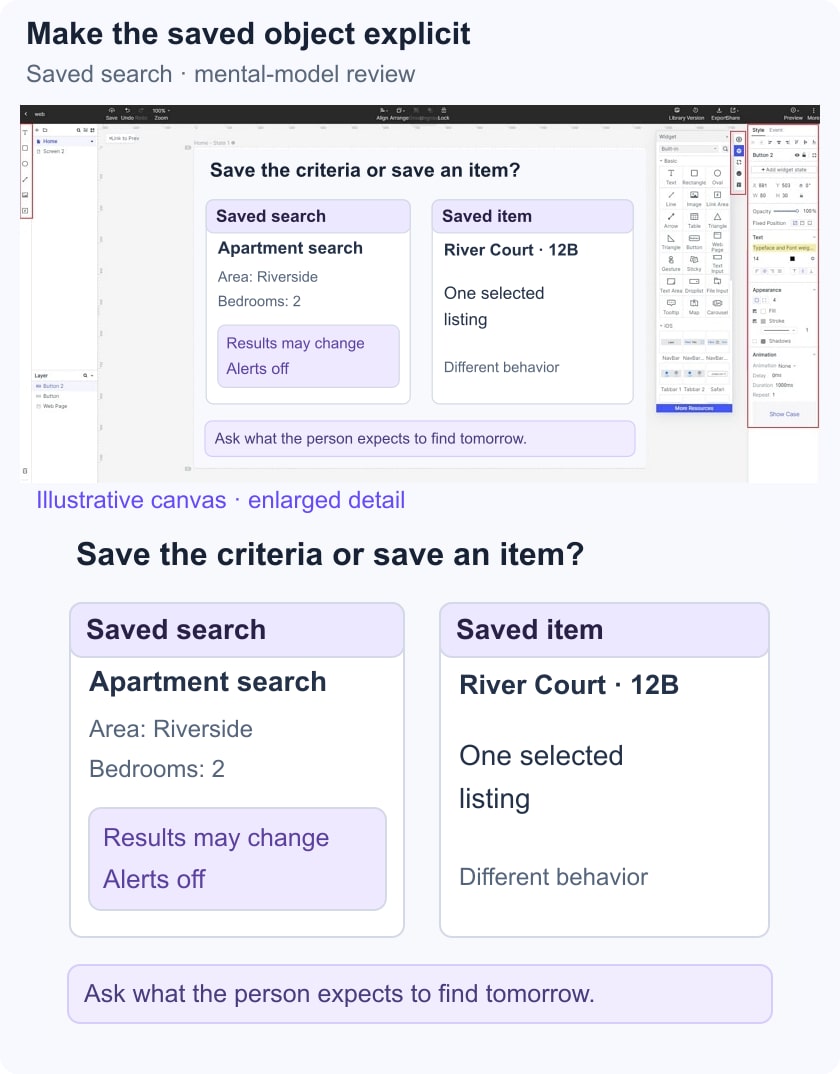
Ask a reviewer what they expect to find tomorrow after saving the search, then inspect the result state. Record any mismatch between the intended behavior and their explanation. The goal is to improve the action and feedback, not to claim that a single session reveals everyone’s mental model.
For handoff, document what is stored, what may refresh, whether notifications are sent and how the person can change or remove the saved search. Those system rules need implementation verification; the prototype only communicates the proposal.