Mockitt AI · Product Research
AI Product
Research Reports
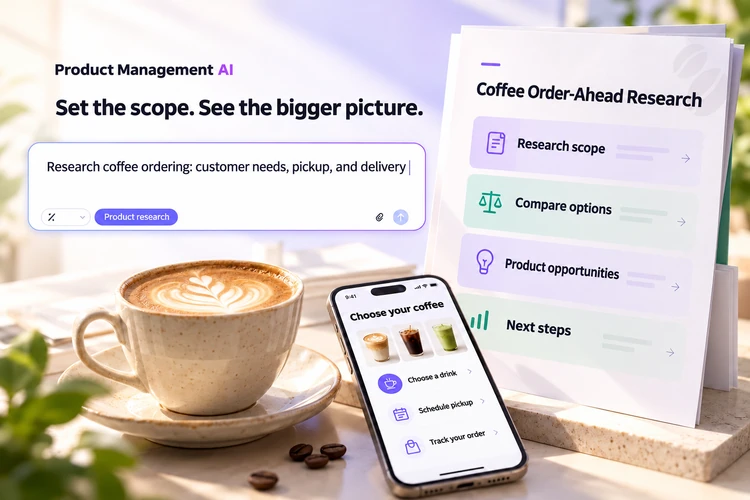
Enter a product or industry topic. Mockitt AI helps you organize public information, compare competitors, and create a product research report with analysis and recommendations. Ask follow-up questions, then bring the findings into discussions about requirements and product plans.
Keep asking questions as you explore market information, competitor differences, and product opportunities.
01 · Define the question
Narrow the scope.
Get more specific answers.
Go beyond a broad prompt like “the coffee industry.” Add the people you are studying, the situation they are in, and the decision you need to make. That context gives the research a specific question to answer.
Try this starting pointResearch coffee ordering for commuters. Compare pickup timing, arrival notifications, and out-of-stock handling. Identify the experience problems we should investigate first.

02 · Organize the evidence
Connect each source
to the question it answers.
Find and organize accessible product information, public reviews, and relevant coverage around your topic. Link each piece of information to a research question, keep its source, and update the report as you find new material.

Sources → Interpretation → Validation
See where each finding comes from.
In the coffee order-ahead example, keep sourced information separate from your own product judgments. A historical announcement can explain the service concept. Current pickup details still need to be checked against today's rules and actual ordering flow.
| Type of information | Example | How to use it |
|---|---|---|
| Historical fact | Starbucks reported that Mobile Order & Pay became available on iOS and Android in its company-operated U.S. stores nationwide on September 22, 2015. | Read the official announcement Accessed November 9, 2026. This historical rollout does not establish today's store availability or cancellation rules. |
| Product hypothesis | Showing the store, order status, and pickup details together may reduce the effort needed to find them. | Treat this as a design hypothesis to test, not an established improvement in conversion or time saved. |
| Questions to verify | What happens if an item becomes unavailable during preparation? Can customers change the pickup store? What happens to an uncollected order? | Record current rules, screen captures, and the conditions they apply to. Leave unsupported details open instead of filling them in with assumptions about competitors. |
Open the evidence record and follow-up research prompt
# Coffee order-ahead research: evidence record

Question: When commuters order before reaching a cafe, how can they know where to go, when to pick up, and what to do if something goes wrong?

Verified historical information: Starbucks reported that Mobile Order & Pay became available on iOS and Android in its company-operated U.S. stores nationwide on September 22, 2015.
Source: https://investor.starbucks.com/news/financial-releases/news-details/2015/Starbucks-Reports-Record-Fourth-Quarter-and-Record-Fiscal-Year-2015-Results/default.aspx
Accessed: November 9, 2026. This announcement does not establish today's rules for every store or order.

Product hypothesis: Keeping pickup information together may reduce repeated searches for store and order details. We do not yet have conversion or efficiency data to support this hypothesis.

Questions to verify: When does preparation status update? Can items become unavailable before or after payment? What restrictions apply to changing stores or canceling?

Next steps: Compare current ordering flows. Record entry points, status changes, and failure paths. Ask customers about their most recent real pickup experience instead of asking whether they like a proposed feature.

Ask AI to organize the material under Facts and sources, Interpretation, Questions to verify, and Next steps. If no source is available, keep the item unverified. Do not fill in competitor features, market share, or user percentages.
03 · Compare alternatives
Compare the same task.
See what changes.
Compare different approaches to the same customer task. For coffee purchases, look at how in-store ordering, ordering ahead, and delivery handle pickup and fulfillment.

Go beyond a yes-or-no feature checklist. Explain how the steps and constraints differ when customers try to complete the same task.

04 · Identify opportunities
Turn comparisons
into ideas worth testing.
Use the evidence to identify strengths, weaknesses, opportunities, and threats, keeping the SWOT analysis tied to a specific product task. If pickup timing is unclear, for example, investigate when customers need a notification and how much notice helps.
Where do customers keep checking for updates?
Where could the experience provide feedback sooner?
What should the next interview or prototype test explore?
05 · Put the research to work
Share the report.
Make the next steps clear.
Bring the sources, comparisons, findings, and recommendations together, then share or download the report using the options available on the results page. Take the highest-priority questions into requirements discussions before deciding which screens and flows to build.

The Mockitt AI workflow
Keep your product work
moving forward.
Move from research findings to plans, requirements, and prototypes.
AI Product Research
Organize information, compare competitors, and create a research report.
AI PRD Generator
Document features, flows, and rules.
AI Requirements Review
Check the logic and identify questions to resolve.
AI Product Planning
Connect goals, scope, and feature planning.
AI Test Case Generator
Turn requirements into tests and edge cases.
Research with a clear purpose
Explore your next research question.
Competitive Analysis for UX: Compare Tasks and Turn Findings Into Decisions
Compare the same task across products, record the evidence, and turn meaningful differences into design decisions.
Understand your customersWhat Is UX Research? Methods, Planning and a Practical Example
Choose a research method based on the question you need to answer, then plan recruitment, observation, and next steps.
Make sense of the findingsUX Research Synthesis: Turn Notes into Traceable Design Decisions
Connect observations to themes, preserve contradictory evidence, and build a clear path from research notes to a design decision.
Define market requirementsCreate an MRD with ChatGPT: Market Evidence Before Requirements
Use sourced market research to distinguish assumptions, compare alternatives, and define the questions your requirements need to address.