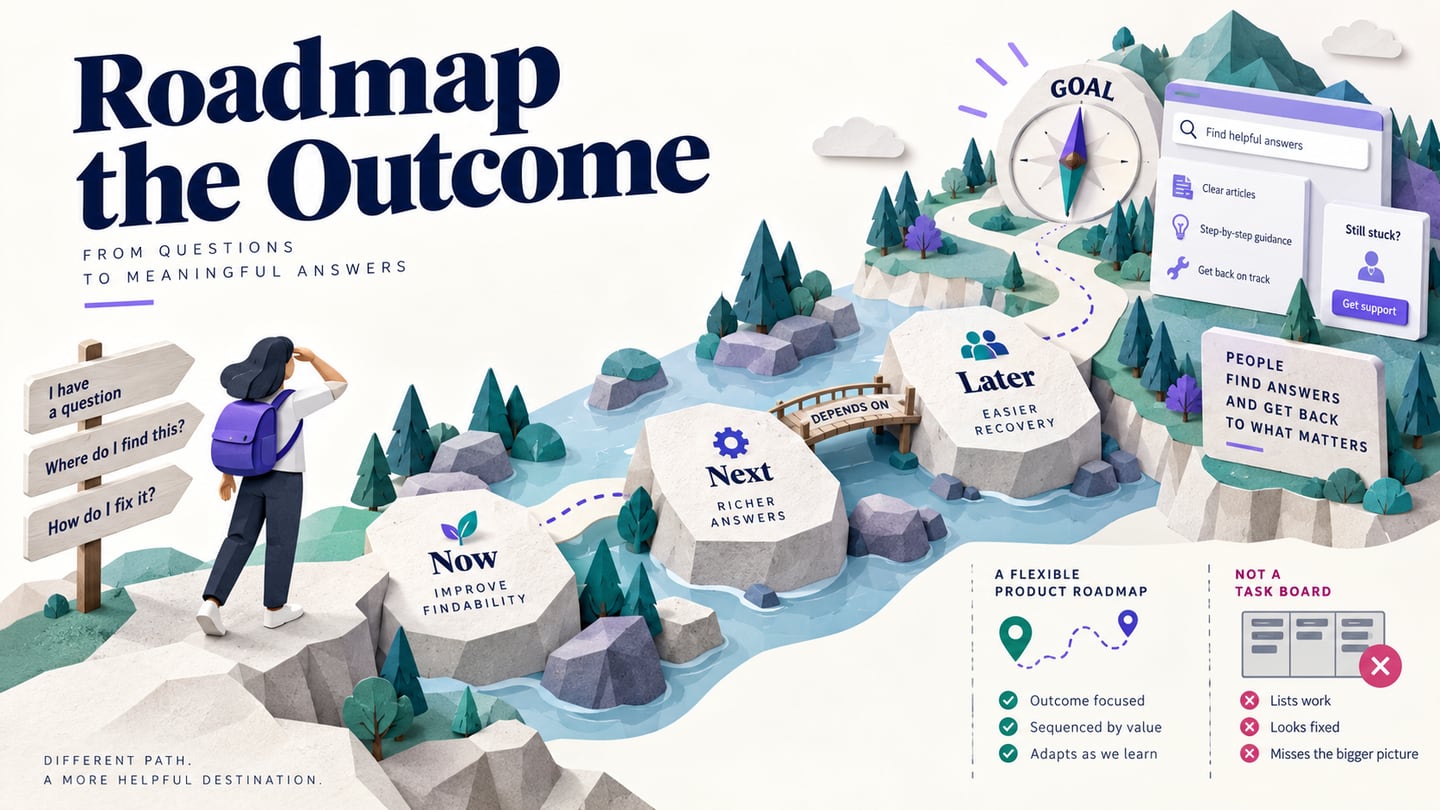
A product roadmap communicates the direction of a product and the reasoning behind upcoming work. It helps people discuss priorities, tradeoffs, and uncertainty. Its value is not a promise that every idea will ship on a particular date; it is a shared view of how the team intends to pursue its goals. For scoped initiatives, a worked RICE prioritization example makes the comparison explicit.
Use the roadmap to answer five questions: who has the problem, what outcome matters, what is being considered now, what depends on it, and when the team will review the decision again. This structure keeps a useful plan readable when evidence or capacity changes.
What is a Product Roadmap?
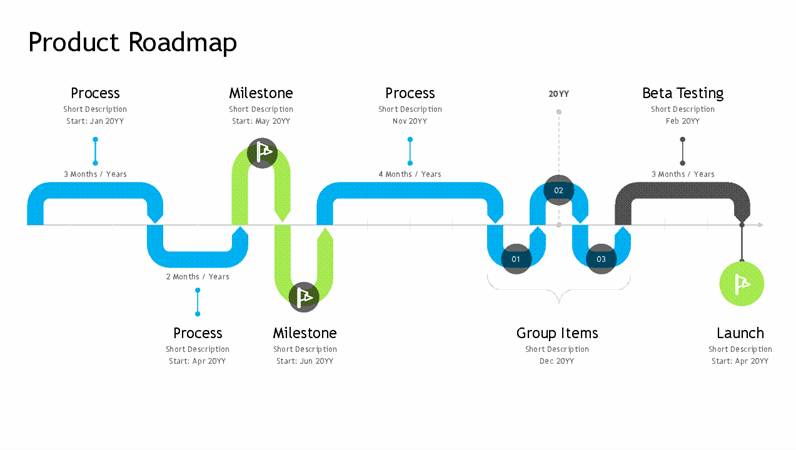
A product roadmap is a high-level view of product goals, opportunities, and planned initiatives over time. Atlassian describes it as a shared source of direction and priorities. It differs from a backlog of requests and a delivery schedule: the roadmap explains why work matters, while delivery planning manages implementation details and commitments.
Treat a roadmap as a maintained decision artifact. New evidence, dependencies, or business constraints may change it. That does not make the plan meaningless, provided the owner explains the change and distinguishes committed work from options still under discovery.
A practical roadmap card records the outcome, opportunity, scope boundary, owner, evidence, dependency, confidence, and next review. A feature name without these fields is a request list; a date without a commitment label is easy to misread.
Choose a format that matches your certainty
- Now, Next, Later: show priority and dependency order while the solution or timing is still uncertain. “Next” means conditional on earlier work, not automatically next month.
- Time windows: use quarters, months, or release windows when teams need to coordinate. Mark each item as a commitment, a target, or an exploration; sharing a column does not give them equal certainty.
- Outcome themes: group initiatives under improvements such as easier discovery or clearer recovery. Use these for strategic discussions where the important question is what to improve, rather than which team finishes a ticket.
Keep the roadmap distinct from a Gantt chart, which coordinates task duration and dependencies, and a Kanban board, which tracks work in progress. Connect those views when needed; do not turn the roadmap into a list of every implementation task.
How to Build a Product Roadmap?
Before arranging dates or columns, agree on the goal and evidence. The steps below use an illustrative support portal: users need to find a relevant answer or reach support without losing context. No usage or outcome data is assumed.
If the team has not agreed which opportunity to pursue, use a discovery workshop agenda to compare evidence and choose a next test before adding an initiative to the roadmap.
- Set the strategy. State the customer problem, segment, and business objective. For the portal, ask what evidence shows people cannot find relevant answers and which tasks matter most. Link research and support observations, record what remains unknown, and agree how progress will be measured. “Add an AI search box” is a solution idea; it is not the underlying goal. Compare it with improving content, navigation, or escalation before committing.
- Choose the audience and level of detail. Executives may need goals and investment choices; the delivery team needs dependencies and readiness; customers need careful communication about what is actually committed. Use consistent underlying decisions across these views. Label exploratory work explicitly and avoid turning an internal possibility into a public delivery promise.
- Build the roadmap around opportunities. Group work by meaningful themes, then show the initiatives being considered. For the portal, a “find a relevant answer” theme could contain content improvements and search evaluation; “recover when help is missing” could contain a clearer escalation path. Add an owner, supporting evidence, unresolved assumptions, and dependencies to each initiative.
- Choose a horizon and label certainty. Use Now/Next/Later when order matters more than dates. Use quarters or release windows when coordination requires them. Mark items as committed, target, or exploratory so a discussion point is not mistaken for a delivery promise.
- Keep it adaptable and explain changes. Review the roadmap when new evidence arrives, a dependency moves, or a significant decision changes. Do not silently move items between columns. Record the reason, affected stakeholders, and next review point. A review cadence can keep the artifact current, but it should not force changes when the evidence has not changed.
For example, the team may discover that search cannot return useful results until outdated help content is corrected. Move content ownership and cleanup ahead of a search-interface experiment, document that dependency, and tell reviewers why the sequence changed. Keep the implementation tasks in the delivery tracker; the roadmap should still explain the intended user outcome.
Before an initiative moves into committed delivery, check that its owner can explain the problem, evidence, scope boundary, major dependency, and learning or success measure. A colored bar without those decisions gives a false impression of certainty. A user-story map connects that scope to an end-to-end release slice.
Choose a tool for the roadmap you need
The tool should make the plan understandable and maintainable. Check how it handles ownership, audience-specific views, linked evidence, permissions, and updates. These examples describe roles, not a universal ranking.
- Mockitt Whiteboard gives a product team a shared canvas for discussing goals, assumptions, and dependencies. Keep the agreed decisions near their supporting material, and use a separate delivery tracker for implementation work.
- Trello can represent a lightweight roadmap using boards and cards. Define what each column means and separate possible ideas from committed work.
- Jira Product Discovery provides roadmap views for product ideas and initiatives. Evaluate it when discovery decisions need to stay connected to a Jira-based workflow.
- Boardmix can support a collaborative planning workshop. Use the board to compare opportunities, then name an owner for maintaining the resulting decisions.
- Notion can keep a roadmap alongside briefs and research documents. Establish a clear status model and an approved view so a collection of notes is not mistaken for a commitment.
- ProdPad supports product ideas, feedback, and roadmapping. Check whether its workflow fits how your team moves from evidence to prioritization.
- ProductPlan provides roadmap planning and communication features. Try the views and access controls required by your actual stakeholders before choosing a plan.
Use a prototype to investigate a roadmap assumption
A roadmap says what the team intends to explore or deliver; a prototype helps investigate a proposed experience. Use Mockitt to make a selected user task concrete before treating a solution idea as ready for implementation. Keep the roadmap and prototype linked, but do not treat a polished screen as evidence that the opportunity is validated.
- Prototype: model the specific task and its important alternate states. Interactive screens demonstrate a proposal, not a deployed service or measured business outcome.
- Review: share the task with relevant reviewers and record observations against the assumption being examined. Convert a useful finding into a roadmap decision with an owner.
- Handoff: connect the approved design, requirement, and delivery work after the decision is made. Engineering still needs to implement and test the actual service.
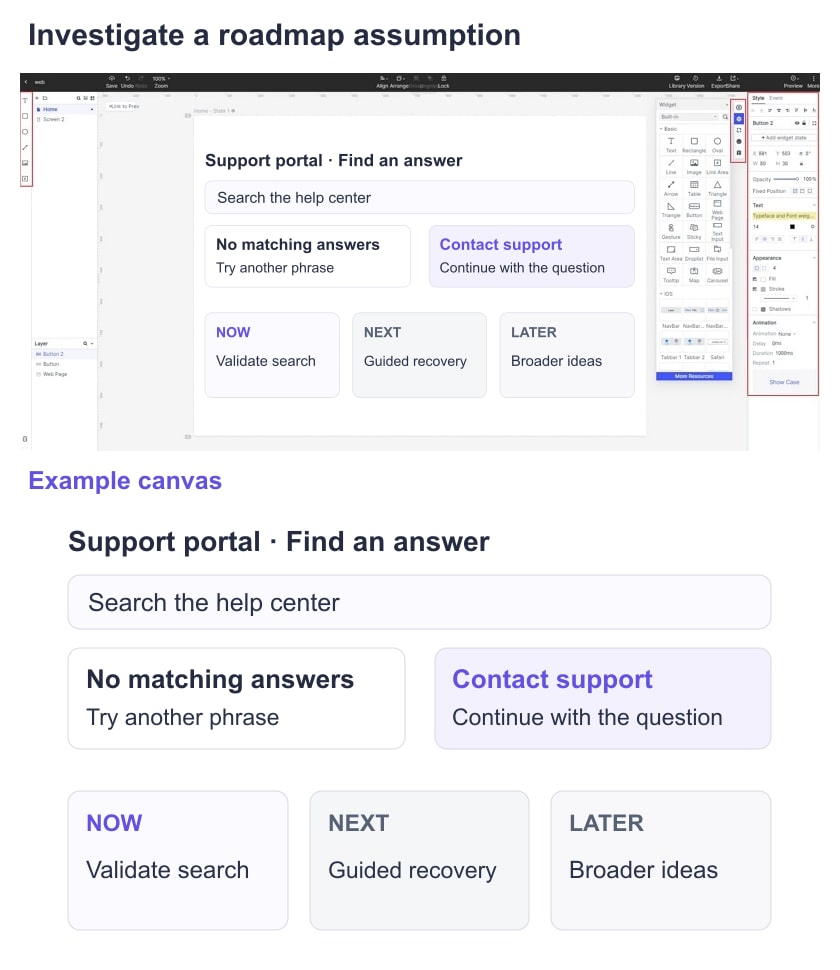
For the support-portal example, prototype a search result, a no-results state, and a contact-support path that preserves the question. Ask participants to find an answer and recover when none is available. If they cannot tell what to do next, revise the experience and record the learning before expanding scope. This is an illustrative investigation, not a claim that a prototype alone improves support performance.
A useful roadmap leaves people knowing why an initiative matters, what is currently decided, and what evidence could change the plan. Maintain that clarity as the product evolves.
Make dependencies and status visible
A roadmap becomes easier to review when every item uses the same small set of fields. For the support portal, the first card might read: “Improve answer findability; owner: content lead; dependency: approved source inventory; status: target; next review: after the content audit.” The wording exposes what must happen before the next decision without pretending that the work is already scheduled.
- Outcome: describe the user or business change the team wants to observe.
- Scope: state what the initiative covers and what remains outside it.
- Dependency: name information, access, people, or technical work that must be ready first.
- Confidence: distinguish evidence-backed work from a hypothesis worth testing.
- Review trigger: use a date or event that will cause the team to revisit the choice.
When a dependency moves, update the affected card and its reason. Do not quietly drag every later item to a new date; explain which outcome is protected, which scope is reduced, or which work is paused.
Use AI to draft structure, then verify it
AI can turn a long brief into candidate themes, but it cannot confirm an opportunity, capacity, or commitment by itself. Give it the product, users, evidence, team constraints, time window, and explicit exclusions. Ask for a distinction between known facts, assumptions, and questions that still need an owner.
For example, a useful prompt might say:
Organize a product roadmap for a support portal. Users need to find reliable answers or reach a person without losing their question. Use Now, Next, and Later. For each theme, list the intended outcome, scope boundary, dependency, owner role, evidence, and next review trigger. Separate confirmed facts from assumptions. Do not invent dates, adoption, revenue, or efficiency gains. Keep self-service expansion out of scope until a small recovery flow has been evaluated.
Review the result against the source material. Remove invented metrics, merge duplicate themes, and check that each dependency has a realistic owner. Then move the accepted structure into the team’s editable board and record what changed during review. A generated outline is a starting point for a decision, not a delivery promise.
Roadmaps work when they make tradeoffs discussable. Start with a small, evidence-linked view, invite the people who own the decisions, and update the artifact when the reasons change.