Card sorting helps you discover how people group content and what they call those groups. Give people separate cards representing real items, let them organize the cards, and use their arrangements and explanations to develop candidate categories. The useful output is a reasoned proposal for organizing content, not a menu to copy directly into a website.
Use this method when your content categories and labels are still open to change. A good study starts with a clear question and a carefully prepared card set. This guide follows a fictional Northbank Library website from its content inventory to a proposed structure; the cards and alternative arrangements are examples, not results from a participant study.
Choose a question before choosing a card-sorting format
Northbank Library has information about borrowing, membership, visits and events. The team wants to know which services readers associate with one another before redesigning the site. Its question is: “How would members organize these services so the groups make sense to them?” That differs from asking whether a person can find a particular item in an existing menu.
In an open sort, participants create and name their own groups. In a closed sort, they place cards into supplied categories. A hybrid sort supplies some categories but permits additions. NN/g’s card-sorting guide explains these formats and cautions that the names participants suggest are not automatically suitable final navigation labels.
An open sort fits Northbank’s initial question because the team does not yet want to impose its departments or preferred categories. A closed sort would fit a narrower placement question, such as where people put a new service among established categories. A hybrid format can expose gaps, but the starting labels may steer people toward the team’s existing model.
Write down what can change. If the library can rename its help categories but cannot change the names of legal services, those are different constraints. Do not ask participants to solve an organizational decision the team has already fixed, then describe their compliance as discovery.
Make cards from content, not from the menu you want
Start with the maintained content inventory. Each card should represent one understandable item at a comparable level of detail. “Membership” is a broad category; “Replace a lost membership card” is a specific service. Mixing them without a reason can make the sorting task ambiguous before a participant starts.
For the worked example, this compact set makes the relationships easy to inspect. A real study would select a broader set appropriate to its content and question, then pilot the workload rather than treating twelve as a recommended study size.
| Card ID | Participant-facing label |
|---|---|
| L01 | Join the library |
| L02 | Replace a lost membership card |
| L03 | Change your contact details |
| L04 | Renew a borrowed book |
| L05 | Reserve a book |
| L06 | Borrow a laptop |
| L07 | Book a study room |
| L08 | Use library Wi-Fi |
| L09 | Find opening hours |
| L10 | Attend a reading group |
| L11 | Find children’s story sessions |
| L12 | Ask a librarian for help |
Keep the IDs in the research record so a wording correction does not break the connection to the inventory. Participants need the clear label, not an internal page ID. Where a short explanation is essential, provide it consistently and check that it explains the item without revealing the intended category.
Review repeated words carefully. If five cards begin with “Account services,” people may group the shared phrase rather than the underlying services. At the same time, do not replace ordinary language with obscure synonyms to eliminate every repetition. “Borrow a laptop” and “Renew a borrowed book” may legitimately share language.
Remove duplicate items and resolve obsolete content before the study. Keep genuinely awkward items, such as Ask a librarian for help: they may reveal where your proposed organization is unclear. Do not hide the difficult material simply to obtain tidier groups.
Prepare the materials and an independent session
Arrange the draft cards on Mockitt Whiteboard for the team to review their wording and coverage. Keep the unsorted card set separate from researcher notes about possible categories. Here, the whiteboard is a preparation and analysis workspace; use an appropriate research setup to collect independent participant responses.
The preparation canvas keeps the library’s twelve service cards ungrouped, with researcher questions in a separate area so they do not become suggested answers.
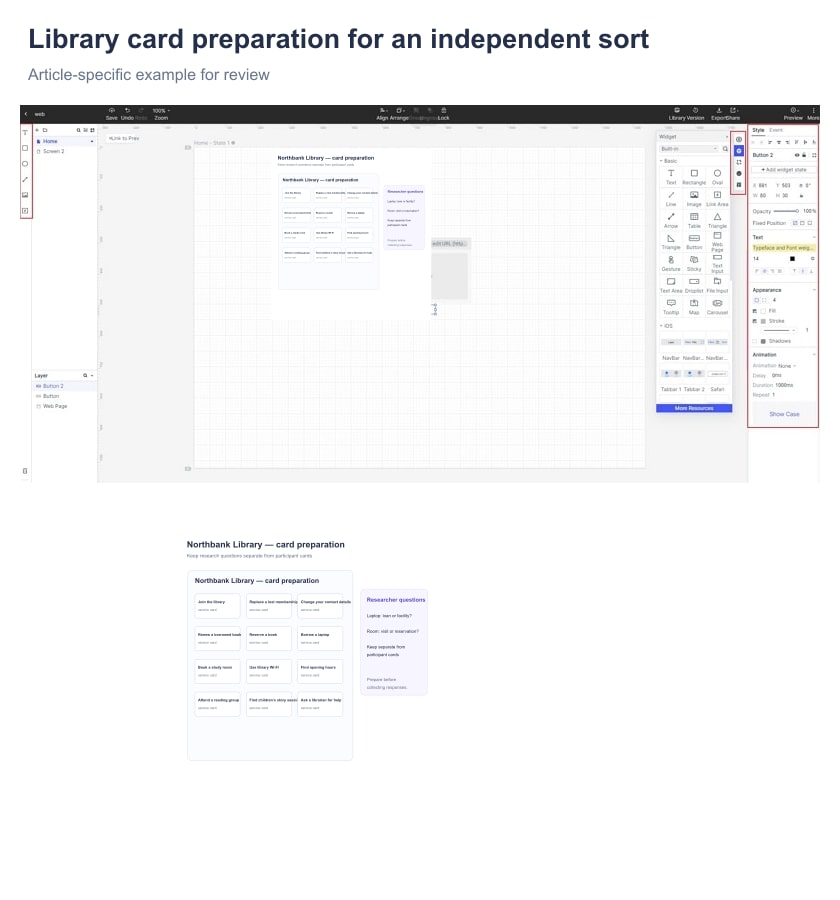
Two useful preparation questions are whether members think of laptop borrowing as a loan or an on-site facility, and whether room booking belongs with visits or reservations. Keep those questions in the moderator’s brief. Showing them above the cards would draw attention to relationships that participants might not otherwise consider.
Recruit people who match the service audience and record relevant experience, such as new versus established membership. Avoid treating library staff as substitutes for members: staff know the department structure and may use language a visitor never encounters. Decide the sample and recruitment approach from the decision and the kind of evidence you need, rather than promising a universal number of sessions.
Have people sort independently before any group discussion. A workshop in which colleagues negotiate a shared arrangement is useful design work, but its single agreed board does not show how individual members would group the content.
Choose materials people can operate comfortably. Physical cards, a moderated digital arrangement and a specialized remote service involve different access and recording requirements. Pilot the instructions, card wording, rearrangement and saving process. If someone cannot manipulate the chosen interface, adapt the method and record the assistance instead of treating the difficulty as a content-grouping result.
Let participants explain relationships without teaching the answer
For Northbank’s open sort, an instruction could be: “Organize these library services into groups that make sense to you. You can move cards as you reconsider. When you are satisfied with the groups, give each one a name.” Explain how to set aside an unfamiliar item and how to indicate that an item seems to fit more than one group.
Do not supply a target number of groups just because the future menu has a limited width. The study concerns content relationships; the team can address presentation constraints later. Likewise, refrain from praising a grouping that matches your preferred structure.
In a moderated session, ask about a choice after the participant has had time to make it. “What connects these items for you?” leaves room for their explanation. “Did you put laptop borrowing here because it is a facility?” supplies the rationale. Record a participant’s own words separately from your interpretation.
If a card appears to fit two groups, follow the study’s agreed rule. You might ask the participant to choose a primary location and note the alternative, or allow a recorded duplicate. Keep this consistent across sessions. A duplicated card must not silently become a second content item when you analyze the data.
Save each participant’s final arrangement, group labels, unplaced cards, alternative placements and relevant comments. Preserve earlier changes when they explain an important hesitation, but distinguish those movements from the final sort. Keep participant identifiers and sensitive recordings in the approved research location.
Analyze the relationships without forcing a consensus
Start with the raw arrangements. For each participant, record which card IDs belong together and the exact group name. Create a separate interpretation field if you standardize similar labels. “Borrowing” and “Things I can take home” may describe a similar group, but they are not identical statements.
Consider two possible arrangements for L06, Borrow a laptop. One arrangement could place it beside books because both are borrowed. Another could place it beside Wi-Fi and study rooms because the person thinks about equipment used during a visit. These invented alternatives illustrate the question you would investigate; neither is a participant finding or an answer to Northbank’s taxonomy.
If actual responses showed this difference, inspect the accompanying explanations and participant context. Does the service allow a laptop to leave the building? Do members understand that distinction? An unclear card description and a genuine difference in how people think about the service call for different changes.
Pairing counts can help identify items repeatedly grouped together. Preserve the denominator and treatment of incomplete sessions: “eight of ten completed sorts” communicates something different from “eight people.” Do not count ten movements of the same card by one person as ten independent preferences. The numbers here describe a reporting format, not study results.
A similarity display can highlight a relationship, but it does not explain it. Read the group labels and comments alongside any quantitative summary. Keep rare but consequential needs visible, and avoid creating a large “Other” category merely because some cards resist the main pattern.
Produce a small set of candidate structures with a rationale. For each one, record the evidence that supports it, conflicting placements, unclear labels and the remaining question. Where the evidence cannot distinguish two reasonable arrangements, keep both available for the next study instead of using a majority vote to claim certainty.
Turn the sort into a structure you can investigate
Card sorting supplies ideas for organization; it does not evaluate the full route through a navigation hierarchy. NN/g’s comparison of card sorting and tree testing makes that distinction. Once the team has candidate categories, test findability rather than asking another group to approve the appearance of the board.
For Northbank, a proposal might have Membership, Borrowing, Visiting and Activities as top-level categories. That is a starting hypothesis drawn for this example, not an instruction to use those labels on every library site. L06 still needs a placement decision; L12 may need a general help route as well as a maintained home in the structure.
Keep the content identity separate from its routes. If the same laptop policy is relevant to both Borrowing and Visiting, the team can maintain one page and consider more than one useful link to it. Duplicating the full policy into two pages introduces a maintenance problem that the card sort cannot solve.
Use a tree test with realistic findability tasks to examine the proposed hierarchy. A task might ask where a member would look to get a laptop for an afternoon; the research prompt should not name the category you hope they will choose. Later, bring the structure into the complete interface to assess the menu, search, content and accessibility together.
The handover should make the decisions traceable: the content inventory and card version, session procedure, raw arrangements, interpretation notes, proposed groups and the question for the next test. For the library, the unresolved laptop placement is part of that handover. Keeping it visible gives the next round a clear purpose and prevents a neat board from becoming an unsupported final menu.