System architecture diagrams
System architecture diagrams your team can follow
A system architecture diagram should make its components, boundaries, and dependencies easy to understand. Build a view your team can discuss in the Mockitt flowchart tool, then use separate diagrams for the details that need a closer look.
Choose the question before choosing the shapes
A system overview and a deployment diagram serve different conversations. Start by naming the reader and the decision: Does the product team need to understand the service boundaries? Does engineering need to examine how a request reaches an external provider? Do operators need to discuss network placement?
Use the Mockitt flowchart tool to arrange shapes, text, and connectors for the view you need. Keep components at a similar level of detail. Mixing one entire application with individual database tables makes it harder to understand what the boxes represent.
| View | Main question | Keep visible |
|---|---|---|
| System overview | What participates in this system? | Users, system boundary, major components, and external services |
| Component or service view | Which parts depend on each other? | Responsibilities, labeled calls or events, and data ownership |
| Deployment view | Where do those parts run? | Relevant environments, network boundaries, and runtime resources |
| Data flow view | Where does information enter, move, and persist? | Data sources, transformations, stores, and consumers |
Example: a subscription service from signup to access
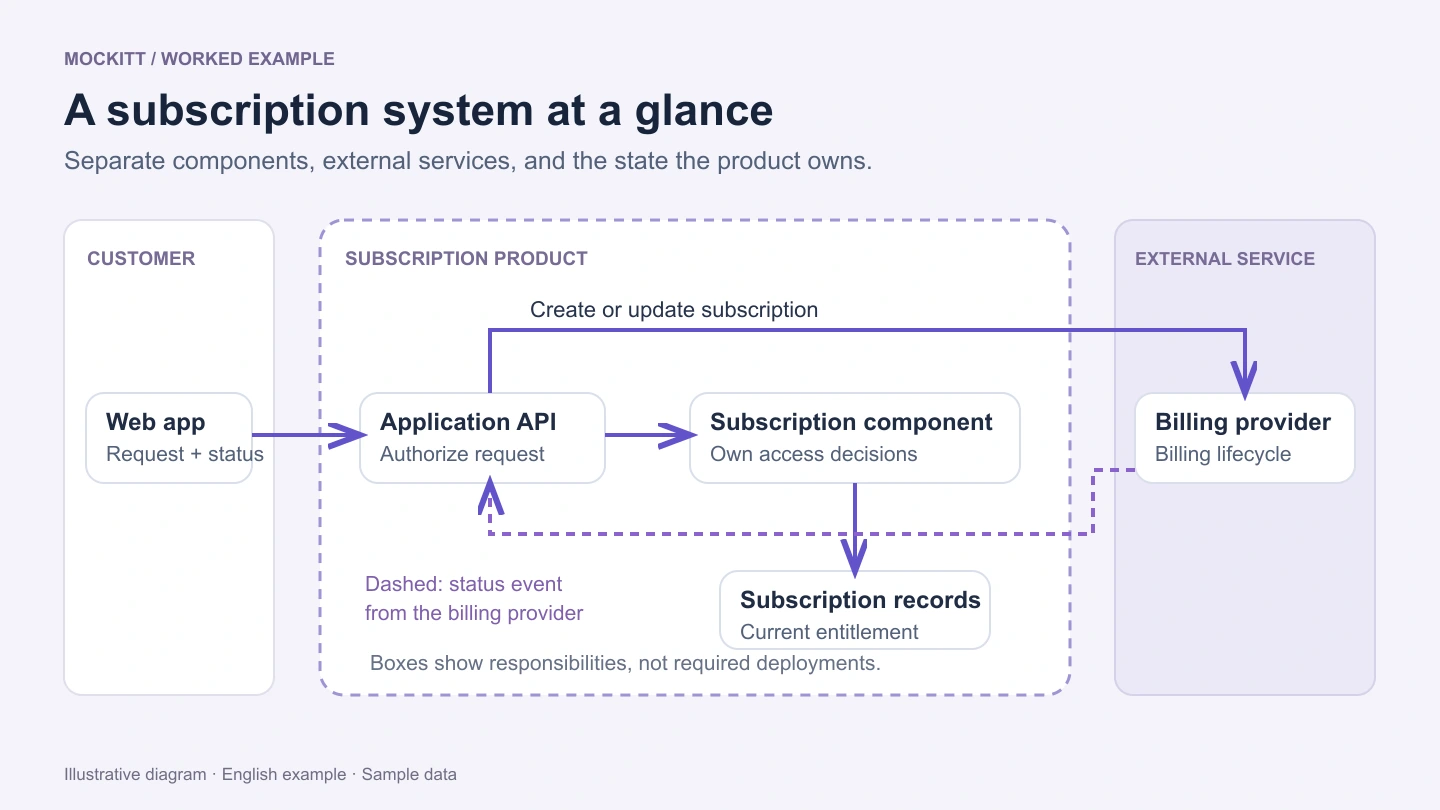
Imagine a team planning a subscription product. This example focuses on subscription activation and access checks. It leaves catalog management, tax calculation, and the billing provider's internal implementation outside the system boundary.
Start with the web app, an application API, a subscription component, the product's subscription records, and an external billing provider. Add a notification service only if it belongs to the design being discussed. Separate boxes here communicate responsibilities; they do not require separate deployed services.
| Relationship | Suggested connector label | Question to resolve |
|---|---|---|
| Web app → application API | Request subscription change | How is the account identified and authorized? |
| Application API → billing provider | Create or update subscription | What happens when the provider rejects the request? |
| Billing provider → application API | Subscription status event | How does the system authenticate and handle repeated events? |
| Subscription component → subscription records | Read or update entitlement state | Which component owns the authoritative access state? |
| Application API → web app | Return current access status | What does the interface show while confirmation is pending? |
These are design questions for the example system, not services that Mockitt deploys or connects on your behalf. The diagram is a communication artifact.
Make an arrow mean one thing
An unlabeled line can mean calls, sends data, runs inside, or depends on. Choose the relationship you intend and name it. Use direction consistently, and include a short legend when different connector styles have different meanings.
For the subscription example, distinguish a request to the billing provider from an event sent back by the provider. Do not use one double-headed arrow to hide two different responsibilities. If the order of messages matters, add a separate sequence diagram rather than forcing timing into the overview.
Show external services outside the system boundary. Identify ownership without implying a particular storage technology or cloud provider unless that decision is already known.
Build a view that another teammate can explain
Write the scope
Name the system, the audience, and the question. List what is deliberately outside this diagram.
Place the components
Use shapes and short labels for the parts you know. Give each component a responsibility, not just an unexplained technology acronym.
Group the boundaries
Separate the system from users and external services. Add environment or network boundaries only when they help answer the stated question.
Label the relationships
Connect callers to the parts they call. Distinguish events, data movement, and structural containment in a legend.
Read one request through the diagram
Follow the subscription change from the web app to the provider and back to the product's access state. Mark missing ownership or uncertain behavior as a question.
Review and maintain the view
Share the diagram with the people responsible for its components. Record its owner and the decision or revision it represents.
Keep unresolved decisions in the conversation
An architecture review should expose uncertainty. If the team has not decided how repeated billing events are handled, put that question beside the event connection. Do not draw a retry queue merely because it appears in another system's template.
Use Mockitt Whiteboard when the discussion also needs requirements, research notes, or alternative sketches beside the architecture. Shared editing and contextual comments help connect a question to the component it affects. Check access settings before sharing the board.
After the review, update the agreed relationships and retain a concise record of open decisions. An attractive diagram is still misleading if the running system has changed and nobody knows which revision it describes.
System architecture diagram questions
How is a system architecture diagram different from a flowchart?
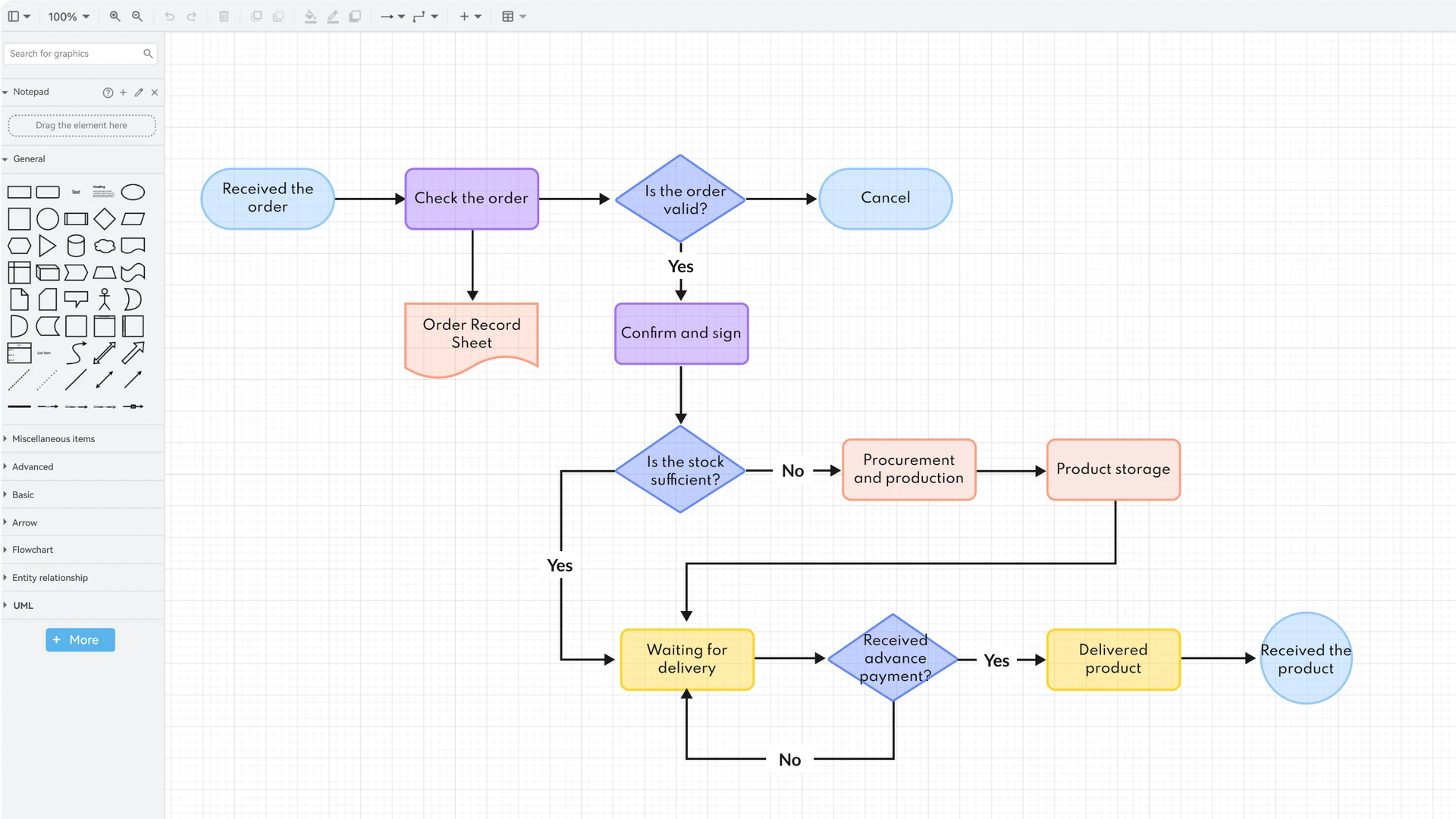
An architecture diagram shows the parts of a system and their relationships. A flowchart shows actions, decisions, and possible paths through a process. They can describe the same product without belonging in the same diagram.
Do I need every technical detail in the first diagram?
No. Show enough detail to answer the reader's question. Use a separate deployment, sequence, or data view when the discussion needs network placement, message order, or data movement.
Is an architecture diagram the same as UX information architecture?
No. UX information architecture organizes content and navigation so people can find what they need. System architecture describes software components and their relationships. A product may need both, but they have different readers and outputs.
Can I start from a template?
Yes, if its structure suits the question. Replace sample names, remove components you do not have, and check every connection. A template is a layout starting point, not evidence that your system needs a particular service or database.
Start with the relationship your team needs to understand
Lay out the components, label the connections, and bring an explainable diagram to your next review.
Start with Mockitt