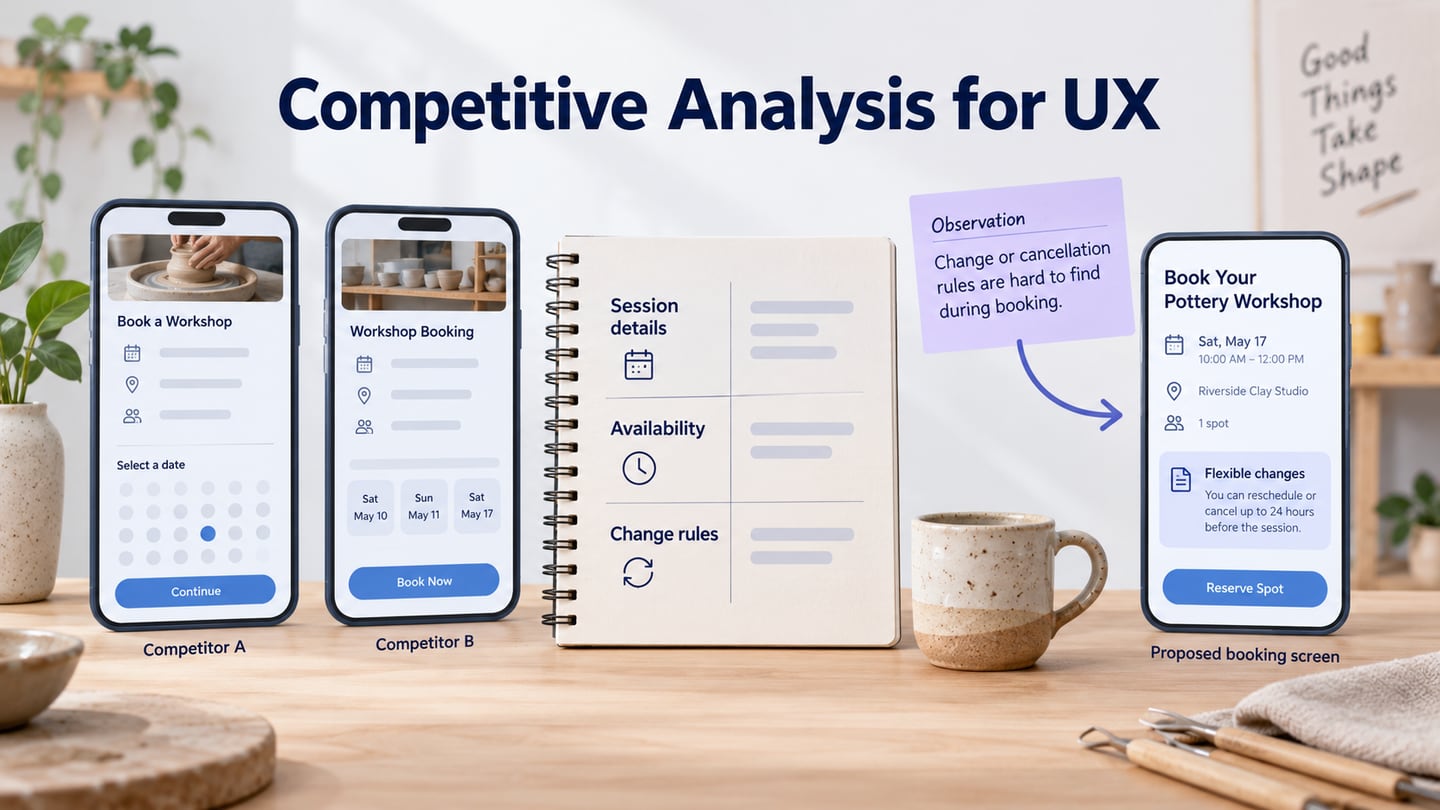
A UX competitive analysis examines how other products support a task relevant to your audience. It can reveal alternative approaches, missing information and questions worth investigating. Its value comes from the decisions it informs, not the number of logos in a comparison table.
What Is Competitive Analysis in UX?
Competitive analysis compares selected products or services using a defined set of questions. A UX-focused review examines the experience of completing a task, such as choosing a time slot or understanding a cancellation rule. A business review may also consider positioning and pricing, but those are not substitutes for examining the interface.
Distinguish an expert review from research with participants. A reviewer can describe an observed design and a potential problem; only an appropriate study can show how the people in that study used it. Neither approach provides complete knowledge of a competitor’s strategy.

Illustration of themes that may inform a competitive review.
Why is competitive analysis useful?
A focused comparison helps the team see different ways of handling the same problem. It can challenge a familiar design assumption and identify information that your interface may be missing. NN/g’s competitive-evaluation guidance distinguishes reviews from comparative usability testing.
Use the findings to form design hypotheses rather than copying a popular product. A competitor’s feature may depend on a different audience, policy or business model. A visible pattern is not proof that it improves conversion or solves a usability problem.
Repeat the relevant parts of the review when your question or the market changes. Keep the date, device, access conditions and evidence for each observation so another reviewer can understand what was actually inspected.
How to Conduct a Competitive UX Analysis
Start with a decision the team needs to make. The following workflow uses a fictional neighborhood workshop booking service: people need to choose a session and understand whether they can change it later. The example contains proposed review criteria, not findings from a study of named competitors.
Know the goal
Define the task and the decision. For the workshop service, ask: “What information does someone need before selecting a session?” Record the audience, relevant constraints and what is outside the review. Do not turn a narrow booking question into an unfocused audit of every feature.

Illustration of setting a goal before comparing products.
Track Your Competitors
Choose direct competitors that meet a similar need and indirect alternatives that people may use instead. A class-booking platform and a venue’s email enquiry process might both matter to this task. Record why each is included; there is no universally correct number of competitors.

Illustration of observing alternatives in a market.
Details on the competitor's product
Inspect the same task under comparable conditions. Record where duration, location, availability and change rules appear; whether the time zone is clear; and what happens when a session is full. Separate observed behavior, supporting evidence and your interpretation. Record “not observed” when access prevents verification rather than assuming a feature is absent.
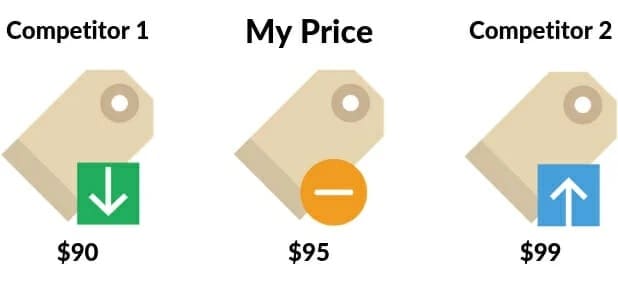
Illustrative price comparison only; these figures are not current prices for identified services.
Summarize after Analysis
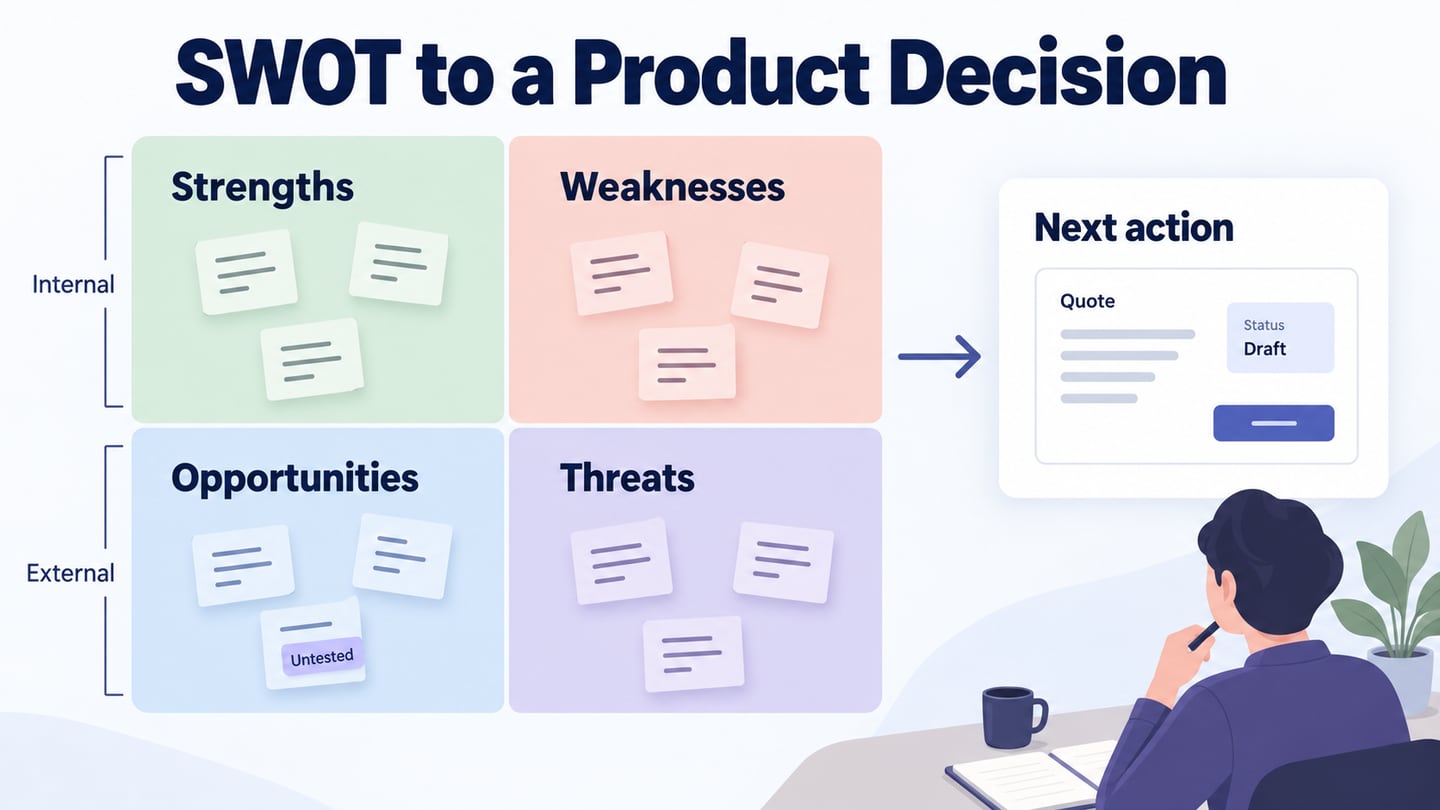
Group findings by the design question rather than by which product you prefer. For each finding, record its evidence, likely implication and the next action. For example, “the change rule appears only after selection” is an observation; “people may hesitate before selecting” is a hypothesis that needs investigation.
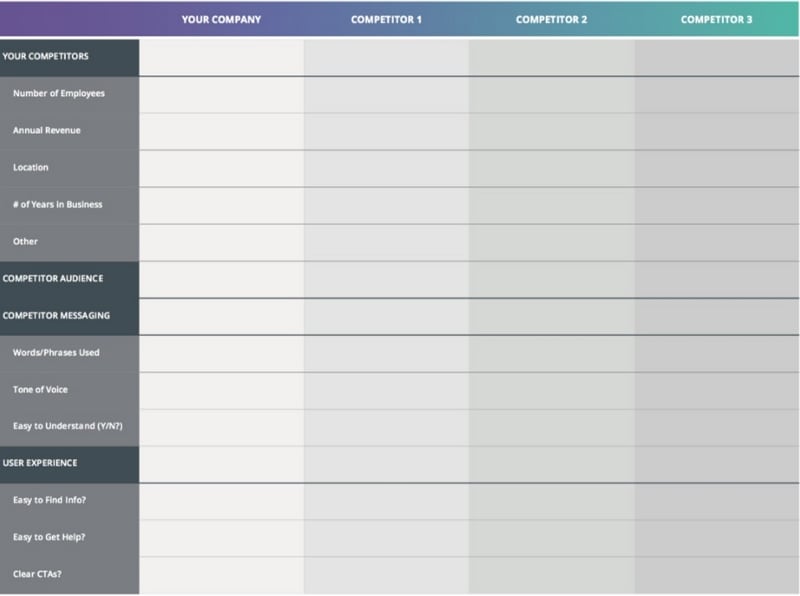
Example comparison worksheet; choose fields that match the UX task rather than filling every business field.
Present the analysis
Present the decision, supporting examples and limitations together. Show what the team proposes to change, what remains uncertain and how it will be checked. A small annotated comparison can be more useful than a long slide deck with unsupported scores.

Illustrative photograph of presenting research findings to a group.
A useful output is a traceable decision record: task, comparison criteria, evidence, interpretation, proposed response and follow-up. Do not convert an untested design hypothesis into a claim that the new version will increase revenue.
Turn a Finding Into a Prototype
Use Mockitt to review the interface response to a specific finding. For the workshop example, create Session list, Session details and Review selection screens. Show the change rule before confirmation, with a separate Session full state. Use fictional sessions and policies; the example does not make real bookings.
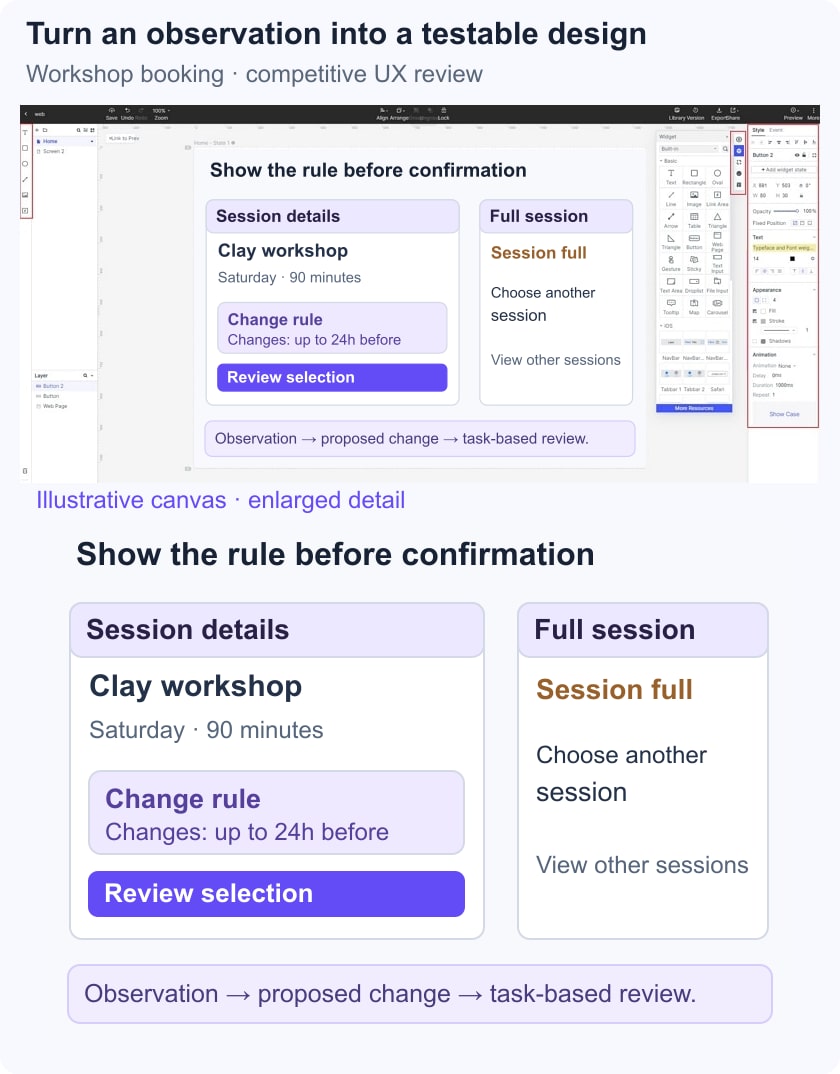
Prepare a focused review:
- Keep the session name, date and duration consistent across the list, details and review screens.
- Show where the attendee can inspect the location and change rule before committing.
- Make a full session visibly different from an available one and offer an appropriate next step.
- Record which proposed change responds to which observation, without presenting it as a proven improvement.
- Ask a reviewer to choose a suitable session and explain the change rule. Capture uncertainty and wrong turns before refining the visual treatment.
Keep the Comparison Honest
Check that the task was comparable, evidence is dated, inaccessible states are marked unknown and the recommendation addresses the original decision. If a real participant study is run, document its tasks and conditions separately from the expert review. Do not report fictional example data as research results.
Conclusion
Competitive analysis is useful when it leads to a better-informed question and a reviewable design decision. Preserve evidence, distinguish interpretation from observation and test the proposed response with the right audience. A polished comparison table alone does not establish that one experience is better.