A useful web design book should match the skill you want to develop. Learning HTML structure, working with a CSS framework, considering accessibility and improving website copy are different tasks. The seven titles below cover those areas with different prerequisites and limits; they are a reading list, not a ranked promise that one book will teach everything.
Check the edition and contents before buying or borrowing. Framework-specific examples age, while broader questions about content and inclusion remain useful across tool changes. Pair a chapter with a small exercise so you can see which decision the reading helps you make.
Turn a Reading Lesson into a Page Design
For a visual exercise, use a Mockitt page-design canvas to compare a layout before and after applying one idea. For a code exercise, use a text editor and browser. These activities complement each other: a prototype can clarify the desired layout, while source code establishes how the actual page is built.
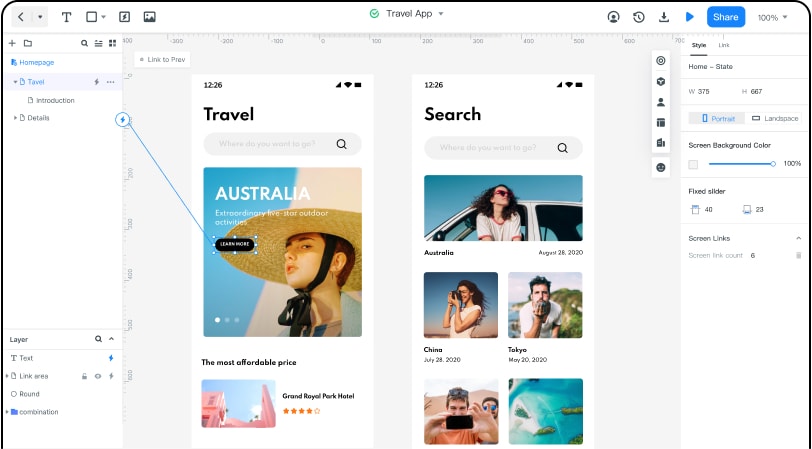
The retained editor image shows a historical travel-app example. The relevant workflow is arranging content and reviewing relationships, not reproducing its sample travel screens. Keep the exercise small enough to explain what changed and why.
For a fictional Cove Archive page, start with a card labelled “Local history,” a short description of its photograph collection, and “Browse collection.” Compare a cramped card with one that separates the title, description and action. Use the reading lesson to explain the change, then check whether another person understands the card.
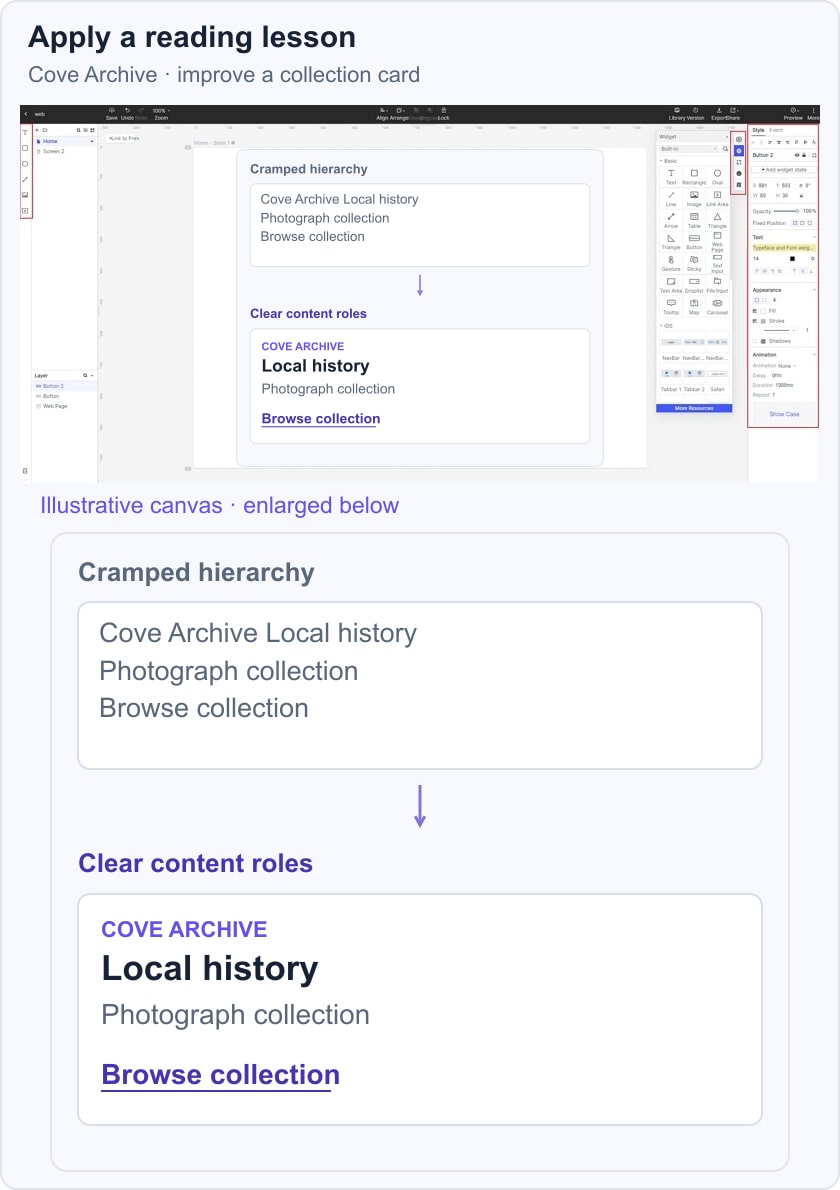
The following workspace tasks can support that exercise:
Use the Tool for the Learning Task
- Assets: choose available text, image and control resources, then adapt them to the page content. Reuse consistent elements where repetition helps the review.
- Design: adjust hierarchy, spacing and dimensions. Add a connected state only when it helps demonstrate the task being studied.
- Presentation: preview the alternatives at a useful reading size and ask a focused question, such as what the card offers and where its action leads.
- Handoff: explain the agreed content and behavior alongside available specifications. A design handoff checklist helps distinguish the design decision from implementation work.
- Collaboration: share the draft with the relevant people using suitable permissions. Keep an intentional record of decisions; cloud access is not a guarantee against every form of data loss.
A review can reveal a misunderstood label or unclear grouping. Record that observation separately from your own preference, then revise the specific part of the page that caused the problem.
Code examples from a book should also be run and inspected in their intended environment. A visually convincing draft does not establish that the implemented page behaves correctly.
If you want books centred on interaction and perception rather than web implementation, the separate UI design reading guide covers that set of questions.
Seven Web Design Books by Learning Goal
Books offer a structured route through a topic, while current documentation helps check details that have changed since publication. Use both. A fixed printed example is especially useful for practice when you understand which version of a framework it targets.
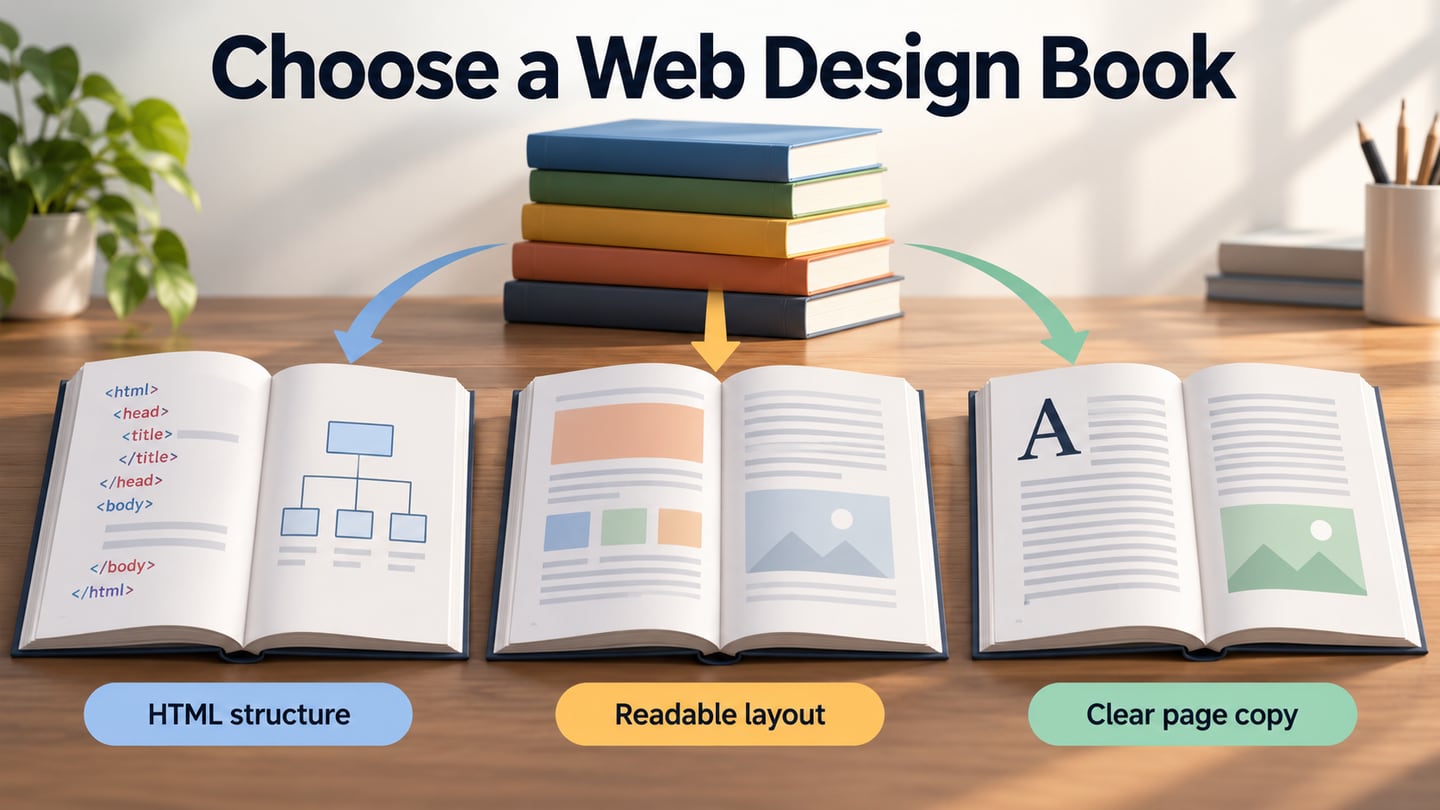
Choose one goal before choosing the book: build a page from markup, use an existing CSS system, make the design more inclusive or improve its message. Reading several introductions without applying them can hide whether you have learned the underlying skill.
The list keeps a mixture of technical, inclusive-design and business-oriented titles. The descriptions identify what can be established from publisher, author or cover information rather than claiming firsthand tests of every exercise.
1. Responsive Web Design with HTML5 and CSS — Ben Frain
Ben Frain’s Responsive Web Design with HTML5 and CSS concerns the HTML/CSS techniques used to build layouts across screen sizes. Check which edition you are using, because the available CSS features and examples differ across editions.
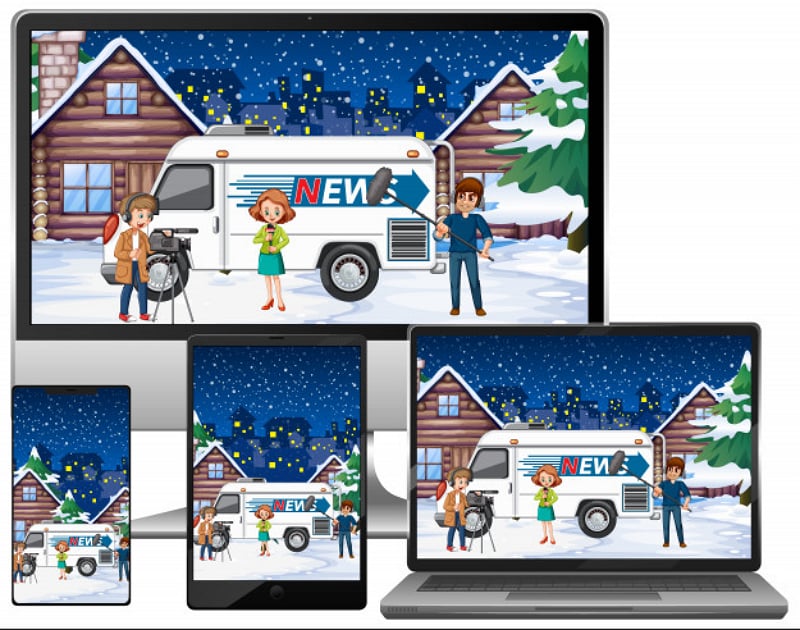
Use it when you already have page content and want to understand how its layout responds to available space. Follow an example, then change the content length or viewport and observe what breaks. That is more informative than checking only the author’s ideal sample.
The retained multi-device illustration is a general image of content on different screens, not the book’s cover. It illustrates the responsive-design question but does not demonstrate that a particular implementation works.
2. Learning Bulma — Aravind Shenoy
Apress describes Learning Bulma as an introduction for readers with basic HTML, CSS and JavaScript knowledge. Its 2020 first edition covers Bulma’s layout helpers, navigation, forms and components. Treat its framework version as part of the exercise rather than assuming every current class or feature is identical.
The documented learning areas include:
- Using the grid system, layout and modifiers.
- Applying CSS utilities and component classes.
- Taking a mobile-first approach to web-page layout.
Choose this title for a Bulma-specific project after learning basic markup and styling. It is not a substitute for understanding HTML, and a CSS framework does not itself create a complete mobile application.
3. HTML 5, CSS 3 & Bootstrap 4 All-in-One — Mike Ludo
The retained cover identifies Mike Ludo and Code Blaze Books, with an introductory front-end development scope in its title. Its explicit Bootstrap 4 focus makes it an older, version-specific choice. Before relying on it, inspect a sample and compare any framework instructions with the version used in your project. The cover establishes the title and attribution, but not the quality or current accuracy of every exercise.
4. Inclusive Design for a Digital World — Regine M. Gilbert
The first edition of Regine M. Gilbert’s book explains inclusive design and accessibility considerations across digital experiences. The retained cover is that earlier edition. The publisher also lists a 2025 second edition, so check the edition when selecting a copy.
Use the book to ask broader questions about who can participate in a design and how the process accounts for them:
- Why accessibility and inclusion belong in design decisions from the beginning.
- How research and development practices can account for different access needs.
- How the context of use changes across digital platforms.
- How to examine barriers through evaluation and testing.
- How emerging technologies create additional design questions rather than automatically solving existing barriers.
5. The HTML and CSS Workshop — Lewis Coulson and Co-authors
The Packt publisher page describes a practical introduction to creating and maintaining websites with HTML and CSS. The retained first-edition cover credits Lewis Coulson, Brett Jephson, Rob Larsen, Matt Park and Marian Zburlea.
Its exercises provide a route from document structure to styling and page features. Work through the source, open the result in a browser and change one property or content element at a time so you can connect an edit with its visible effect.
The documented scope includes forms, layouts, media and styling. Choose it for those web foundations. It is not presented here as training for Mockitt, WordPress or Shopify; those products have separate workflows and documentation.
6. How to Start a Web Design Business from Home — Omer Hina
This is a business-oriented entry rather than an HTML/CSS manual. The retained cover identifies Omer Hina and its focus on starting a home-based web-design business. Inspect the contents before choosing it for a specific business question.
Treat claims about starting with no experience, a fixed launch time or minimal capital as promises to evaluate, not expected outcomes. Client discovery, scope, delivery and the quality of the actual work still require preparation. This list does not verify an earnings result or a current purchase offer for the title.
7. Making Your Website Work — Gill Andrews
Gill Andrews identifies Making Your Website Work as a book series about improving website copy and design. The retained cover shows the original “100 Copy & Design Tweaks for Smart Business Owners” title. Its content-oriented purpose differs from a coding or framework manual.
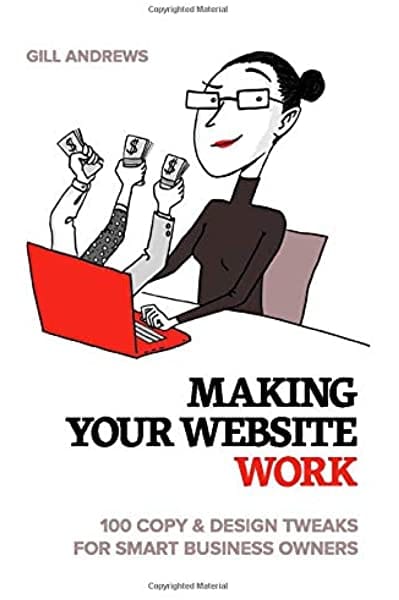
Use this kind of reading when the page’s message or next action is unclear. Apply one suggestion to a real paragraph or card, then examine whether it answers the visitor’s question more directly. Avoid treating a copy change as a guaranteed conversion improvement without evidence from the actual site.
Choose the book that addresses your current difficulty and apply one bounded lesson. The useful result is a page, piece of code or design decision you can explain and evaluate.
Edition, prerequisite knowledge and a relevant sample matter more than a numbered position in a list. No Amazon rating or buyer-review ranking is claimed here.