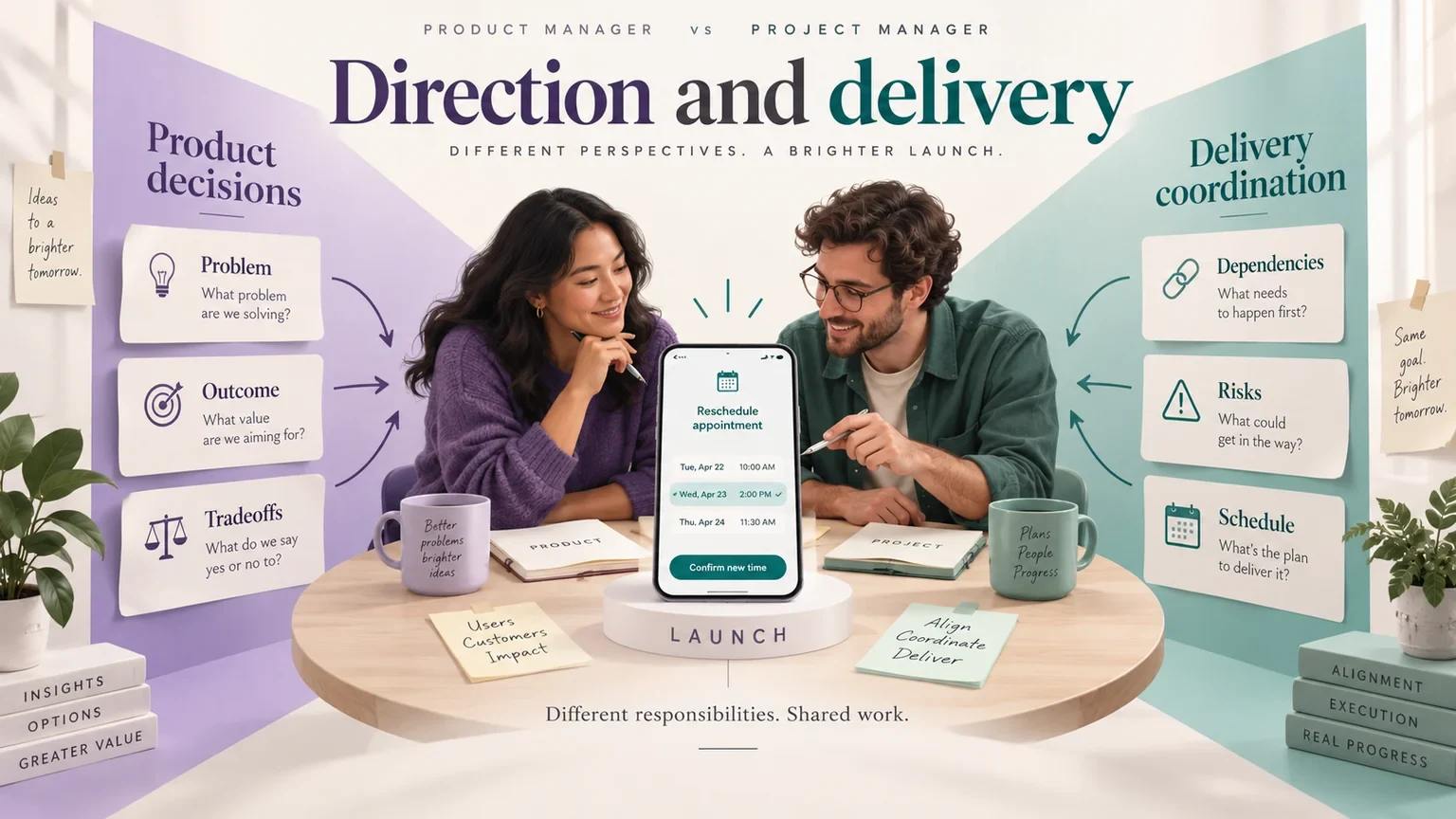
A product manager helps a team decide which customer problems to address and what outcomes to pursue. A project manager coordinates a defined initiative so that people understand its scope, dependencies, risks, and delivery commitments. The roles overlap in planning and communication, but the decisions they organize are different.
A roadmap makes product direction visible. A tool such as Mockitt's AI product roadmap generator can help draft that picture, but a generated sequence still needs evidence, priorities, and realistic commitments. This guide explains the distinction through a fictional appointment-rescheduling feature, including what the two managers would discuss when delivery constraints change the plan.
What each role is responsible for
Product manager
Product managers help establish a product's direction, connect customer needs with business goals, and make priorities understandable to the people building it. Their work may include research, roadmap decisions, requirements, and reviewing what happens after release. Marketing, commercial ownership, and budget authority vary by organization; a job title does not establish all of them.
For a service called Cedar Appointments, imagine that customers must contact support to move a booking. The product manager investigates who needs self-service rescheduling, what makes the existing process difficult, and whether solving it is more valuable than other work. A useful proposal names the problem and the evidence needed, rather than beginning with a predetermined calendar widget.

Project manager
A project manager organizes the work needed to deliver an agreed initiative. That can include schedules, resources, dependencies, risks, communications, and completion criteria. PMI describes a project as a temporary effort producing a distinct result. A project can improve an existing product; it does not have to create a new one.
For Cedar's rescheduling initiative, the project manager helps make dependencies visible: the availability service, confirmation messages, support preparation, and release checks. They work with the people responsible for those areas to understand sequencing and uncertainty. They do not personally control every technical decision or guarantee that no risk will occur.
Initiating, planning, executing, monitoring, and closing are useful descriptions of project work. They should not be treated as a compulsory one-way sequence for every team. Plans change as the team learns, and responsibilities can be distributed across different roles.
Product and project work: different questions, shared decisions
A product can contain several projects
A product delivers an ongoing service or capability to people. A project has a defined purpose and completion boundary. Cedar's appointment service may continue through many releases; adding self-service rescheduling is one bounded initiative within it. Later work might address reminders or staff availability.
| Comparison | Product | Project |
|---|---|---|
| Main question | What useful capability should continue to exist and improve? | What defined change must this initiative deliver? |
| Time boundary | A lifecycle that can include launch, growth, maintenance, and retirement | A bounded effort with agreed completion or closure criteria |
| Planning reference | Goals, opportunities, priorities, and a roadmap | Scope, dependencies, milestones, resources, and risks |
| Team arrangement | May have a continuing team | May use a dedicated team or the same continuing product team |
Neither column implies a permanent organizational rule. Products can be retired, and project teams do not always disband. A date on a roadmap also does not automatically become a delivery commitment. The team needs to agree what the date means and which assumptions support it.
Responsibilities and skills
Atlassian's role comparison distinguishes product direction and priorities from project coordination and execution. Both roles require communication and judgment. The product manager needs to explain why an outcome matters; the project manager needs to explain what the delivery plan depends on. Neither should conceal uncertainty to make a plan appear more convincing.
Product managers benefit from research literacy, prioritization, and the ability to connect evidence with a decision. Project managers benefit from dependency planning, risk assessment, and making commitments explicit. Listening, negotiation, and problem-solving belong to both roles. So does understanding enough of the work to ask useful questions.

There is no universal reporting hierarchy between these titles. A product manager may need approval for a budget change; a project manager may escalate a scope decision to a sponsor. Record who can decide each disputed issue. “The PM owns it” is especially unhelpful when the same abbreviation refers to both people.
A worked example: rescheduling an appointment
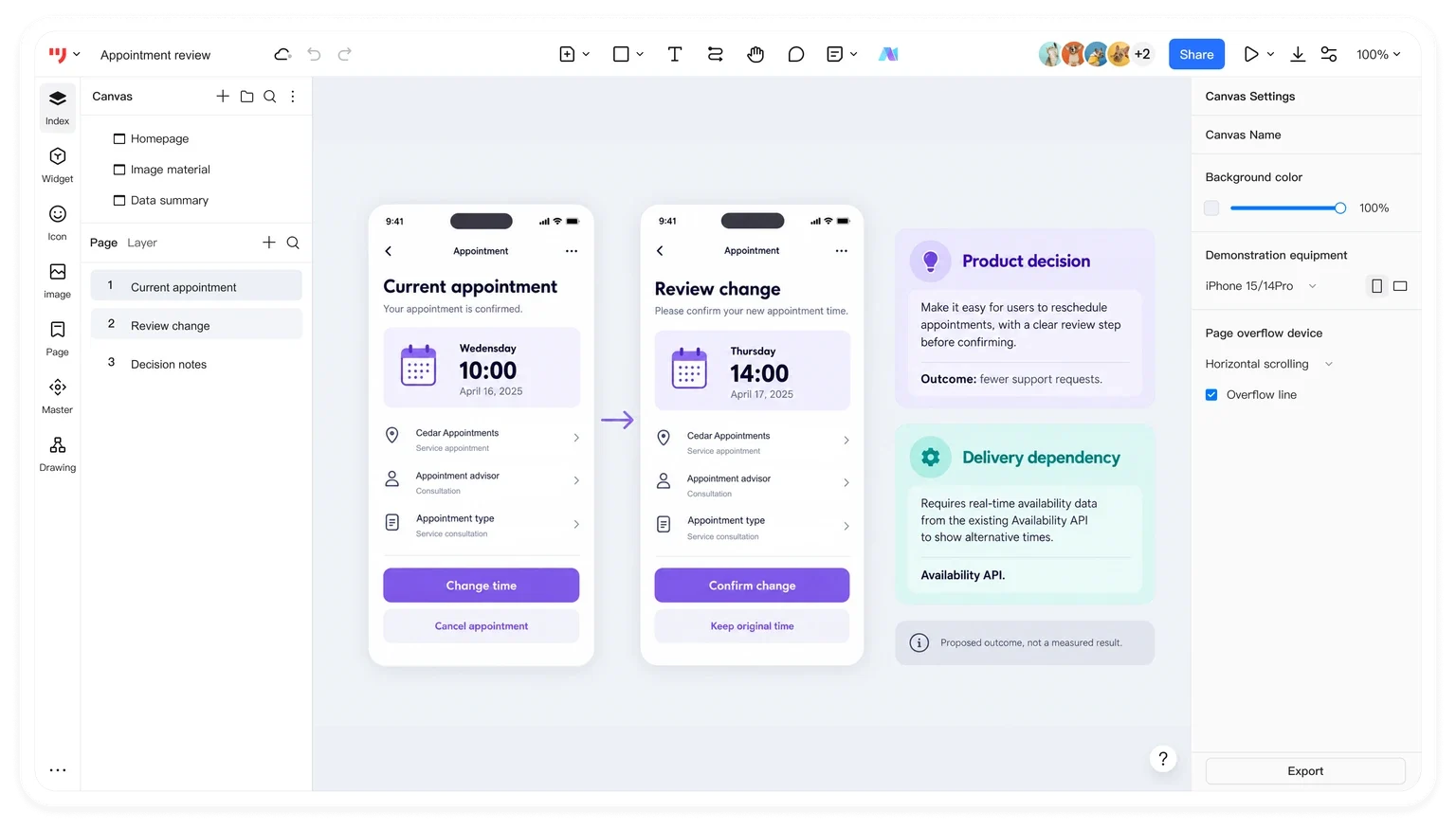
In this fictional scenario, Cedar wants customers to move an appointment without contacting support. The product manager proposes a first release for eligible bookings, with existing cancellation rules unchanged. The team needs to learn whether people understand which bookings qualify and whether they can identify their new appointment time.
The project manager maps the delivery dependencies with engineering, design, and support. Available slots must come from a reliable service; the confirmation message must agree with the booking record; support needs to recognize a rescheduled appointment. These are separate deliverables that have to work together.
During planning, engineering reports that the availability service will not support every appointment type in time. The product manager considers the customer impact of supporting fewer types. The project manager explains how that scope choice changes implementation, testing, and communication. Together with the relevant decision-makers, they might narrow the first release or revise its date. Neither role should quietly make both decisions alone.
A useful decision note would say: “First release supports standard appointments only. Specialist appointments keep the support-assisted route. Review excluded customers' needs after launch.” The associated delivery record identifies the service dependency, responsible team, review date, and fallback. The note preserves the reason for the boundary; the plan makes the work executable.
Keep three acceptance questions separate. The product question is whether the selected customer group can complete a useful rescheduling task. The design question is whether the old and new times are understandable before confirmation. The delivery question is whether the booking change, message, and support record remain consistent. Different people may answer them, and passing one does not answer the others.
For example, a release can meet its technical completion criteria while customers still call support because the confirmation is unclear. Record that observation as a product issue for investigation rather than retroactively pretending the delivery never occurred. Conversely, positive feedback on a clickable prototype does not close the engineering dependency. Separate evidence makes both progress and remaining work easier to explain.
Before launch, review a prototype showing the old time, the selected new time, and the confirmation. Ask whether someone can tell what has changed and what remains booked. After launch, compare observed rescheduling behavior and support requests with the team's expectations. No improvement is assumed merely because the feature shipped.
When one person covers both roles
A small team may assign both kinds of work to one person. Keep two visible records anyway: the product decision and the delivery commitment. When an urgent request arrives, first decide whether it deserves priority, then assess what changes in the plan. Combining those conversations can otherwise turn the loudest request into an unexamined promise.
If the main difficulty is unclear priorities, assigning another schedule owner will not resolve it. If the direction is understood but dependencies repeatedly surprise the team, more coordination may be the missing capacity. Choose responsibilities around the actual problem rather than assuming one title is more senior or more valuable.
Choose software around the work
Product discovery, design, and feedback
Mockitt's interactive prototyping workspace can help both managers discuss a proposed experience. For Cedar, show the rescheduling choice and its confirmation, share the design for review, and keep comments beside the relevant screen. Check the actual sharing permissions for the reviewers. A prototype demonstrates the proposed interaction; it does not prove that the availability service or message delivery is implemented.
Figma's prototyping tools also support building and sharing interactive design examples. They fit the design-review part of the workflow, rather than replacing all product-management responsibilities. Keep the selected prototype linked from the team's decision record so reviewers know which proposal is being discussed.
Pendo offers product analytics, feedback, and in-app guidance capabilities. Those serve a different purpose from drawing the proposed rescheduling screen. A team considering it should first specify the behavior it wants to understand and how the collected information will inform a decision.
Project coordination and delivery
Basecamp organizes project communication and work through features such as messages, to-dos, schedules, and files. ProofHub provides project planning and collaboration, including task views and proofing. Evaluate either against the coordination problem: who owns the next action, which work is blocked, and where an approved decision can be found.

For Cedar, the minimum useful connection is a decision note, its prototype reference, and the delivery tasks that implement it. The same person may contribute to all three. What matters is that customer intent, agreed scope, and the next action remain distinguishable as the work changes.