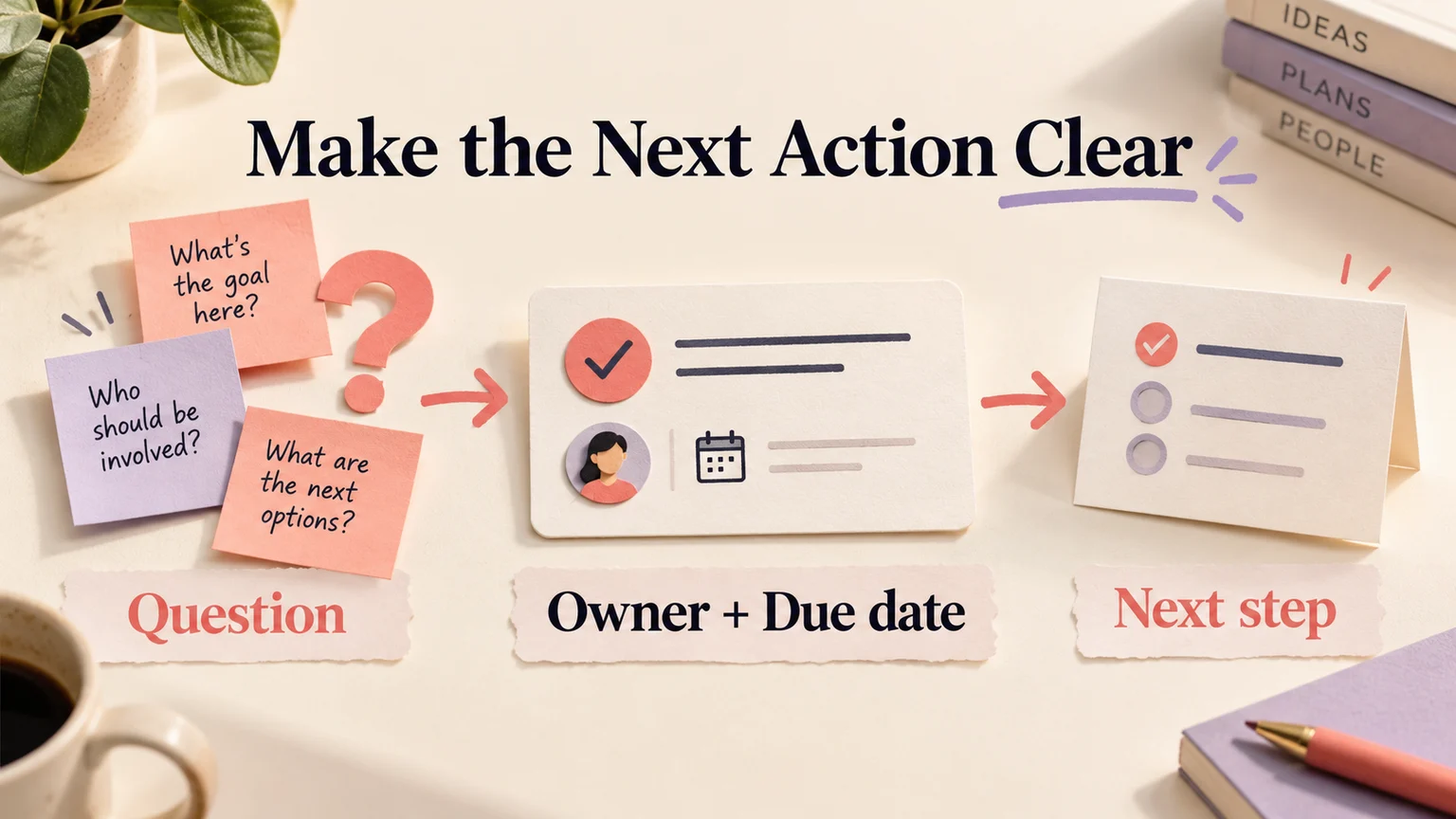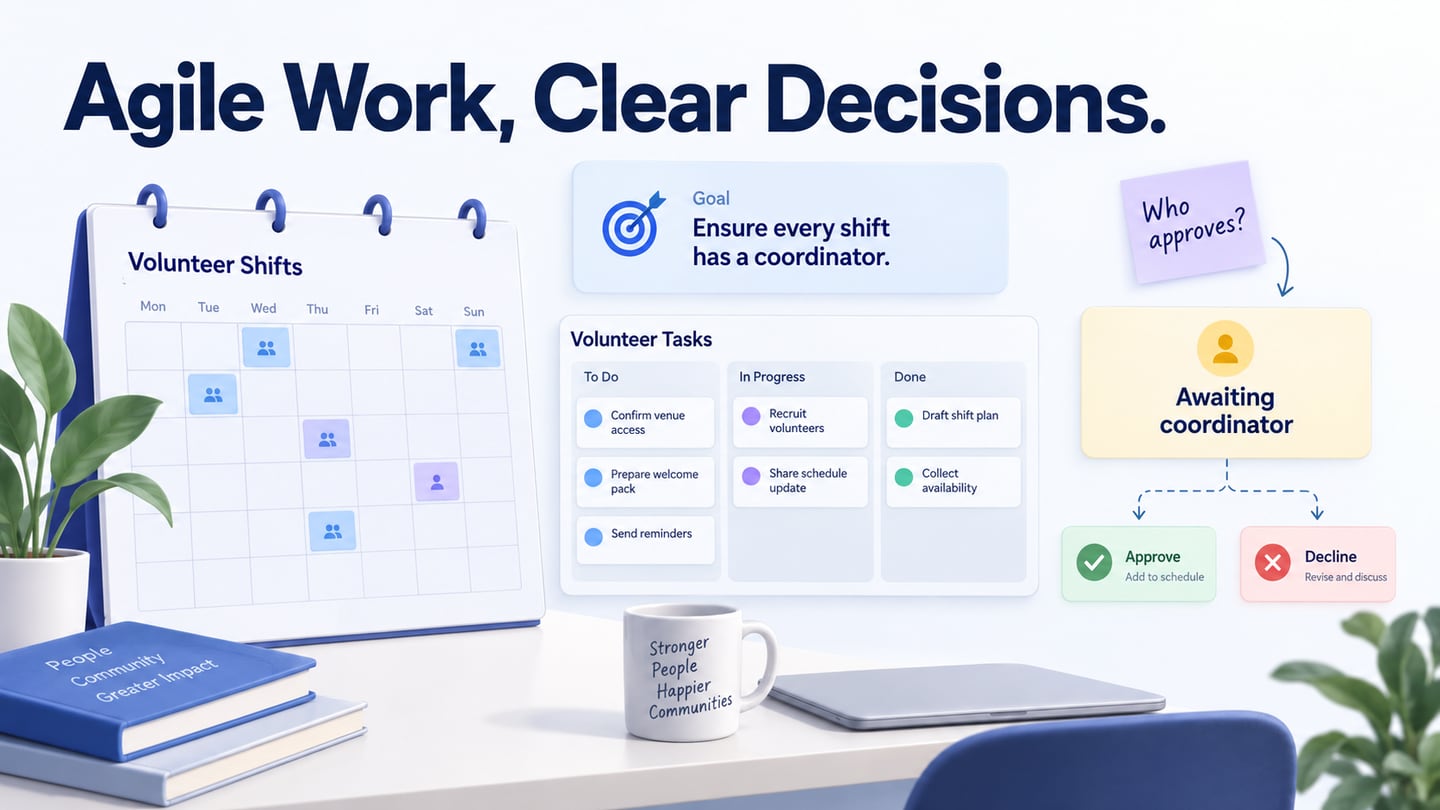
Agile project management uses frequent feedback and adaptation to guide work toward a clear goal. It is not simply a faster schedule or a reason to accept every new request. Teams make progress visible, inspect what they have learned and revise the next decision when the evidence changes.
The overview below covers the meaning, team practices and relationship with Scrum. A volunteer shift-swap feature illustrates how a focused prototype review can clarify work before implementation without being mistaken for a finished product.
What Is Agile Project Management?
Agile approaches favor collaboration, usable outcomes and responding to change while work proceeds. The Agile Manifesto describes values for software development; it does not prescribe one universal project-management method. Teams still need a purpose, responsibilities, constraints and a way to evaluate progress. Short feedback cycles help only when their evidence informs the next decision.

Practical Features of Agile Work
Agility depends on how people make decisions and adapt, not on whether everyone works in one office. A distributed team can collaborate effectively when goals, work and decisions are visible. A co-located team can still be inflexible if feedback never changes its plans.
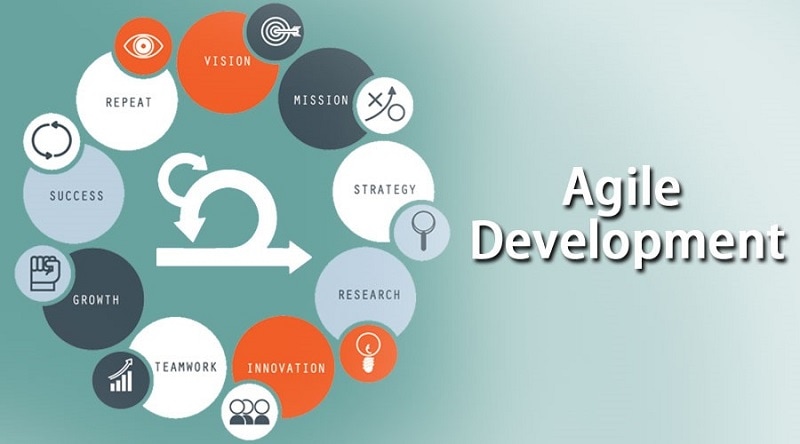
Scrum and Kanban are related approaches that may support adaptive work, but they are not synonyms for agile and do not have identical origins or rules. Choose practices for the task and constraints rather than treat one label as proof of effective delivery.
- Goal and planning: Keep the intended outcome clear, then plan the next useful piece of work. Revisit assumptions when evidence changes; neither abandoning planning nor defending an obsolete plan helps the team.
- Time and scope: Use a manageable planning horizon and make trade-offs visible. New requests need evaluation rather than automatic inclusion. In Scrum, scope can be clarified and renegotiated as learning occurs without undermining the Sprint Goal.
- Responsibility: Make decision ownership explicit and let the people doing the work plan how to accomplish it. In Scrum, the Product Owner, Scrum Master and Developers have distinct accountabilities; self-management is not the absence of responsibility.
- Cooperation: Share progress, obstacles and feedback in terms colleagues can act on. A prototype comment such as “I cannot tell whether this request was approved” is more useful than an unexplained preference for a different color.
Do not confuse agility with rushing. Skipping necessary testing, documentation or review can make later change harder. The useful balance is enough planning and evidence for the next decision, with the willingness to adapt rather than a promise that every project becomes faster.
How Scrum Fits into Agile Work
The Scrum Guide defines a framework for addressing complex problems through inspection and adaptation. A Sprint is not a miniature sequence in which analysis, design and testing must occur as isolated phases. The team works toward a Sprint Goal and a usable Increment that meets its Definition of Done.
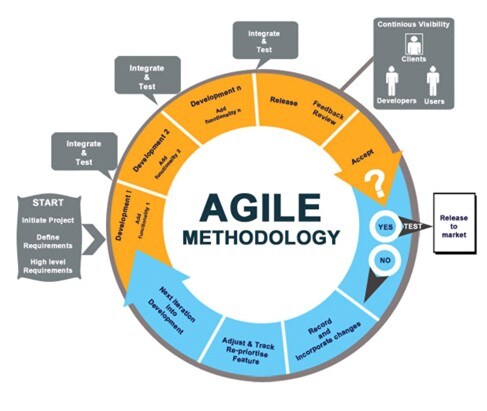 Concept illustration, not the event structure or complete definition of Scrum.
For a volunteer shift-swap feature, the Product Goal might concern reliable coordination of volunteer coverage. A selected piece of work could let a volunteer request a swap and understand its review status. The team still needs to clarify eligibility, coordinator authority, notifications and acceptance criteria. A prototype can expose a missing state, but a design review alone is not a usable implemented Increment.
During refinement or planning, separate an assumption from an agreed rule. For example, “the coordinator approves every swap” needs confirmation from the service owner. If reviewers cannot tell that a request is pending, clarify the interface and update the relevant work item. Do not add unrelated scheduling features merely because another idea appears during the review.
The Manifesto’s four value comparisons help explain the emphasis. They give greater weight to the items on the left while recognizing value in the items on the right; they do not abolish tools, documentation, contracts or plans.
- Value people’s interactions while using processes and tools to support their work.
- Prioritize working software while keeping documentation that helps people build, operate and maintain it.
- Collaborate with customers while retaining the agreements needed for a responsible working relationship.
- Respond to change while using a plan to make the consequences of that change understandable.
Use a Prototype to Resolve a Planning Question
Product teams often need to make an unclear workflow concrete before they can discuss it well. Use a prototype for a specific uncertainty, such as whether someone understands who must approve a request. This is a design-learning activity, not a replacement for implementation or operational testing.
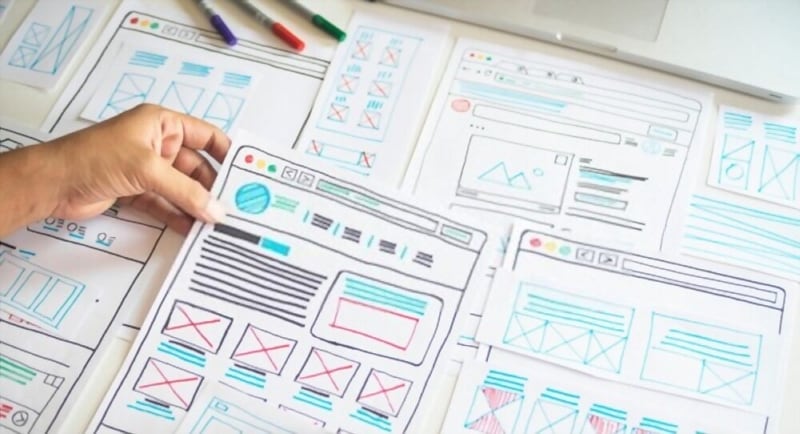
In Mockitt, create the relevant states and connect the actions needed for a review. The older workspace image illustrates screen organization; current controls and available capabilities may differ. Use synthetic volunteer details and agree who should have access to the review.
For a volunteer shift-swap feature, show a request moving to Awaiting coordinator, followed by an approved or declined result. Ask a reviewer what happens next and who controls the decision. Record unclear wording, missing states and unresolved service rules separately. The prototype illustrates the decision; it does not actually change a roster or send a notification.
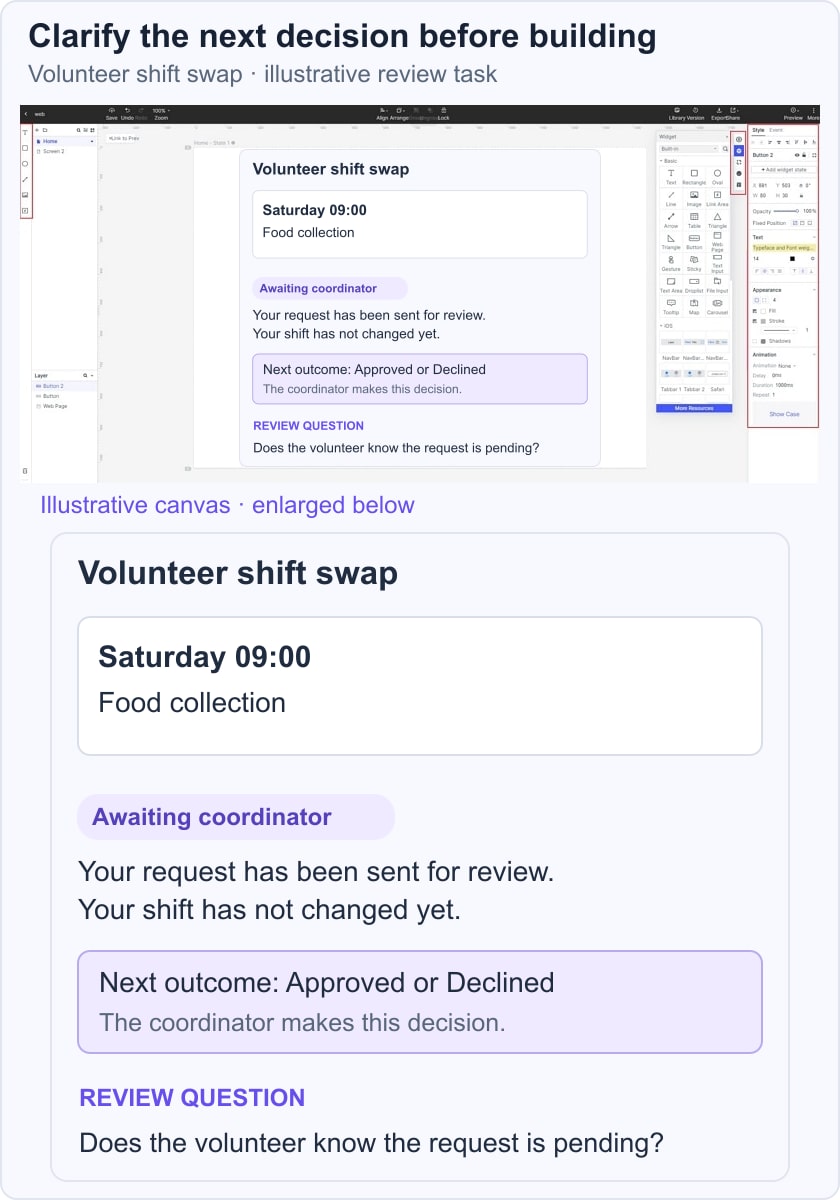
Bring the findings back to the work plan. Clarify the acceptance criteria, update the design and decide what requires implementation testing. Keep the goal stable enough to evaluate progress, while allowing a specific learning to change the solution. No tool can guarantee a fixed number of hours or dollars saved by this process.