Prepare for product manager interview questions by explaining how you understand a problem, choose between options, work with a team, and evaluate a result. Build a small set of truthful examples from your experience, then practice adapting them to the question instead of memorizing a polished script.
The six questions below cover role understanding, career motivation, customer needs, prioritization, an initial work plan, and company research. Use them to practice the product manager skills behind a strong answer. They are practice prompts, not a verified question bank from a particular employer.
6 product manager interview questions to practice
Before answering, identify what the question is asking you to demonstrate. For an experience question, explain the situation, your specific responsibility, the action you took, and the outcome or learning. For a hypothetical case, state your assumptions and explain what evidence you would seek. Do not present a hypothetical result as something that happened.
1. What is the role of a product manager?
Go beyond a definition, but avoid claiming that a product manager makes every decision or manages every employee. Explain how the role connects customer needs, business objectives, and delivery constraints. Then describe how responsibilities were divided in a team you know.
For example, you might explain who conducted research, who made design and engineering decisions, and which prioritization or scope decisions you owned. This demonstrates an understanding of collaboration more clearly than saying that you “led everything.”
Answer direction: “I help the team decide which customer problem to address, what success would look like, and what to prioritize within the constraints. In my previous project, my responsibility was [your actual scope], while [the relevant team] owned [their scope].” Complete the answer with a real decision and what you learned from it.
Atlassian's description of the product manager role emphasizes user needs, business objectives, prioritization, and alignment. The exact boundaries vary by team; use the job description to understand the role you are discussing.
2. Why did you leave your last job, or why are you considering a move?
Be factual, professional, and specific about what you want next. You can explain a change in scope, an organizational change, a different product domain, or a desire to develop a particular capability. Do not invent a positive story that conflicts with your actual circumstances.
If the previous role was difficult, focus on the work and what you learned rather than attacking colleagues. Connect your motivation to something concrete in this opening. “I want more ownership” is incomplete unless you explain which decisions or stage of the product lifecycle you want to own.
Prepare: a brief explanation of the move, one example of what the previous role taught you, and a reason this role is a sensible next step. Keep the answer consistent with the dates and responsibilities on your resume.
3. How do you understand customer needs?
Explain how you combine customer conversations, observed behavior, support evidence, and relevant product data. A request for a feature is useful input, but it does not by itself establish the underlying problem or its priority. Describe how you would investigate what happened and who was affected.
A jobs-to-be-done approach can help you explore the situation and progress a person is trying to make. For example, someone asking for a calendar integration may be trying to avoid missing a changed appointment. Investigate the existing workflow before assuming that an integration is the only useful response.
Answer direction: describe the question you needed to answer, how you selected evidence, what you found, and how it changed the team's next step. Distinguish a recurring pattern from one memorable comment. If evidence conflicts, explain how you would investigate the difference rather than selecting only the material that supports your preference.
A useful follow-up to practice is: “What did you decide not to build after learning more?” An example of changing your mind can show judgment as well as an example of shipping a feature.
4. How would you prioritize two competing requests?
First clarify the goal, the affected users, urgency, evidence, and constraints. Compare options against the same criteria. A framework can organize the discussion, but an unexplained score is not a substitute for a product decision.
Practice case: an appointment service has requests for a clearer rescheduling flow and a new calendar theme. Start by asking whether people can currently complete rescheduling, how often problems occur, and whether the theme addresses a substantial need. Consider implementation effort and dependencies, then explain what you would investigate or deliver first.
Do not assume the more visible feature wins, or that the rescheduling problem is already proven. State the conditions that would change your recommendation. End by explaining the decision to the team requesting the deferred work and identifying when it should be reconsidered.
5. What would you contribute in your first 90 days?
Offer a sequence for learning and contributing, with room to adapt to the team's situation. Avoid promising a major launch before you understand the product, constraints, or delivery commitments.
| Period | Focus | A useful output to discuss |
|---|---|---|
| First 30 days | Understand the product, users, business model, team responsibilities, existing data, and commitments. | A shared problem summary and a list of questions or evidence gaps. |
| Days 31–60 | Investigate a worthwhile problem with the team and compare possible responses. | A reasoned priority, initial scope, and a proposed way to evaluate it. |
| Days 61–90 | Contribute to an agreed delivery or learning milestone and review the evidence. | A decision, tested concept, release contribution, or measurement plan appropriate to the product's stage. |
This is a planning example, not a fixed schedule for every organization. Ask how the team defines a successful first quarter. An established product with a committed roadmap and a new discovery team may need very different contributions.
6. What do you know about this company and product?
Research the product, intended users, business model, positioning, and publicly documented priorities. Try the public experience when possible. Use official product pages, documentation, and public company materials to separate known facts from your own hypotheses.
Bring one observation, one possible implication, and one question. For example: “I noticed that changing an appointment starts from the booking details. I wonder whether returning users find that path easily. How does the team currently assess rescheduling success?” This gives the interviewer something substantive to discuss without pretending you know the team's internal data.
Profit reports, customer lists, and detailed strategy may not be public. Do not fill those gaps with invented figures or present an outside impression as established fact.

Adjust the examples to the role
For an early-career role, a clearly labeled university, volunteer, or independent project can demonstrate useful reasoning. For an experienced role, prepare examples of scope, stakeholder disagreement, prioritization, and outcomes. For a technical product role, explain how you worked through technical constraints with engineers without claiming expertise you do not have.
Check the stories against your product manager resume. You should be able to explain your role, the evidence, and any numbers you included. If you do not know an answer, state what you would need to learn and how you would approach it.
Use a prototype to practice explaining a product decision
A visual example can help you explain a flow, but it should support your reasoning. Mockitt's prototype editor supports reusable interface components, connected screens, and shared review links. Use a small example to make a decision visible rather than preparing a large, decorative presentation.
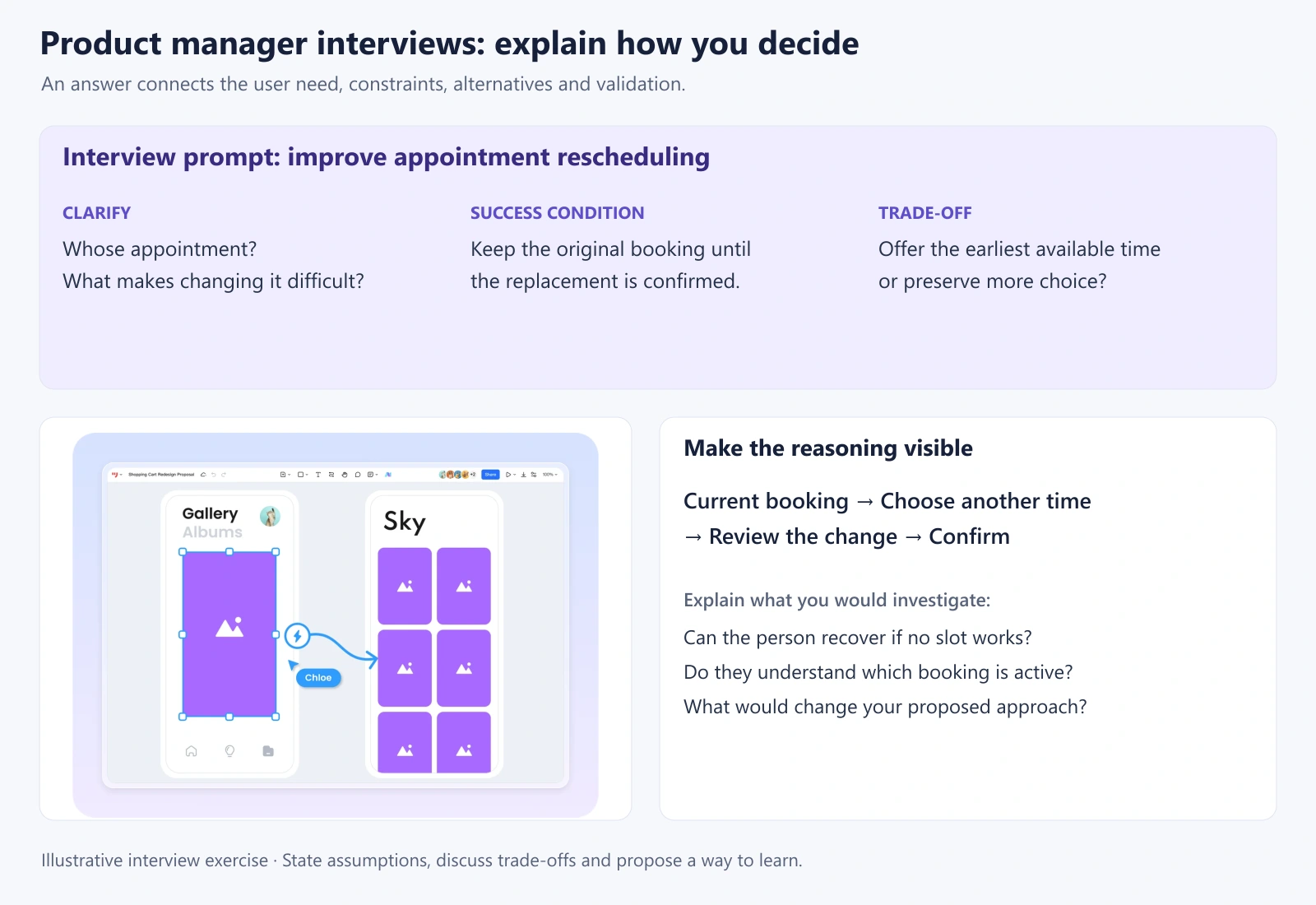
A focused product-case rehearsal
- Choose a task. For the appointment example, a user needs to change a booking without accidentally losing the original slot.
- State the assumptions. Identify which booking rules are known and which would need investigation, such as cancellation deadlines.
- Sketch the key screens. Show the existing booking, the choice of a new time, and a confirmation. Include a recovery path if the selected time becomes unavailable.
- Explain a trade-off. Discuss why confirmation is needed, what information should remain visible, and what you would postpone.
- Describe the next evidence. Ask whether people understand what changed and what you would observe to evaluate the flow. Do not claim a successful test that you have not run.
During a live interview, agree on the format and time available before opening a tool. A concise sketch may be enough. Share only examples you are entitled to disclose, and keep private employer projects out of the presentation.
Finish with a clear decision and useful questions
A strong answer makes your reasoning understandable: what the problem was, what you did, why you chose that approach, and what the evidence showed. Prepare real examples, leave room for follow-up questions, and ask how the team makes decisions and measures success. The aim is a productive discussion about the work you would do together.