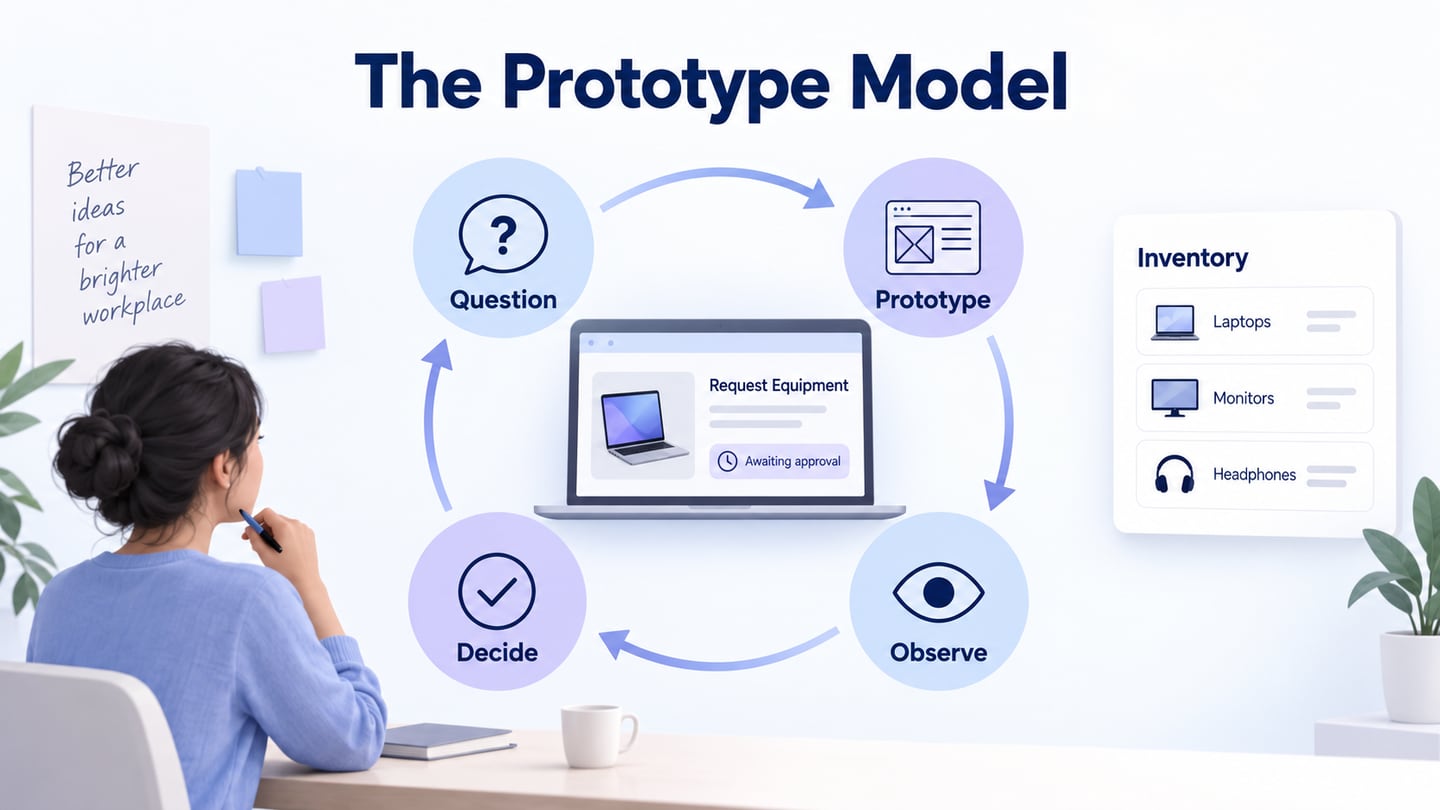
A prototype model in software engineering uses a limited representation or implementation to investigate uncertain requirements, behavior or feasibility before committing further effort. The useful result is a decision supported by evidence, not simply a more polished demonstration. It is especially relevant when people disagree about how a proposed system should work.
What Is the Prototype Model in Software Engineering?
In a prototyping approach, a team defines a question, builds enough of a solution to investigate it, evaluates the result and revises its understanding. Some prototypes are discarded; others evolve into the product under deliberate engineering controls. A UI prototype may clarify a task without implementing the system behind it.
Keep the scope explicit. A screen model can explore labels and states, while a technical experiment might test an integration or performance assumption. A limited prototype does not need to reproduce the entire system, and stakeholder approval does not establish that all requirements have been discovered.
Types of Prototype Model in Software Engineering
The following labels describe different ways of using prototypes. They are not compulsory stages, and terminology can vary between organizations.
- Throwaway or rapid prototyping: build a limited artifact to answer a specific question, preserve the learning, and discard the artifact when its purpose is complete. The work is not wasted if it prevents commitment to an unsuitable idea. Avoid turning experimental code into production code by accident.
- Evolutionary prototyping: develop a small implementation that is intended to grow into the system. This requires decisions about architecture, testing and maintainability from the start. It is not simply a shortcut that makes rework disappear.
- Incremental prototyping: explore parts of a larger system separately, then evaluate how they fit together. Define shared data, navigation and assumptions early; individually convincing prototypes can still conflict when combined.
- Extreme prototyping: a term used for some web-development approaches that move from interface pages to simulated services and then integrated services. Treat it as one possible organization of work, not a universal standard or a guarantee that integration will be straightforward.
Stages of Prototype Model in Software Engineering
Use each iteration to resolve an explicit uncertainty. For example, a fictional equipment-request service needs to distinguish a requested item from an approved or unavailable item. The team is unsure whether requesters understand those states and what to do after a rejection.
- Define the decision and evidence needed: can a requester explain the request status and the next available action? Record technical questions separately, such as how stock information will be obtained.
- Sketch the minimum screens and states needed to investigate the question.
- Build the first prototype with representative fictional content and clearly simulated responses.
- Evaluate it with relevant users and stakeholders, recording observations rather than collecting only general approval.
- Analyze misunderstandings and distinguish content, interaction and underlying policy issues.
- Revise the affected states and repeat the relevant task, keeping a version record.
- Stop, continue or change direction based on the evidence and remaining uncertainty; do not iterate without an exit decision.
- Carry the resulting requirements into implementation, or evolve the prototype only if that was an intentional engineering choice.
- Test the implemented system’s real behavior, integrations, permissions and failure handling, then maintain it after release.
Advantages and Disadvantages of Prototype Model
The value of the approach depends on the question, the quality of evaluation and what the team does with the findings.
Advantages
- Relevant users can expose missing information or confusing behavior before the team commits to more implementation.
- A focused prototype can investigate a specific risk, while leaving other risks explicitly unresolved.
- Feedback can improve understanding of user needs; it cannot guarantee satisfaction.
- A visible example can make disagreements about requirements easier to discuss.
- Alternative designs can be compared without building a complete service.
- Screens and state transitions can support communication across roles.
- Reusable knowledge and suitable components may carry forward, even when the experimental artifact is discarded.
Disadvantages
- An iteration without a clear question can consume time without improving a decision.
- Building unnecessary detail can cost more than the uncertainty justifies.
- Uncontrolled scope changes can obscure the decision and weaken documentation.
- Technical shortcuts in a demonstration can become costly if treated as production foundations.
- Repeated evaluation requires time and access to suitable participants.
- A polished interface can cause stakeholders to underestimate the remaining implementation work.
- Poorly explained limitations can make feedback misleading or reduce trust in the review.
Apply the Model to an Equipment-Request Workflow
Use Mockitt for the interface portion of the investigation. Create Request details, Awaiting approval, Approved and Unavailable states using fictional item names. The prototype can show the proposed status messages and routes; it does not connect to an inventory system or authorize real requests.
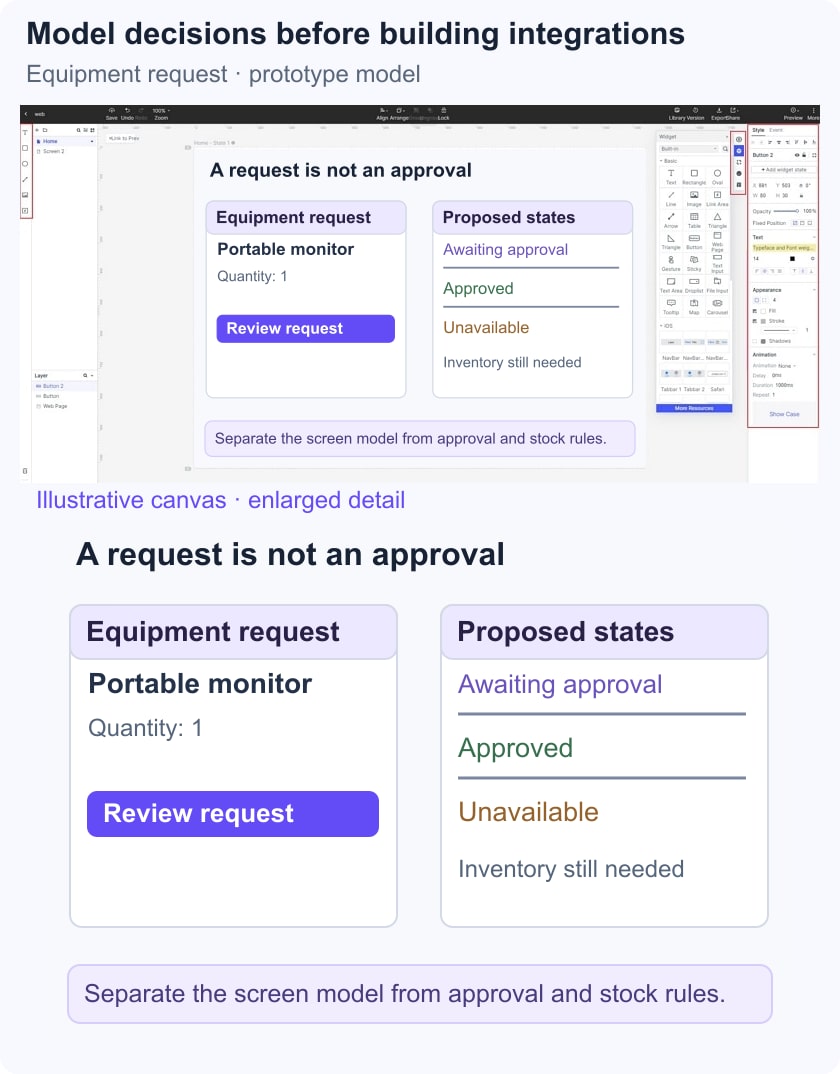
Ask a reviewer to request an item, explain whether it has been approved, and describe what they would do if it became unavailable. Record the screen and wording behind any misunderstanding. If the status meaning is clear but stock availability remains uncertain, move that question to a technical experiment instead of adding more visual polish.
Define the Iteration’s Exit Decision
Before the review, state what evidence would support the next step. For this example: the status labels distinguish requested from approved, the unavailable message offers an appropriate next action, and policy questions have named owners. These are proposed review criteria, not results from an actual study.
Keep a short record of the question, prototype version, observations, decision and remaining risks. A decision to discard the interface, change the underlying policy or run a technical experiment is as legitimate as deciding to implement it.