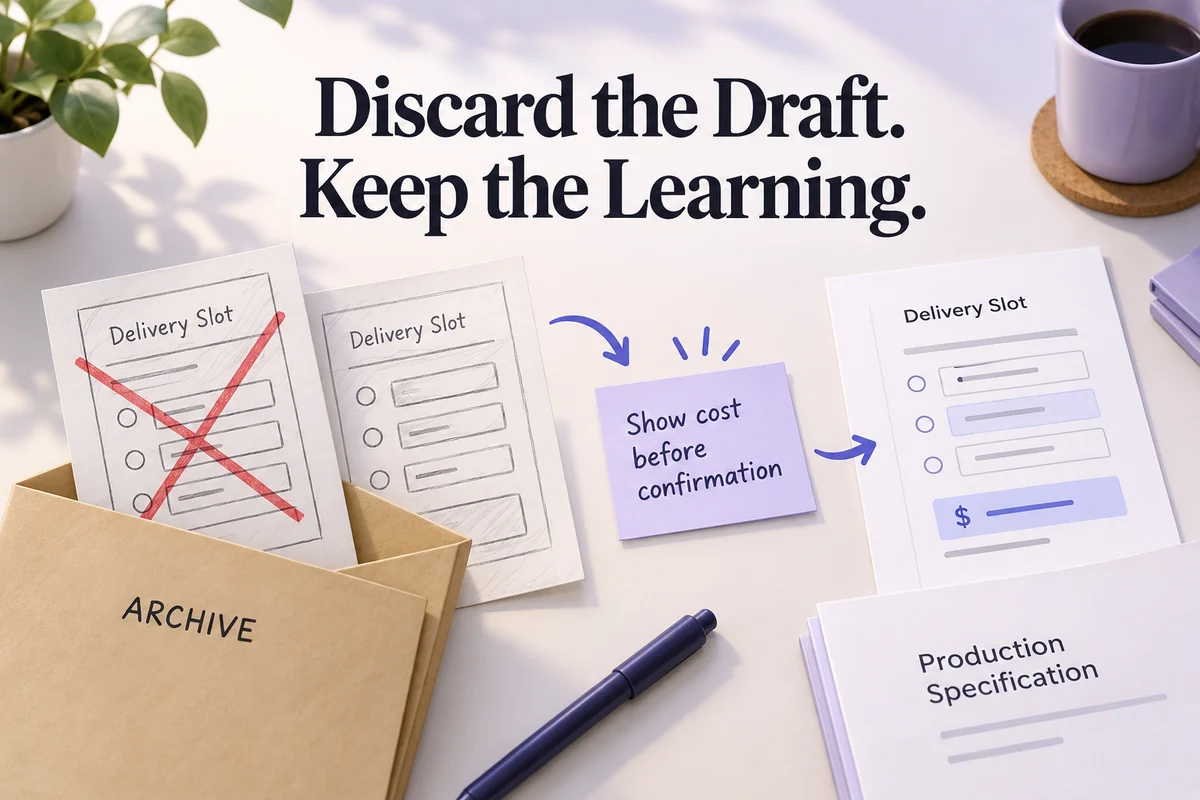
A throwaway prototype is a temporary model made to answer a specific question. The team uses it to explore an idea, clarify a requirement, or observe a task, then discards the artifact instead of treating it as the foundation of the final product. The findings, examples, and decisions are the parts worth keeping.
For instance, a delivery team may compare two ways to choose a delivery slot before committing to either layout. A rough interactive model can expose confusion about fees without implementing inventory, payments, or scheduling. After the study, the team builds the chosen approach with the appropriate production architecture.
What is throwaway prototyping?
The methodology
Throwaway prototyping separates learning from implementation. The prototype is intentionally limited to the uncertainty under investigation. That might be a screen arrangement, the wording of a warning, or the feasibility of a technical approach. The researcher and developer should agree which question the artifact can answer and which parts are simulated.
Rapid throwaway prototypes
“Rapid” describes a short learning cycle, not a promise that every prototype takes minutes. A sketch may be sufficient to compare layouts; a small coded experiment may be necessary to investigate a browser behavior. Both can be disposable. Choose the least elaborate representation that lets someone evaluate the actual question.
The throwaway model
Outline the uncertainty, build the minimum testable representation, evaluate it, and transfer the result into requirements or design decisions. Then archive or discard the experimental work. Keep the evidence that explains why a direction was selected; otherwise the next team may repeat the same experiment.
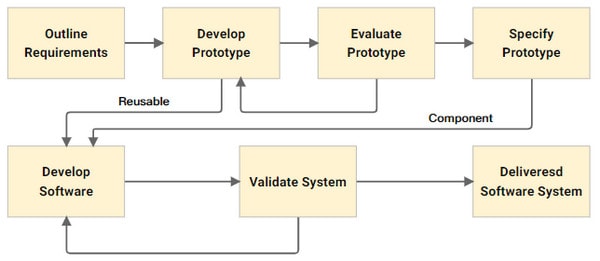
The figure includes a reusable-component path. That path needs an engineering decision: a prototype asset may be reusable, but the label “throwaway” does not certify its code quality. A tested interaction and a production-ready implementation are different outcomes.
What does “close-ended” mean here?
You may encounter “close-ended prototyping” as another name for this approach. The intended boundary is that the experiment ends when its question has been answered; it is not refined indefinitely into the final system. A positive result does not change that original decision automatically.
Advantages and disadvantages
Advantages of a disposable model
- Lower commitment to an early idea. A rough artifact is easier to replace when the evidence points elsewhere. Compare alternatives before investing in detailed visual treatment.
- Focused expenditure. Simulating a delivery-slot screen avoids building unrelated account and payment features for that study. Savings depend on what is avoided, not on the number of prototypes produced.
- Freedom to use a different medium. Paper, linked screens, or a technical spike can each be appropriate. The prototype does not have to use the final programming language if implementation feasibility is not the question.
- Specific feedback. A bounded task gives the team something observable: where a participant looks, what they select, and what they misunderstand.
Disposable does not mean undocumented. You do not need production documentation for every disposable sketch, but you do need a compact record of the question, participants or review context, observations, limitations, and decision. Otherwise the work is hard to explain or reuse.
Disadvantages to plan for
Communication can fail if someone sees an attractive prototype without knowing it will be discarded. State its status in the project brief and review invitation. Avoid a realistic payment confirmation that could be mistaken for a completed transaction.
Schedule visibility can also suffer. A series of unbounded experiments may consume the implementation budget. Give each experiment an owner, a timebox appropriate to its complexity, and an exit decision. “Build another version” needs a new question, not just discomfort with choosing.
Finally, disposal can feel wasteful. Teams become attached to completed screens or working code and may quietly promote them into production. The GOV.UK prototype guidance explains why prototype code should not simply be copied into a live service. Reuse requires its own quality review.
When should you use a throwaway prototype?
Proof of concept
Use a technical spike to investigate a narrowly defined feasibility question, such as whether a particular browser interaction can be implemented within a constraint. A clickable visual prototype cannot prove API reliability or actual system performance; choose the medium that produces the evidence you need.
Ideation and comparison
For the delivery example, create one option with a calendar and another with a list of available slots. Use the same sample dates, prices, and task in both. Ask people to choose a slot within a budget; do not tell them which interface the team prefers. Record misunderstandings and recovery attempts instead of collecting only a favorite.
Research and development
A disposable model is useful when the proposed solution is still uncertain. It may reveal that the requirement itself is wrong: users need an estimated arrival window, not a longer slot-selection form. Feed that finding back into the brief before producing another layout.
It is less useful when the question requires sustained real usage, live operational data, or a system's behavior under load. A prototype session is not a substitute for a production trial, security review, or performance test.
Throwaway versus evolutionary prototyping
Both approaches use feedback. Their main difference is what happens to the artifact after that feedback, not a universal rule that one is fast and the other is slow.
| Decision | Throwaway | Evolutionary |
|---|---|---|
| What survives? | Learning and selected decisions; the experimental artifact is retired. | The prototype is refined over successive cycles. |
| Useful starting condition | A direction or isolated assumption is uncertain. | A direction is worth developing, with details still unresolved. |
| Main risk | Learning is lost, or disposable work is mistaken for production. | Attachment and scope growth make fundamental change difficult. |
| Exit question | What did the experiment establish? | What evidence supports the next refinement or handoff? |
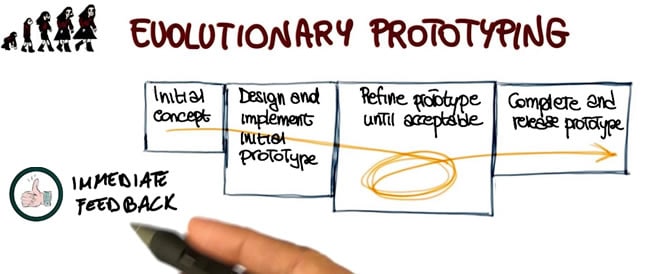
A project can use both approaches. Explore two disposable concepts first, then evolve the stronger direction. The separate evolutionary prototyping guide explains how to manage that continuing feedback cycle.
Build and retire a throwaway design in Mockitt
An interactive Mockitt prototype can represent the screens needed for a disposable UX experiment. Keep the delivery example limited to selecting a slot, seeing the fee, and reviewing the choice. Reuse common controls so the comparison focuses on the layout rather than accidental visual differences.
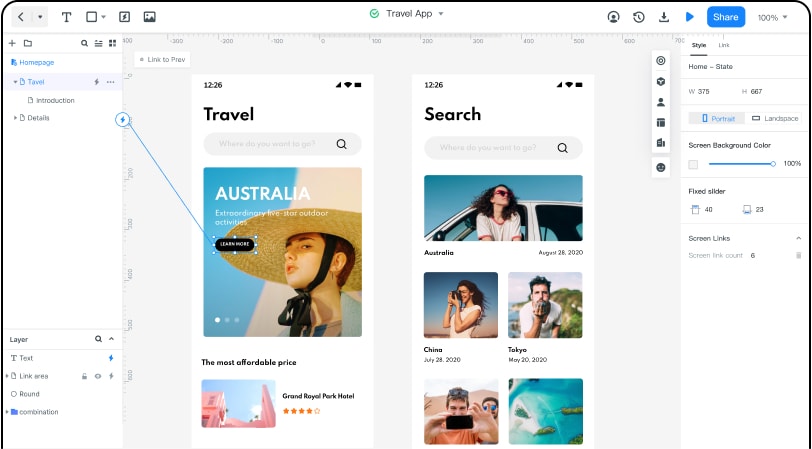
Preview every route before sharing. Include a way to go back and a clear unavailable state, then use the same task prompt for each alternative. Keep comments connected to the relevant screen, and distinguish a participant's observation from a stakeholder's preference.
Afterward, save the selected requirement, supporting observations, discarded alternatives, and unresolved questions. Mark the prototype as an archived experiment. If the team needs a more realistic follow-up, follow the wireframe-to-prototype workflow with that decision as the input. Discarding the artifact is useful only when the learning remains accessible.