Mockitt - Best Free Wireframe Tool
Helpful Tips About Wireframe
- How To Create A Wireframe
- Wireframe Tools You Should Know
- Wireframe Templates for Your Inspiration
- Free-to-use Wireframe Kit
Design Review Questions for Product Teams
Use focused design review questions to assess users, flow, accessibility, feasibility, evidence, and the next product decision.
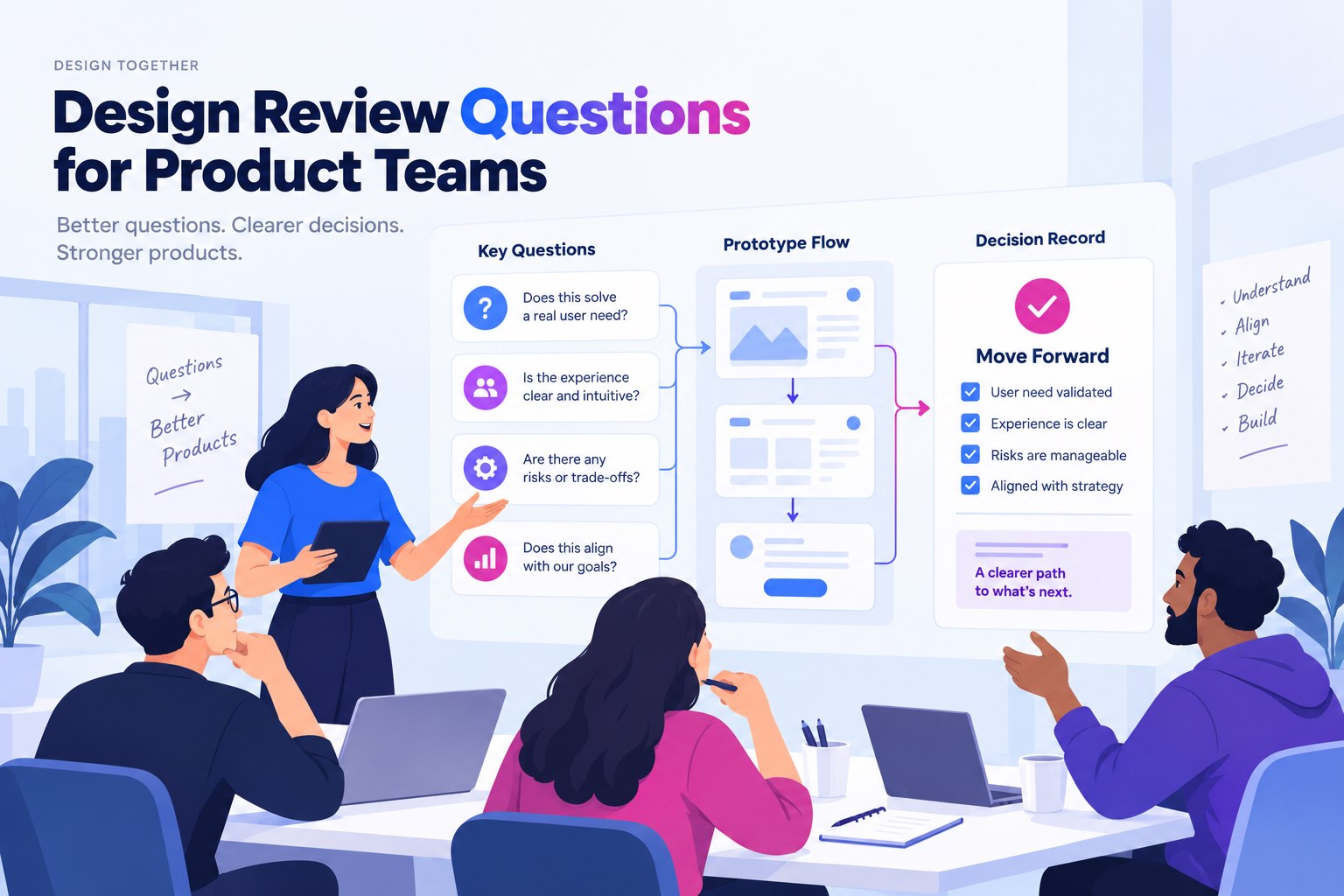
A design review is a decision meeting, not a search for a single personal preference. The most useful questions connect the proposed experience to a user task, the evidence behind the choice, and the work required to test or build it.
Share the review goal and the prototype version before the meeting. If the team is reviewing an interactive flow, a link in Mockitt's prototyping workspace can give everyone the same starting point. The review still needs a clear scope: what is ready to discuss and what is intentionally outside it.
Set the decision before the meeting
Write one sentence such as “Decide whether the onboarding flow is ready for a user test” or “Choose which navigation direction to prototype next.” The sentence tells reviewers what kind of evidence matters. It also prevents a review from expanding into a general critique of the whole product.
Questions about users and evidence
- Which user and situation does this design support?
- What evidence led us to this problem or opportunity?
- What assumption is most important to test next?
- Which users or contexts are not covered by this version?
- What would count as a successful task outcome?
These questions keep the conversation grounded. If the team cannot name the user situation, postpone detailed visual debate until the problem is clearer.
Questions about flow and interaction
- Can the user identify where to start and what to do next?
- What happens when the expected data is missing or the action fails?
- Can the user recover, go back, or cancel without losing important work?
- Are choices presented in the order the user needs to make them?
- Does the prototype show the state that matters for this decision?
Walk the primary task before discussing individual components. A polished control cannot repair a flow whose next decision is unclear.
Questions about content and accessibility
- Does the heading describe the current task or state?
- Are labels, instructions, and errors specific enough to act on?
- Could a user understand status without relying on color alone?
- Will longer names, translations, or user-generated content fit?
- What keyboard, touch, zoom, or assistive technology needs should the next version address?
A prototype may use placeholder content, but mark it clearly. Do not approve a layout based on short placeholder text if real content is likely to be longer or more variable.
Questions about feasibility and measurement
- Which data, permissions, integrations, or states need engineering confirmation?
- What is represented by the prototype, and what is deliberately not represented?
- What event or observation will tell us whether the design is working?
- Which decision can be made now, and which requires research or implementation evidence?
- What is the smallest next prototype or test that reduces the biggest risk?
A clickable flow demonstrates an intended interaction. It does not prove production performance, data security, or a complete backend implementation. Keep those questions visible so that approval is scoped correctly.
Close the review with an action record
- Write the decision in plain language.
- List the observations or evidence that support it.
- Separate accepted changes, open questions, and deferred ideas.
- Name one owner and a next checkpoint for each action.
- Save the reviewed prototype version and link it to the record.
End with a short read-back. If two people describe the decision differently, the review is not finished yet.
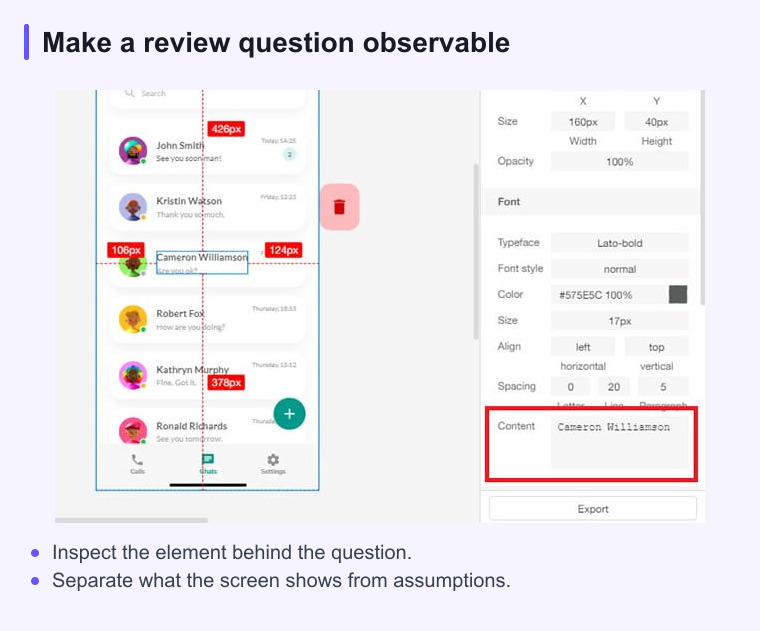
For example, consider an onboarding prototype with a required team-name field and a primary action labeled “Create.” A reviewer asks, “Will the user know whether this creates an account or a team?” The screen shows the ambiguous label; it does not show how users will interpret it. A useful action record is: “Designer: change the action to Create team and preserve the existing account information. Researcher: check understanding in the next onboarding task session. Decision: ready for that session after the copy change, not approved for release.” This hypothetical record ties a question to visible evidence, a limited change, an owner, and the remaining uncertainty.
Quick design review checklist
- User, situation, and decision are explicit
- Primary flow and important states are visible
- Content, accessibility, and localization questions are recorded
- Feasibility limits are separated from design evidence
- Actions have owners, next steps, and a saved prototype version
Good review questions make feedback more specific and less personal. They help a product team move from “I like this” or “this feels wrong” to a clear statement about the user, the evidence, and the next decision.
Sources and scope
This guide combines product workflow guidance with the linked reference material. Product capabilities and limits can change, so check the current Mockitt page before relying on a feature detail.