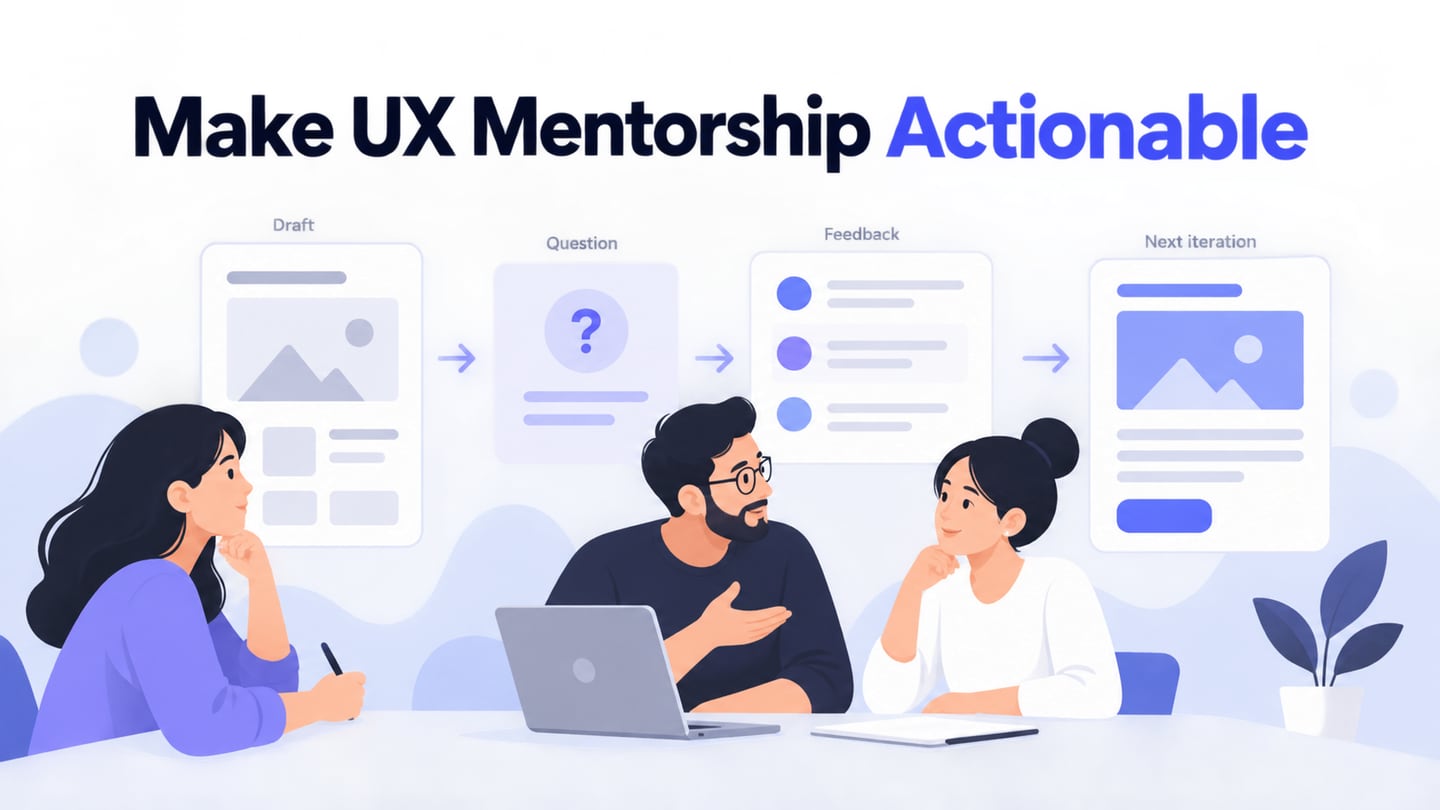
A UX mentor can offer another perspective on your work, career questions, and design decisions. The relationship is most useful when you know what help you need and can act on the feedback. For a design review, prepare a small interactive prototype in Mockitt or another shareable artifact and bring one specific question. A mentor can challenge your reasoning, but cannot guarantee a job, promotion, or successful product.
- UX mentors can help turn broad feedback into a concrete design question.
- UX mentors can offer an outside perspective and ask which assumptions still need evidence from users.
- UX design mentors can introduce relevant examples and explain how they approached a similar problem.
- UX mentors can explain aspects of the industry or a role that you have not encountered.
- A design mentor can help you think through a career difficulty while leaving the decision and next steps with you.
What can a mentor offer?

Start with the purpose of the relationship. You might need critique on a portfolio, help planning a research activity, or perspective on a new role. These are different needs, and one person may not cover all of them. Write down the question, the context you can share, and what a useful next step would look like before contacting someone.
A mentor can suggest skills to practice and help you choose a manageable exercise. They are not responsible for completing the work or designing an entire training program for you. Agree on the scope: for example, one review of a saved-reading flow, followed by an independent revision and a brief follow-up.
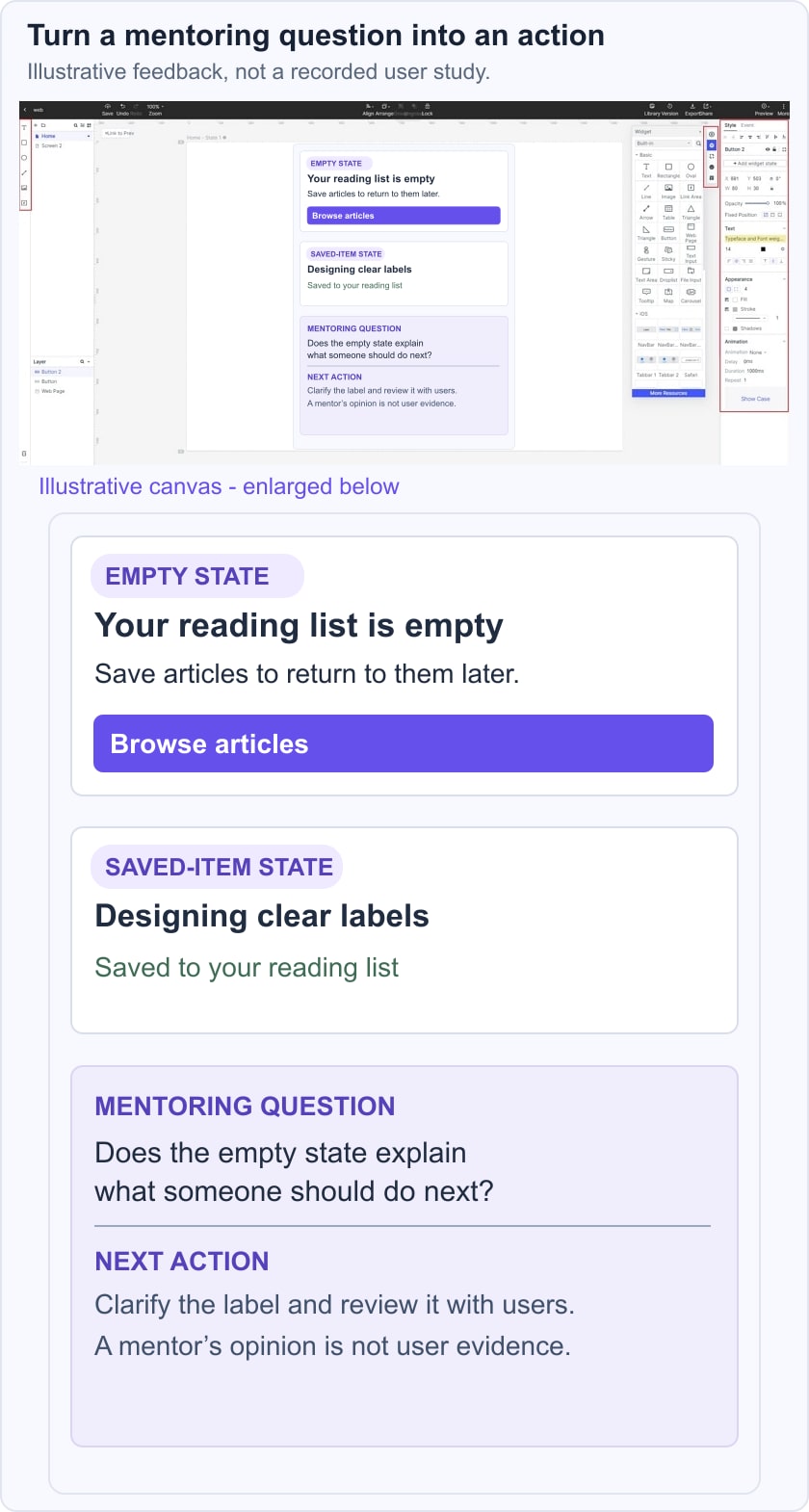
It is easy to become attached to a design before the underlying question is clear. A mentor can ask why a control exists, what information a person needs, or which alternative you considered. For an illustrative reading-list screen, bring the empty state and a saved-item state. Ask whether the empty state explains the next action, then separate the mentor’s opinion from evidence you would need to collect with users.
An outside conversation can be valuable when your immediate team cannot provide the perspective you need. Colleagues, communities, and structured mentoring programs are possible routes. Set expectations about confidentiality and time before sharing work. Do not upload client or employer material simply because a mentor has agreed to review it.
Regular conversations can help you notice patterns in your decisions, but frequency alone is not a measure of progress. Track the question discussed, the action you chose, and what you learned after trying it. Advice should be evaluated against your situation rather than accepted because the person is senior or has a higher income.
The action steps to find mentors.
Begin with a relevant colleague, a professional community, an introduction, or a mentoring platform such as ADPList. Check the person’s experience and the session terms before booking. A short request is easier to evaluate: explain your design focus, the specific question, the artifact you can share, and the time you are asking for. Do not assume availability or an ongoing commitment.
Use a career conversation or informational interview when you want to understand someone’s work. Be transparent about that purpose. Applying for a role you do not want simply to obtain coaching can waste the hiring team’s time. If you are genuinely interviewing, prepare questions about the UX team and role and keep the hiring conversation distinct from a mentoring request.
An interviewer may be unable to provide detailed feedback because of time or company policy. A refusal is not evidence that they would be a poor mentor. If someone offers useful advice, thank them, act on it where appropriate, and ask permission before following up. The other person should be free to decline or limit further contact.
What makes a good mentor?
Two practical qualities matter when evaluating a potential mentor: a clear willingness to support the agreed goal, and openness to learning about your context. Seniority alone does not establish either quality. Use an initial conversation to discuss expectations, boundaries, and whether the relationship is a good fit.
1. The mentor must make a conscious decision to work with and support the newbies
The mentor should choose to participate and be clear about the help they can offer. Relevant experience matters more than age. Look for someone who asks questions, explains their reasoning, and distinguishes personal preference from evidence. Agree on how often to meet and which topics are outside the relationship’s scope.
2. The mentor shows a willingness to develop himself further and to get to know new perspectives
A productive mentor listens as well as advises. They should be willing to learn about unfamiliar constraints, acknowledge uncertainty, and adapt their guidance. The mentee should be able to disagree respectfully and explain why an idea may not fit. Neither person needs to treat every recommendation as a rule.
Two Historical Examples of Learning from Others
Well-known accounts can illustrate the value of outside advice, but they are not evidence that a particular mentoring arrangement will produce the same outcome. The following examples concern business relationships, not UX training. Their useful lesson is to seek relevant perspective while making your own decisions.
- Richard Branson has described learning from Freddie Laker when launching Virgin Atlantic. His account emphasizes understanding risks and drawing on experience. For a UX mentee, the parallel is to bring a concrete situation and ask how an experienced person would reason about it, without assuming their circumstances match yours.
- In his 2016 account of his friendship with Warren Buffett, Bill Gates describes learning through thoughtful questions and conversation. This is a historical personal account, not a claim about their current relationship. In a design discussion, a well-chosen question can be more useful than an instruction to copy someone else’s solution.
How to be a good mentee?
Mentees have to become aware of their own strengths
Bring your own observations and attempts to the conversation. Explain what you can already do, where you are uncertain, and what you tried. A mentor is there to support learning, not to complete your portfolio or solve every decision. Respect both people’s time and avoid making access to advice a dependency for routine work.
In an initial conversation, the why must be clarified
Clarify the purpose in the first conversation. Agree on a specific goal, a reasonable next step, and whether a follow-up is appropriate. For the reading-list exercise, the goal might be to make the empty-state action clearer, then review the revised screen and note what still needs testing with users.
Discuss what the relationship does not include, such as job placement, referrals, or unlimited review time. After a session, send a concise summary if the mentor welcomes it. Explain which suggestion you tried and what changed; do not report a hypothesis as a validated improvement.
Work on your visibility
Make progress visible through the work rather than repeated requests for attention. Keep a short record of the problem, feedback, revision, and next question. A focused case study can help you explain that learning later. If the arrangement no longer fits, thank the mentor and close or revise it respectfully.