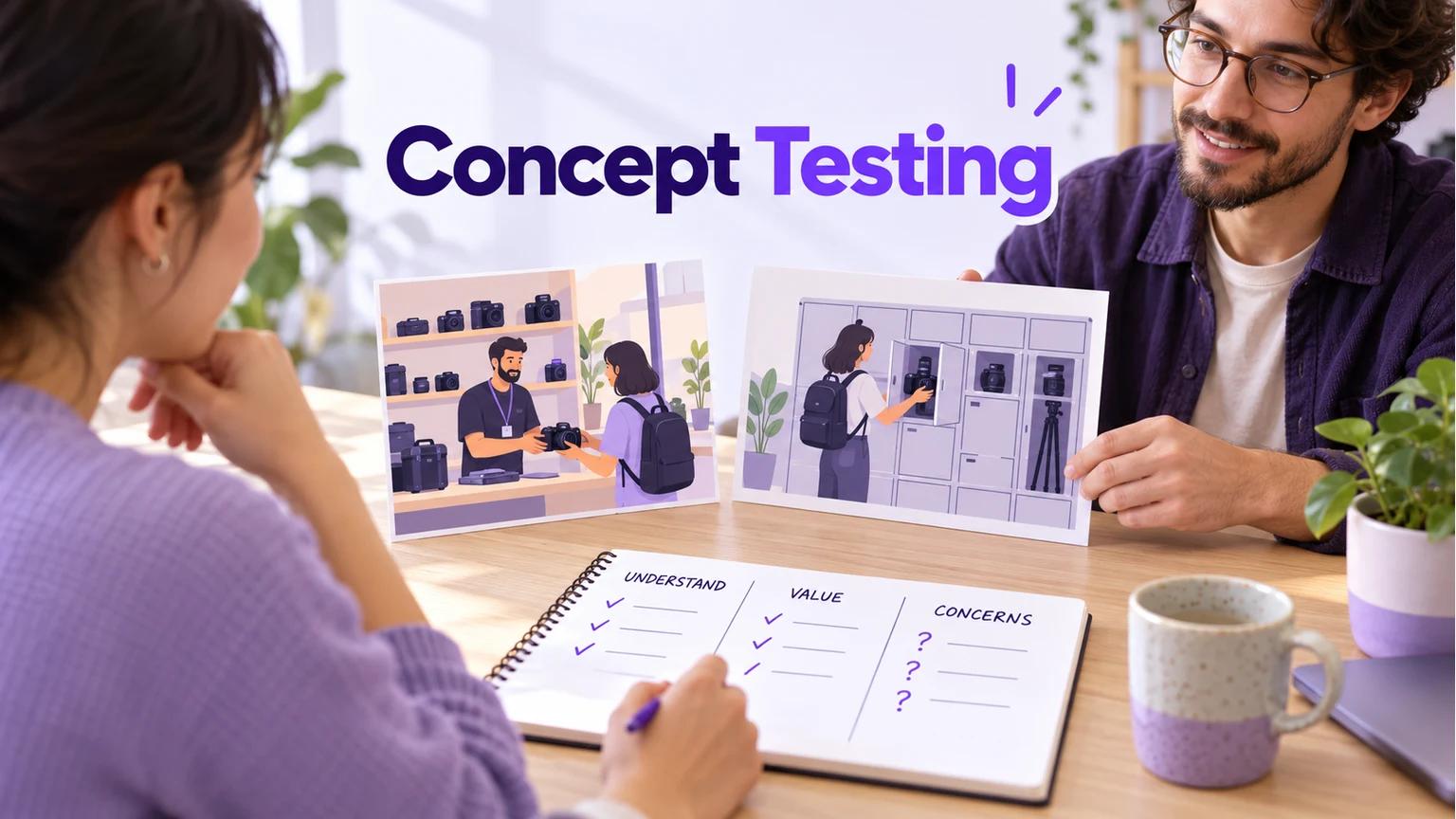
Concept testing explores whether people understand an early product idea, see a relevant use for it, and encounter reasons not to use it. Show a simple, consistent explanation of the concept, ask about the participant’s real situation, and record what supports changing, advancing, or stopping the idea. A positive reaction alone is not evidence that someone will adopt it.
You do not need a finished application. A brief description, storyboard, or a few screens in Mockitt’s prototyping workspace can make the idea concrete enough to discuss. Choose the smallest presentation that explains the proposed value without implying that unbuilt services already work.
What does a concept test answer?
Nielsen Norman Group’s research-method overview describes concept testing as presenting the essence of a product or service to explore whether users would want or need it. The emphasis is the idea’s usefulness and meaning, rather than the detailed mechanics of using an interface.
Keep the study question narrow. “Does this concept help occasional equipment borrowers resolve a meaningful problem?” is different from “Can someone find the Reserve button?” The second asks about usability. Likewise, a preference test can explore reasons for choosing one presentation over another, but preference alone does not establish demand for the underlying service.
Define the decision before making the stimulus
Write down what this research will change. Perhaps you are deciding whether to prototype a reservation service, change its audience, or drop a proposed notification feature. List the beliefs that would make that decision unsafe. An existing prototype assumption map can help identify which question the concept study should address first.
Use a fictional example: a community workshop is considering a service that lets occasional members reserve a shared toolkit for a weekend project. The initial question is whether knowing availability in advance solves a meaningful problem. Pricing, identity checks, and collection logistics are relevant constraints, but a short study should not pretend to settle the entire business model.
Specify whose experience matters. Someone who borrows equipment every week may answer differently from someone doing one project a year. Recruit for the situation you intend to support, and record the limits of that scope in your research plan.
Make a clear, consistent concept stimulus
A concept stimulus is the material the participant sees. Keep it understandable without a sales pitch. Describe the situation, the proposed service, what the person would need to do, and any condition that could change its usefulness.
Illustrative concept: Before a weekend project, a workshop member checks which shared toolkits are available, reserves one for a collection window, and returns it at the agreed time. The service shows what the kit contains. It does not deliver equipment or guarantee that every tool is available.
A simple three-screen sequence could show kit contents, availability, and a reservation summary. In Mockitt, the purpose of these screens is to make the proposal discussable. Use fictional details, label simulated availability, and keep the proposed conditions visible instead of explaining them only when a participant asks.
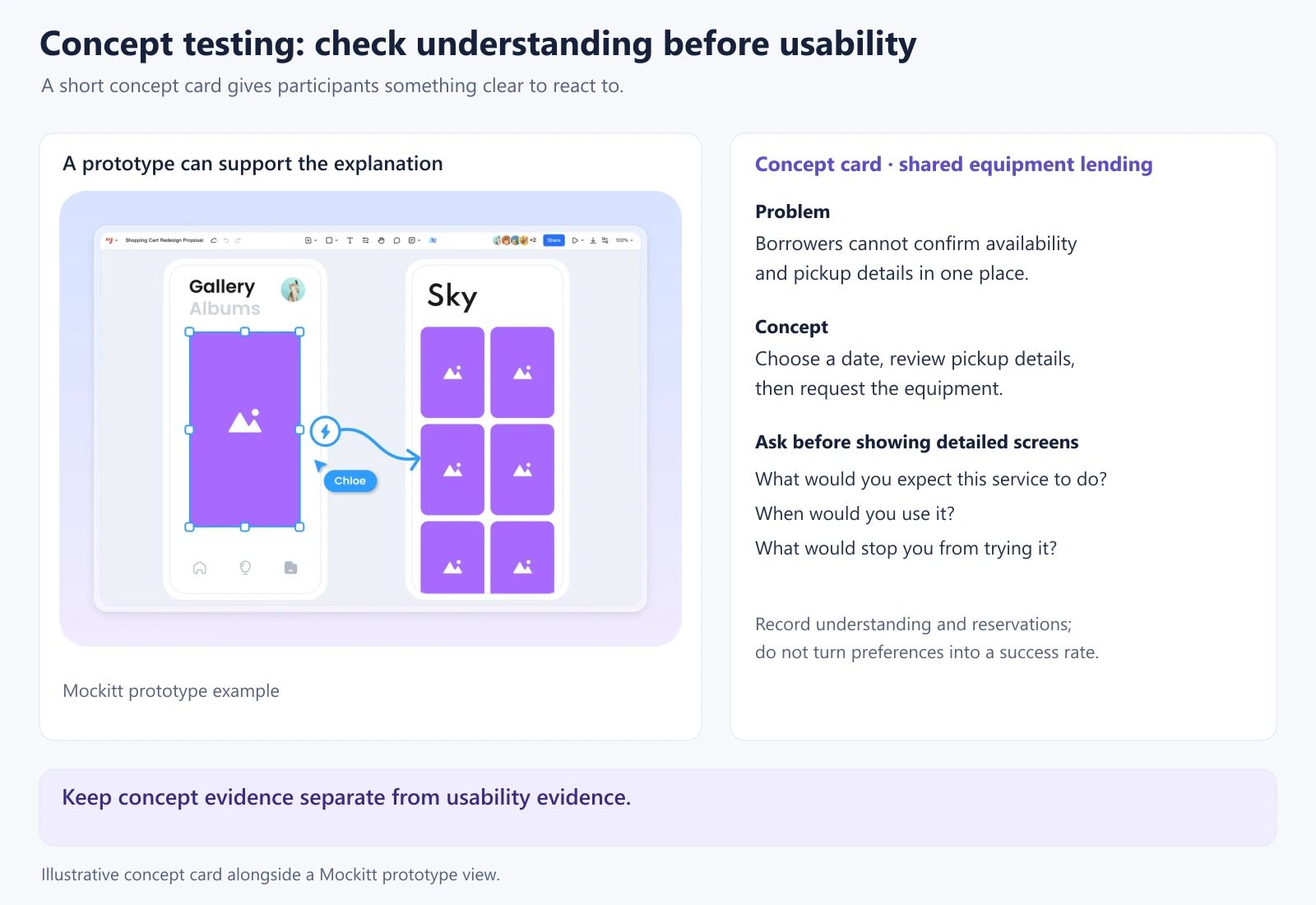
If you compare concepts, give each a similar level of explanation and finish. A polished option beside a vague sentence creates an avoidable presentation difference. Vary the order between sessions where practical, and note which version each participant saw.
Ask about the current situation first
Before revealing the idea, ask for a recent relevant experience. For the toolkit example: “Tell me about the last project where you needed equipment you did not own.” Follow the account: what happened, what the person tried, where the difficulty arose, and how they resolved it.
This gives you something concrete to compare with the proposed service. “Would you use a convenient borrowing app?” encourages agreement with an attractive description. A recent account may instead show that transport, missing expertise, or unpredictable project dates matters more than advance availability.
Do not correct the participant’s account to fit the concept. If the expected problem does not appear, that absence is useful information about this participant and situation, not a reason to explain the pitch more enthusiastically.
A neutral concept-interview guide
| Purpose | Possible question | What to capture |
|---|---|---|
| Comprehension | How would you explain this service to another workshop member? | What they understood, missed, or added. |
| Relevance | Where, if anywhere, would this have fitted the project you described? | A concrete situation or lack of one. |
| Existing alternatives | What would you otherwise do at that point? | Current workaround and reasons for keeping it. |
| Obstacles | What would you need to know before making a reservation? | Conditions, missing information, and concerns. |
| Limits | When would this approach be unsuitable? | Situations the concept should not claim to solve. |
Let participants answer before explaining. Record initial misunderstandings, then clarify only what is needed to continue. Otherwise, the final positive response may reflect your coaching rather than the stimulus. Avoid defending the concept or treating criticism as a request for another feature.
Analyze evidence, not applause
Use one row per relevant observation. Separate what was said, the situation it concerned, your interpretation, and the next action. The following rows are hypothetical examples of analysis, not results from real participants.
| Illustrative observation | Interpretation to examine | Possible next action |
|---|---|---|
| A member cannot tell whether a kit includes a compatible battery. | Unclear contents may prevent a useful reservation. | Revise the concept description and examine comprehension again. |
| A member already borrows a neighbor’s tools and sees no added benefit. | The proposed service may not improve this person’s situation. | Keep the counterexample; reconsider the audience or value. |
| A member describes a recent failed trip caused by unavailable equipment. | Advance information could address a concrete difficulty. | Explore whether the workshop can provide reliable availability. |
Do not convert a small qualitative sample into a market-adoption percentage. Nor should a lack of enthusiasm automatically cancel an idea that participants misunderstood. Distinguish an unclear explanation, a weak value proposition, and a delivery constraint: each requires a different response.
Decide whether to advance, change, or stop
Advance when the concept has a credible use in the intended situation and the next uncertainty is specific enough to investigate. Change it when a meaningful need exists but the proposal, audience, or conditions do not fit. Stop or park it when the evidence does not support the value or a necessary operating condition cannot be met.
Record the decision with its reasons and unanswered questions. If the next task is to examine interaction, move into building a prototype around one concrete scenario. The concept study has then done useful work: it has helped choose what to explore next, without claiming that an early conversation validated an entire product.