UX content testing checks whether people can find information, understand its meaning, and use it to make the right decision. Give intended readers a realistic task, observe what they do, and ask them to explain consequential wording in their own words. Compare that evidence with the meaning the content needs to communicate. Asking whether a page “sounds clear” rarely reveals the same problems.
Start with accurate, useful copy and the principles of UX writing. Then test the words in the situation where someone needs them. A sentence can be grammatically clear while leaving a reader unsure which date changes, whether an action costs money, or what happens next.
Choose the decision the reader must make
Imagine a community equipment library that lends drills, sewing machines, and gardening tools. A borrower has reserved a drill for collection on Friday afternoon, with return due on Monday. They need to move collection to Saturday. The team wants to know whether the booking page explains the consequences accurately.
For this fictional service, changing the collection window is free, the Monday return date stays the same, and the borrower must save the change before the new window is reserved. These are example business rules, not recommendations for every lending service. A real team would confirm its own rules with the person responsible for operations.
The research question is: “Can borrowers change when they collect an item while understanding its return deadline?” This is more useful than “Is our content good?” It gives the writer a defined message and the researcher an observable decision.
Create a short meaning key before recruiting. It should say what must be understood, what action demonstrates that understanding, and which interpretations would cause a problem. Keep this key out of the participant-facing material.
| Required meaning | Evidence to look for | Consequential misunderstanding |
|---|---|---|
| The collection window can change | The reader locates a way to choose another window | They believe the booking must be canceled first |
| The return date remains Monday | They explain when the drill is due back | They assume collecting one day later extends the loan |
| A selection is not yet saved | They complete the save action and recognize the result | They leave after choosing Saturday, believing the booking has changed |
Match the method to the uncertainty
Use a task-based session when readers need to locate and apply information across a page or short flow. Digital.gov’s content usability guidance describes watching people find information and explain what they understand from it. In the equipment example, that means seeing whether the borrower discovers the return-date condition before making the change.
Use paraphrase testing when the immediate question concerns the meaning of a short passage. Ask the person to read it and explain it in their own words. Digital.gov’s paraphrase-testing guidance recommends recording the reader’s explanation without correcting it during the task. A useful follow-up is to ask what they would do as a result.
The two approaches can work together. First let a participant attempt the collection change without directing their attention to the policy. After the attempt, return to the relevant passage and explore its interpretation. Keep the order in your notes: understanding after a facilitator points to a sentence is different from noticing it independently.
A preference question answers another question: which wording someone likes. A quick exposure study examines immediate recall. A prototype content stress test examines what happens to a design when text and data vary. None, by itself, establishes that a reader can apply a service rule correctly.
Put the words where the decision happens
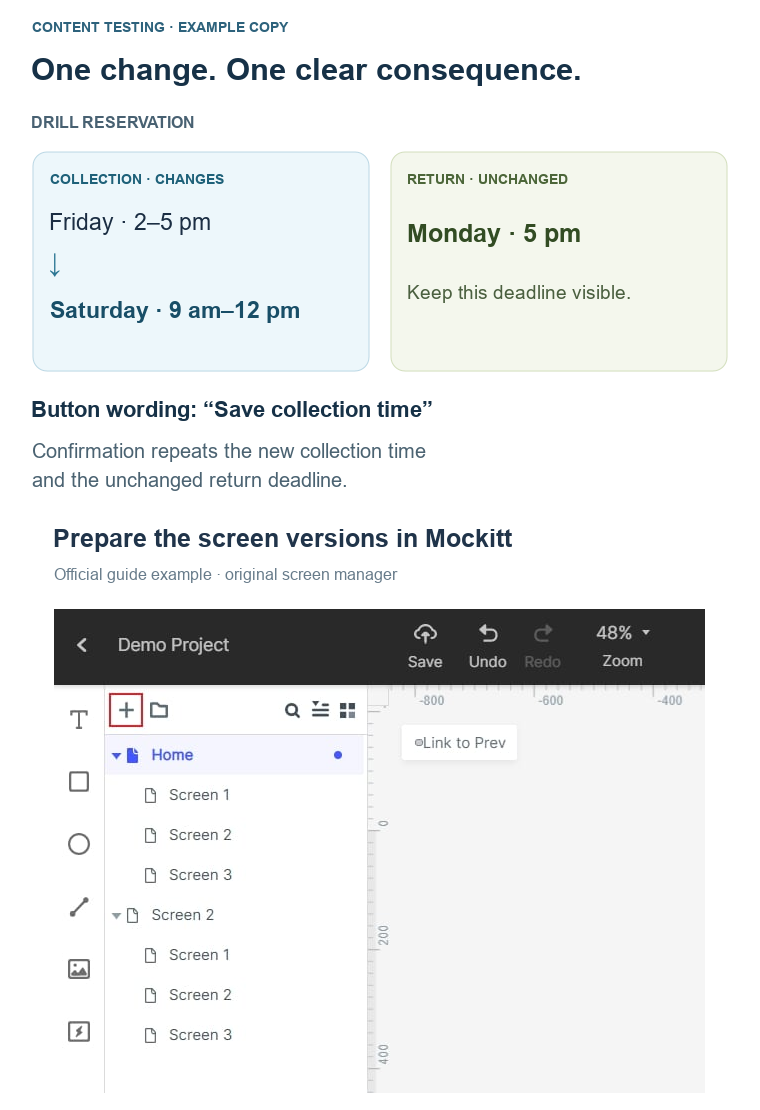
Prepare the booking summary, collection-window selection, and saved confirmation in Mockitt’s interactive prototype workspace. Mockitt is a design and prototyping tool: it lets the team represent the relevant screens and connections before the service is implemented. The study still needs its own participants, questions, and observation record.
Use a consistent fictional booking throughout. Show the drill name, the current collection window, and the return deadline together. Include the surrounding action labels and feedback, because those can change how a sentence is interpreted. Do not test a policy sentence in an otherwise empty screen if the eventual page will contain competing information.
Begin with the actual draft, including any ambiguity you need to investigate. For example, “Move your booking at no extra cost” could refer to collection, return, or the entire reservation. Prepare a proposed revision separately: “Change your collection time for free. Your return deadline stays Monday at 5 pm.” Pair it with “Save collection time” and a confirmation that repeats the resulting dates.
Use the viewport that matters to the task. On mobile, check whether the deadline is visible near the selection and confirmation; do not assume that a desktop screenshot reduced in size represents the mobile experience. Preview the route before the session so a missing connection does not become a supposed comprehension failure.
Keep the tested version stable during a research round. If you change the wording, name the new version and record which participants saw it. A polished prototype is useful only if the team can tell which content produced each observation.
Ask questions that reveal meaning without supplying it
A neutral task could be: “You reserved a drill for Friday afternoon but can now collect it only on Saturday morning. Use this booking to work out what you can do.” Avoid adding “without changing your return date,” because that gives away the very condition under investigation.
Recruit people who could use the service and who bring the relevant range of experience. Someone who wrote the policy knows its intended meaning already. An experienced borrower may also bring expectations that a first-time borrower lacks. Decide which contexts matter before interpreting differences as a writing problem.
After the task, ask the participant to describe the booking as it now stands. Follow up on what happened rather than following a rigid list of questions regardless of the session.
- “When would you collect the drill?”
- “When would you return it?”
- “What on this page helped you decide that?”
- “What do you think happened when you selected Saturday?”
- “Is there anything you would need to check before making this change?”
If a person misunderstands a rule, capture the explanation before clarifying it. When you provide help, note the intervention and treat the later behavior as assisted. GOV.UK’s moderated-testing guidance emphasizes relevant tasks, neutral instructions, and avoiding hints about the route.
Separate finding the words from understanding them
A wrong answer can have several causes. If the participant never sees the return deadline, adding another synonym may not solve the problem. If they see it but interpret “booking” as the entire loan period, the vocabulary needs attention. If they explain the rule accurately but the action behaves differently, the issue concerns the interaction or underlying policy.
Use an observation record with separate columns for location, interpretation, action, and assistance. For each entry, retain the screen version and the relevant wording. Record what was said accurately; distinguish a direct quotation from your own summary.
For example, an illustrative note might read: “Opened collection options; did not return to the summary; expected the return date to move with collection.” That would support investigating the placement of the deadline and the meaning of “move.” It would not support a broad conclusion that borrowers cannot understand dates.
Include correct interpretations and uncertainty as well. Someone may choose the right action while admitting they guessed. Another person may understand the policy and decide not to proceed because it does not meet their needs. The second outcome can be a successful content decision even though it produces no booking change.
Revise the specific misunderstanding, then check it again
Choose the change that addresses the observed cause. For the equipment example, the revised screen could name both dates, place the unchanged deadline beside the new collection window, and label the save action precisely. Keep required conditions visible instead of making the copy shorter at the expense of meaning.
Write the decision plainly: “We will explain that changing collection does not extend the loan, and repeat the return deadline before saving.” Preserve the reason and the version. If the operational rule itself is disputed, resolve that question before testing a confident statement about it.
Check the revised flow with relevant readers using the same underlying decision. Fresh participants help avoid confusing remembered explanations with improved content. If returning participants are useful for another purpose, record their prior exposure.
Report what the study establishes: which messages were noticed, what readers understood, where assistance was needed, and what remains uncertain. A small qualitative study can reveal a serious misunderstanding; it does not establish a population-wide comprehension rate or a conversion improvement. The useful outcome is copy that answers the reader’s real decision, supported by evidence the team can inspect.