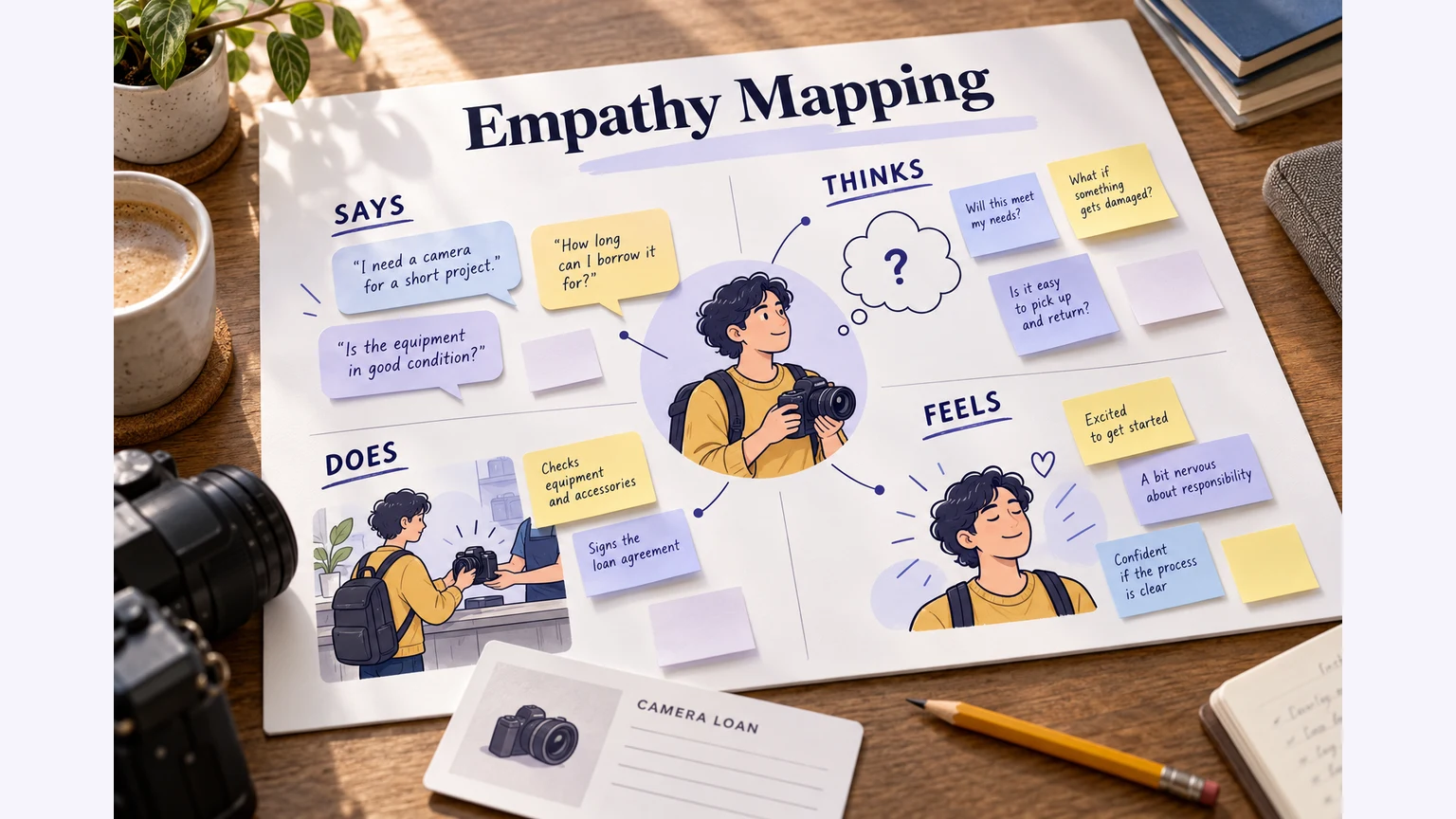
An empathy map organizes what you know about a person’s experience into four views: Says, Thinks, Does, and Feels. To make one useful, start with research notes about a specific situation, attach evidence to each entry, and separate observed behavior from your interpretation. The result should show what the team understands, where accounts conflict, and what it still needs to investigate.
A shared canvas such as Mockitt’s online whiteboard can hold the map beside its supporting notes. The important work happens in the evidence: filling every quadrant is less useful than making a small, accurate map that another person can question.
What belongs in an empathy map?
Nielsen Norman Group’s empathy-mapping guide describes the method as a way to share knowledge about a user or user segment and expose gaps. The familiar four-quadrant format distinguishes statements, thoughts, actions, and emotions. It captures a perspective rather than a sequence of steps.
| Quadrant | Useful entry | Evidence boundary |
|---|---|---|
| Says | A relevant statement, with its source | Use quotation marks only for recorded words. |
| Thinks | A belief, expectation, or concern | Distinguish a reported thought from a researcher’s inference. |
| Does | An action in the situation being studied | Label whether you observed it or someone described it. |
| Feels | An emotion and the event associated with it | Do not diagnose an emotion from a facial expression alone. |
Choose one situation before sorting notes
“Our customers” is too broad to guide a map. Define whose experience you are examining, what they were trying to accomplish, and what was happening around them. A useful scope might be “first-time workshop members choosing equipment for a weekend project.” Staff managing the tool inventory have a different task and should not disappear into the same average person.
Write the scope above the quadrants. Under it, list the research sessions included and their dates. If your inputs cover several different tasks, choose one now and keep the remaining notes for another analysis. An existing UX research plan can help you recover the original question and intended participants.
Turn each note into a traceable entry
Use one meaningful point per note. Add a participant or session ID, a short source reference, and an evidence label such as observed, reported, or inferred. The label matters when the map leaves the research team: “opened three kit descriptions” and “worries about choosing unsuitable equipment” are different kinds of information.
Keep identifying details and raw recordings in the approved research repository. The shared map usually needs a reference such as B04, note 12, rather than a member’s full name or contact details. Paraphrase when a distinctive quotation could identify someone, and label it as a paraphrase.
In Mockitt, arrange the four groups with a separate area for unanswered questions. Keep the source ID in the note text so its meaning survives a screenshot or export. Leave room beside the map for a possible design response; mixing proposed features directly into the evidence makes later discussion harder.
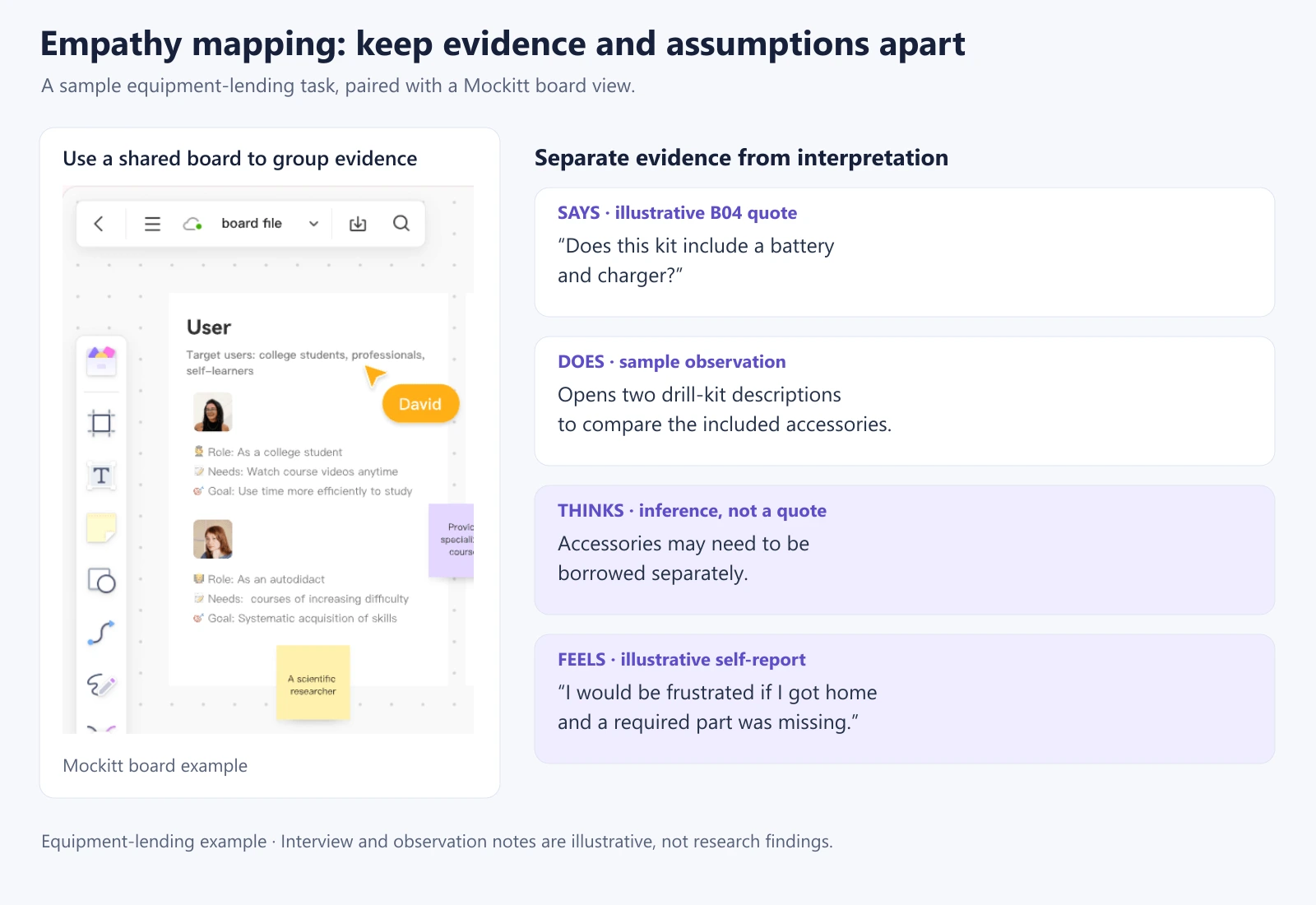
An illustrative example: borrowing equipment for a project
For example, imagine a first-time workshop member comparing two drill kits for installing shelves. The fictional notes below demonstrate the method; they are not findings from a completed study.
| Entry | Placement and label | What remains open |
|---|---|---|
| B04 asks whether both kits include a battery and charger. | Says — reported question | Which information would answer the question? |
| B04 opens both kit descriptions, then returns to the first. | Does — observed | Was the return a comparison, a mistake, or something else? |
| B04 may expect accessories to be borrowed separately. | Thinks — inferred | Ask about that expectation; do not present it as fact. |
| B04 says arriving home with an incomplete kit would feel frustrating. | Feels — self-reported | Does a clear contents list address that concern? |
The map suggests a question about equipment information. A How Might We question can turn that finding into a focused prompt. It does not establish that the service needs a recommendation engine, a new onboarding course, or a shorter signup form. Those are possible responses requiring separate reasoning.
A second member might choose immediately because a friend already explained the kits. Keep that difference visible. “Beginners need more information” loses the distinction between people who have informal help and people who do not.
Combine evidence without flattening differences
Start by checking the entries within each session. Then bring together people whose situation and goal genuinely match, as you would when creating research-based user personas. Keep their source IDs when combining similar notes. Five notes from one detailed interview are not evidence from five people.
When the collection is too large to inspect, use affinity mapping to identify themes before choosing which evidence belongs on the empathy map. The two artifacts serve different purposes: a theme groups related observations, while the empathy map brings several aspects of one experience into view.
Do not smooth away a contradiction just to make the map coherent. Someone may say the process is straightforward while repeatedly seeking reassurance. Write down both observations and investigate the circumstances. The useful question is what explains the difference, not which quadrant should win.
Use the map to choose a next action
Finish with a short list of evidence gaps and possible decisions. For the borrowing example, the next action could be to show two truthful versions of a kit-contents list and explore what each helps people understand. If the team is proposing a new borrowing service, concept testing can examine whether that idea addresses a useful problem. If nobody asked what “complete” meant, a follow-up conversation may be more useful than building screens immediately.
Name the evidence behind each proposed action. “Clarify which accessories are included because B04 and B07 asked about them” is reviewable. “Make the experience more reassuring” is too vague to tell a designer what to change or a researcher what to examine.
If the uncertainty concerns when reassurance is needed—before selection, after reservation, or at collection—extend the work with a customer journey map. Do not stretch the empathy map into a timeline when another format explains the sequence better.
What if you have little or no research?
You can map the team’s assumptions to prepare research, provided they stay visibly labelled as assumptions. Leave unsupported areas blank. Inventing a quote or asking AI to supply a plausible emotion creates an attractive artifact without improving your knowledge of the people using the service.
Give the map an owner and revisit it when relevant evidence arrives. Update a claim because a source changed, a new audience was studied, or an unanswered question was resolved. A useful map makes those changes understandable and keeps the team’s decisions connected to what people actually experienced.