User personas are concise descriptions of meaningful patterns among a product’s users. A useful persona captures goals, behavior, circumstances, and constraints that affect a design decision. It represents a pattern found through research; it is not a fictional biography created to make a presentation look complete.
To create one, define the decision you need to make, collect relevant research, group recurring behaviors, and turn each consequential pattern into a short profile with evidence references. Use Mockitt’s online whiteboard to arrange notes and compare patterns with your team. Keep uncertain claims visible instead of filling gaps with a plausible story.
What makes a user persona useful?
A persona should help answer a concrete question: would this design serve people with these goals and constraints? A profile that says “Alex, 32, enjoys coffee and technology” rarely answers it. A profile that explains when Alex can use the service, what interrupts the task, and what information they need to continue may change the design.
Nielsen Norman Group’s persona guidance describes personas as realistic representations used to support product decisions. The useful distinction is between a fictional identity and invented evidence. A profile may use a pseudonym, but its important characteristics should be traceable to what the team learned.
Include demographic information only when it helps explain a relevant need or constraint. Do not infer confidence, technical ability, or motivation from age or job title alone. Accessibility needs and circumstances can also cut across several profiles; a persona should not become an excuse to design only for the most convenient user.
Build profiles from behavior, not from a blank template
1. Define the product decision and scope
For a learning platform, the question might be how people resume a partly completed lesson. That calls for evidence about study sessions, interruptions, devices, and the meaning of progress. It does not require a comprehensive life story. A profile scoped to buying a course may need different evidence.
If the team has no direct research yet, create a provisional assumptions document and plan how to investigate it. Do not promote it to a research-based persona by adding a photo. A UX research plan can make the missing questions and recruitment needs explicit.
2. Collect and preserve the supporting evidence
Review interviews, observed task behavior, support conversations, and relevant usage data. Record what each source can establish. A page-view count may show that people reopen a lesson; an interview or observation may explain why. Neither automatically explains every user.
Keep anonymized references beside notes so that the team can return to the context. Separate a direct observation, a participant’s explanation, and your interpretation. You can use an empathy map to explore that distinction before deciding whether several accounts form a broader pattern.
3. Group patterns that would change the design
Compare goals, workarounds, frequency, constraints, and decision criteria. Look for combinations that recur, while keeping exceptions in view. A single striking quote can suggest a question, but it should not automatically become a whole user segment.
Ask what you would design differently for each proposed group. If two profiles lead to the same requirements and neither explains a meaningful difference, they may be unnecessarily separate. Conversely, one “average user” can hide conflicting needs, such as quick resumption and deep practice.
4. Write the profile and test its usefulness
Give the pattern a descriptive name, write the goal in plain language, and include the behaviors and constraints that explain it. Add evidence references, gaps, and the date of review. Then use the profile in a real design discussion. If it does not help the team notice a trade-off or ask a better question, revise its scope.
A compact user persona template
| Field | What to record | Avoid |
|---|---|---|
| Pattern name | A recognizable behavior or context. | A label that judges the person, such as “lazy learner.” |
| Goal | What the person is trying to accomplish. | A feature they supposedly want without evidence. |
| Context and behavior | When, where, and how the task happens. | An elaborate biography unrelated to the decision. |
| Constraints and barriers | What limits or interrupts progress. | Inferring ability or motivation from demographics. |
| Current approach | Tools, workarounds, and sources of help. | Assuming your product is their only option. |
| Evidence and uncertainty | Source references, contradictory observations, and questions. | Invented quotes, percentages, or research participants. |
| Design implications | What the team should investigate or support. | Treating the profile as a specification or guaranteed demand. |
Example: two ways to use an online course
The following hypothetical profiles demonstrate how behavior can affect a design. They are a worked example, not reported research findings.
Fragmented-session learner: studies in short windows and frequently stops before finishing a lesson. The immediate goal is to resume at a meaningful point without reconstructing what happened last time. Useful questions include whether progress is saved clearly, whether the next step is recognizable, and whether the learner can distinguish watching from completing an exercise.
Practice-session learner: sets aside uninterrupted time to complete an exercise and check the result. The goal is to apply a concept, not merely finish a video. Useful questions include whether instructions remain available during practice and whether feedback explains how to improve.
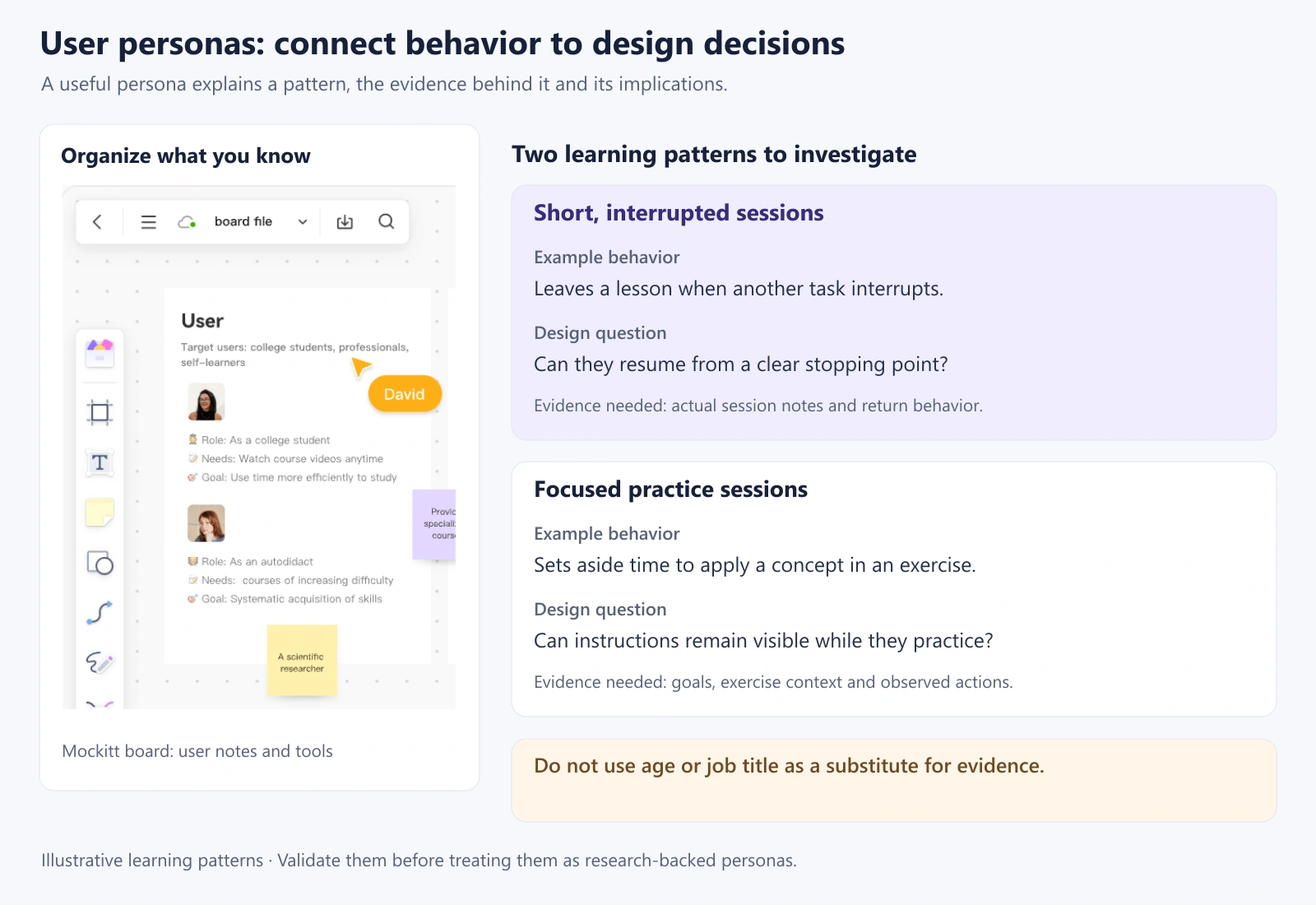
The same person could work in either mode on different days. Research should establish whether these are durable audience patterns, changing contexts, or both. Do not force everyone into one permanent box just because the template has space for a persona name.
Suppose the team proposes an automatic “continue” button. For the first pattern, test whether it returns to a sensible point after an interruption. For the second, test whether it skips unfinished practice. The profiles help reveal the conflict; observing people use the flow provides evidence about what to change.
Personas, journeys, and jobs answer different questions
A persona summarizes relevant patterns across people or contexts. A journey shows how an experience unfolds over time. An empathy map organizes what is said, done, thought, or felt in a bounded situation. Jobs to Be Done focuses on the progress someone wants to make under particular circumstances.
Choose the artifact that helps the decision. You do not need all four for every project. If the unresolved issue is a confusing step in a task, a short observation and an improved prototype may be more useful than creating another persona.
Keep personas connected to decisions and new evidence
Use the profile when choosing scenarios, recruiting for research, or reviewing competing design options. Record which characteristic influenced the decision. For the learning example, “make resumption clear after an interruption” is actionable; “design for Alex” is too vague.
Revisit profiles when the audience, product, or working circumstances change, or when new evidence repeatedly contradicts them. Keep the underlying research accessible to the team under the appropriate privacy controls. A persona is a compact aid to understanding users, not a substitute for continuing to learn from them.