
A UX research repository makes past research retrievable and usable for new decisions. It connects a finding with the study that produced it, the people and circumstances it applies to, and any limits on its use. Start with questions colleagues actually ask, organize a few valuable studies, and test whether someone can find and correctly interpret the evidence before migrating an entire archive.
The repository supports an ongoing UX research practice. It cannot make an uncertain finding stronger simply by storing it in a database. Its job is to help the next person understand what the team learned, what remains unknown, and whether that knowledge still fits the present decision.
Begin with the question people keep asking
Imagine a fictional coworking service that lets visitors book meeting rooms. A designer remembers an earlier study about arrival instructions but cannot find the report. Another team has a slide saying “Visitors need clearer directions.” Meanwhile, the service has introduced self-service access outside reception hours.
The useful retrieval question is not “Where are our research files?” It is: “What do we know about first-time visitors entering a booked room, and does that evidence apply when reception is closed?” That question defines what the repository must expose: audience, arrival context, date, finding, source, and unresolved conditions.
Collect a few real retrieval questions from designers, researchers, support staff, and product managers. Listen for the vocabulary they use. A designer may ask about “arrival,” while operations uses “site access.” Those words should help people reach the same relevant material without requiring them to remember an internal project name.
Choose a small initial collection that can answer those questions. A few complete studies with useful context are a better pilot than a large upload that leaves everyone opening unfamiliar files. Preserve the original archive while testing the new structure; migration should not quietly discard study materials or break existing references.
Keep the study and the finding connected
Nielsen Norman Group distinguishes document libraries from databases of individual findings in its research repository guide. Libraries are relatively simple to contribute to, while finding-level records can make specific evidence easier to discover and require more maintenance. A practical structure can connect both.
For the coworking example, create a study record for the original arrival research. Keep its full question, method, participant context, dates, report, and permitted source materials together. Add a finding record only when someone needs to retrieve a particular conclusion independently of the report.
| Record | What it answers | Illustrative content |
|---|---|---|
| Study | How was this evidence collected? | First-time visitors arriving during staffed hours; moderated task sessions; tested design version recorded |
| Finding | What did this study suggest? | Arrival instructions did not clearly distinguish the building entrance from the meeting-room location |
| Source reference | What supports the finding? | Permitted observation IDs and the relevant report section |
| Applicability note | When should this be used cautiously? | Study did not include visits after reception closed |
| Decision link | What changed or will be examined next? | Revised booking confirmation and a new question about self-service entry |
These entries are teaching examples, not customer research results. In a real repository, the underlying evidence must exist and be accessible to authorized colleagues. A finding that cannot be traced to its source should be marked as unverified until its provenance is recovered.
Do not split every sentence of a report into a separate card. A fragment such as “The door was confusing” loses the task, location, and reason it matters. Store a qualified finding that remains understandable on its own, then link to the details that a reader may need to inspect.
Use a compact record that preserves the limits
A finding record needs a clear claim, its source, its context, and its present status. The following example is deliberately small enough for a researcher to maintain after a study:
- Question: How do first-time visitors find their booked meeting room?
- Finding: In the studied staffed-hours journey, the confirmation did not distinguish entering the building from locating the room.
- Evidence: Links to the authorized observation records and report section.
- Applies to: First-time visitors, the studied locations, and the recorded design version.
- Does not establish: How people enter after reception closes, or whether revised instructions work.
- Owner and review trigger: The research owner; revisit when entry rules or confirmation content change.
- Current action: Review the arrival summary and plan research for self-service entry.
Use the original study’s actual dates and participant context. Do not turn an old finding into current evidence merely by updating a repository timestamp. A review date can record that someone assessed its applicability; it should remain separate from when the research happened.
When findings conflict, keep the difference visible. A later study with returning members may suggest that they ignore arrival instructions because they know the building. That does not automatically invalidate the earlier finding about first-time visitors. The two studies may describe different audiences and tasks.
Organize for retrieval, not for a perfect taxonomy
Begin with a small vocabulary tied to the questions people ask. For this collection, useful fields might include journey stage, audience, location, method, and current relevance. Tags such as “arrival” and “first visit” help retrieval; a dozen overlapping labels for clarity and confusion may not.
Keep the distinction between a tag and a conclusion. “Arrival” describes a topic. “Needs a new check” describes the record’s current applicability. “Visitors cannot enter” is a claim that needs evidence. Combining them into one label makes it harder to search and easier to overstate what the research found.
Give contributors a short explanation of each shared field and an example. Allow a question or proposed new term without immediately expanding the shared vocabulary. Review recurring proposals with the people who retrieve the research, then merge or rename terms when the change improves discovery.
Test the structure with a colleague who did not run the original study. Ask them to find evidence about after-hours entry, explain which audience it covers, and identify what remains unknown. Observe the route and interpretation. Finding a plausible title quickly is insufficient if they miss the staffed-hours limitation.
Make access and maintenance part of the structure
A broadly shared summary and a raw session recording need not have the same audience. Decide what colleagues may view, what requires restricted access, and who can grant it. Keep participant identifiers out of general discovery titles and summaries; use the study’s approved handling and retention process for sensitive material.
The NN/g guidance on participant-data privacy emphasizes planning storage, sharing, and deletion through the research lifecycle. In practice, a repository record should point to the approved source location rather than create unmanaged copies in several presentation decks and boards.
Assign a person or team to maintain each collection. Define what happens when a report moves, a source becomes unavailable, a finding is superseded, or permitted retention ends. Retiring a conclusion from current recommendations and deleting underlying participant data are different operations; follow the relevant process for each.
For the coworking collection, self-service entry is a clear review trigger. Mark the older finding as useful for the original staffed journey but insufficient for the new access model. Preserve the historical decision and add the new question. This helps the team reuse what still applies without pretending that the old study tested an unobserved situation.
Bring a qualified finding into the design discussion
Once the relevant evidence is found, connect it to a proposed response. If the finding still needs analysis, use a traceable research synthesis before treating it as a direction. A repository retrieves evidence; synthesis explains what that evidence can support. For related observations, map the evidence into tentative themes.
For the coworking example, prepare a booking summary in Mockitt’s UI design workspace with separate building-entry instructions, room location, and a help route. Put the evidence reference and open after-hours question beside the review task. Keep the actual research records in the approved repository.
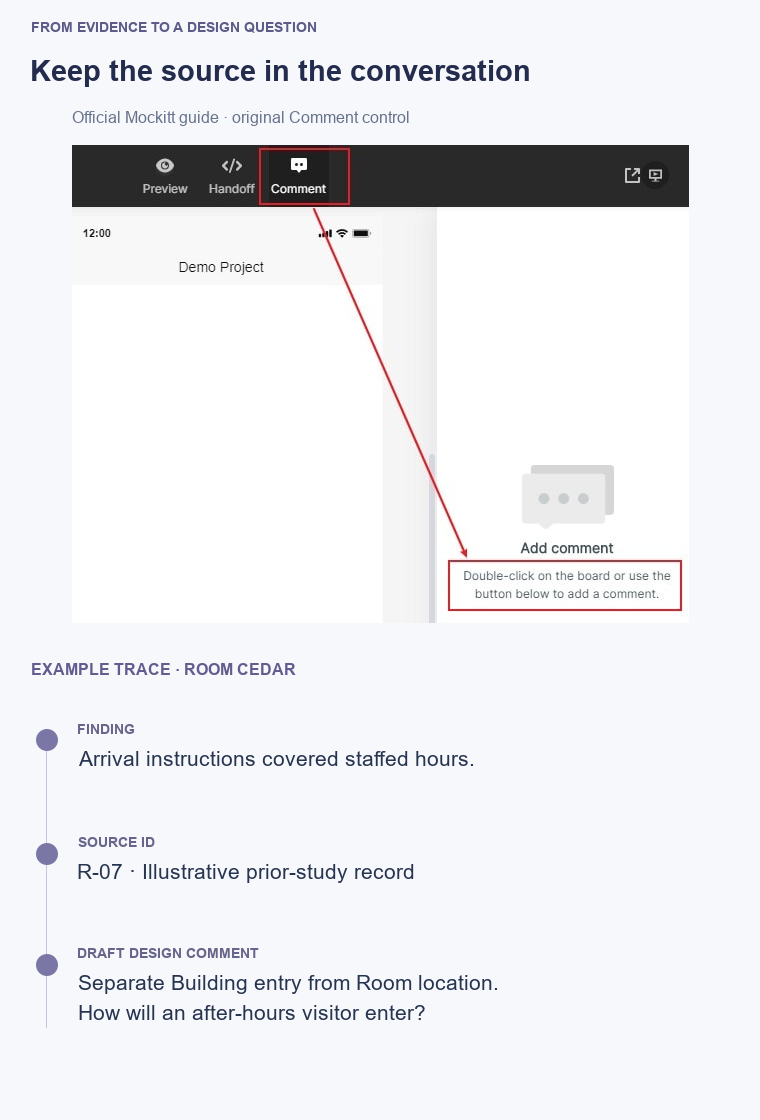
Ask reviewers a precise question: “Does this summary distinguish how to enter the building from how to find Room Cedar?” Keep another question open: what should someone see when reception is closed? The design can make those choices concrete, but its appearance is not evidence that visitors can use it successfully.
Record the tested design version after the next study and connect its findings back to the existing records. If the new evidence changes the conclusion, explain why. The result is a history someone can inspect, rather than a current-looking screen attached to a forgotten assertion.
Choose a home that your team can keep using
The repository may live in an existing knowledge base, a structured database, or a dedicated research platform. Choose according to retrieval, contribution, permission, export, and maintenance needs. A simple index can work for a small collection; a richer system becomes useful when its additional structure solves a demonstrated problem.
Before adopting a tool, try the complete lifecycle with sample material: add a study, retrieve a finding, follow its source, check access as a typical colleague, revise its applicability, and export the record. Check current terms and capabilities directly with the provider. A successful search demo alone does not show that the team can maintain the collection.
Keep Mockitt’s role specific: it helps people develop and review the design response. The repository preserves the research knowledge behind that response. When someone can find the relevant finding, explain its limits, and use it to frame the next decision, the collection is doing useful work.