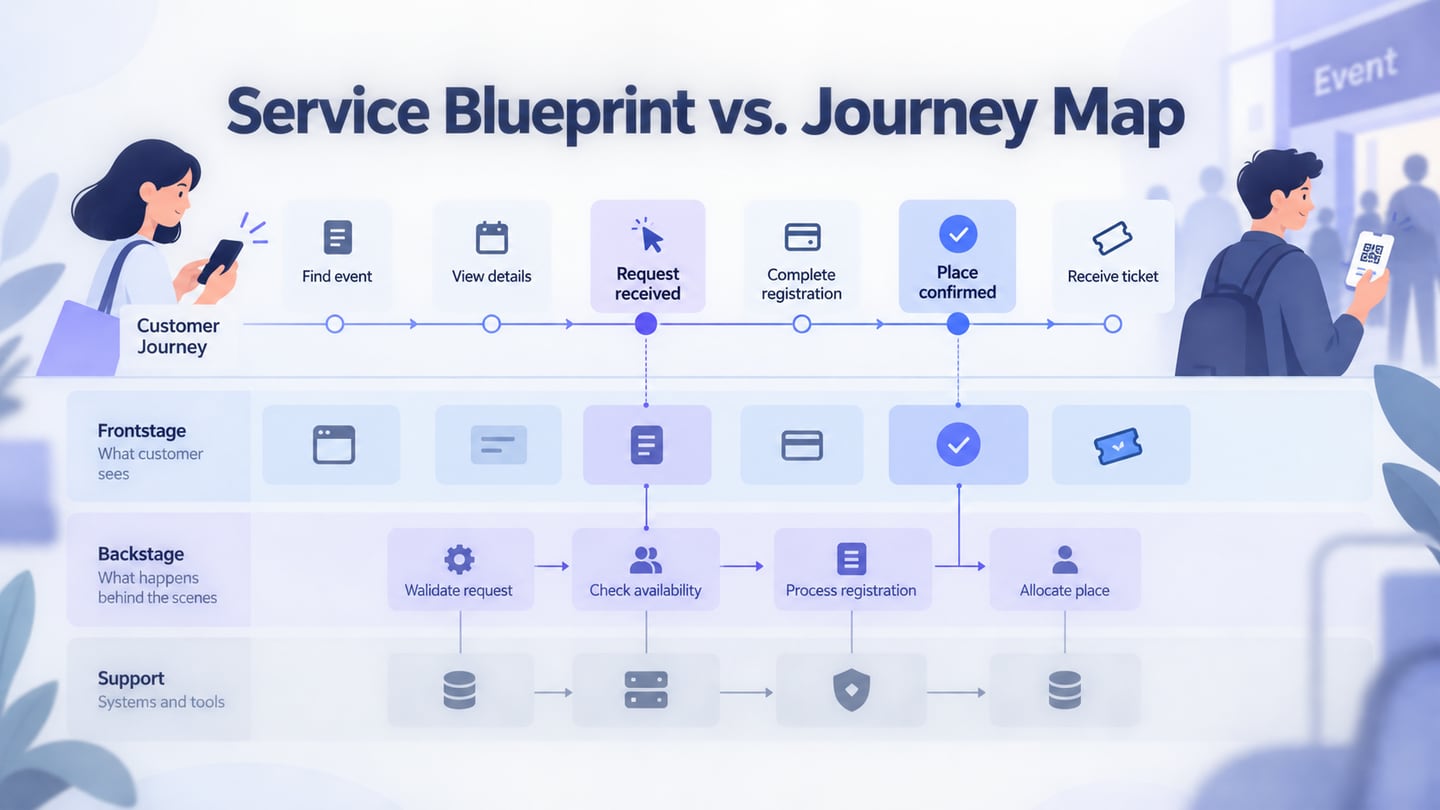
A customer journey map follows a person's experience across a goal. A service blueprint adds the people, systems, evidence, and processes that make that experience possible. Choose a journey map when the main question is what the person is trying to do and where the experience breaks. Choose a service blueprint when the answer depends on work that is visible to the person and work happening behind the scenes.
Use Mockitt Whiteboard to compare the two views with your team. Sticky notes, diagrams, and shared comments can keep the customer-facing steps beside the operational questions. The canvas is a place to make the relationship inspectable; it does not supply research findings or prove that a proposed process works.
This guide uses a fictional event-registration service. A visitor submits a request for a workshop. The service must distinguish a request received from a place confirmed, while staff check capacity and send a message. The example makes the choice visible without presenting a real organization, response time, or customer result.
Start with the question, not the diagram
Ask what you need to understand before choosing a format. If the question is “Where does a visitor hesitate before registering?”, begin with a journey map. If it is “Why can staff not confirm the place after the visitor submits the form?”, a blueprint is more useful because the explanation may include capacity rules, staff review, and the message channel.
| Use a journey map when you need to understand | Use a service blueprint when you need to understand |
|---|---|
| One person's goal, actions, expectations, and touchpoints. | How customer actions connect to frontstage, backstage, and support work. |
| Where the experience changes across stages or channels. | Which dependency, owner, policy, or handoff affects a visible moment. |
| What evidence supports a pain point or opportunity. | What the organization must coordinate to change the service safely. |
The distinction is not a requirement to maintain two separate artifacts forever. A journey map can supply the customer-action row of a blueprint. A blueprint can reveal an operational question that sends the team back to research the journey. Name the relationship so a later reader knows which view is current and which question it was built to answer.
Nielsen Norman Group's journey-mapping guidance describes the map as a visualization of a person moving through a goal. A service blueprint takes a business perspective and extends the journey with service components. Treat these as practical boundaries, not a reason to debate terminology when the team already has a useful shared language.
Map the same event in two views
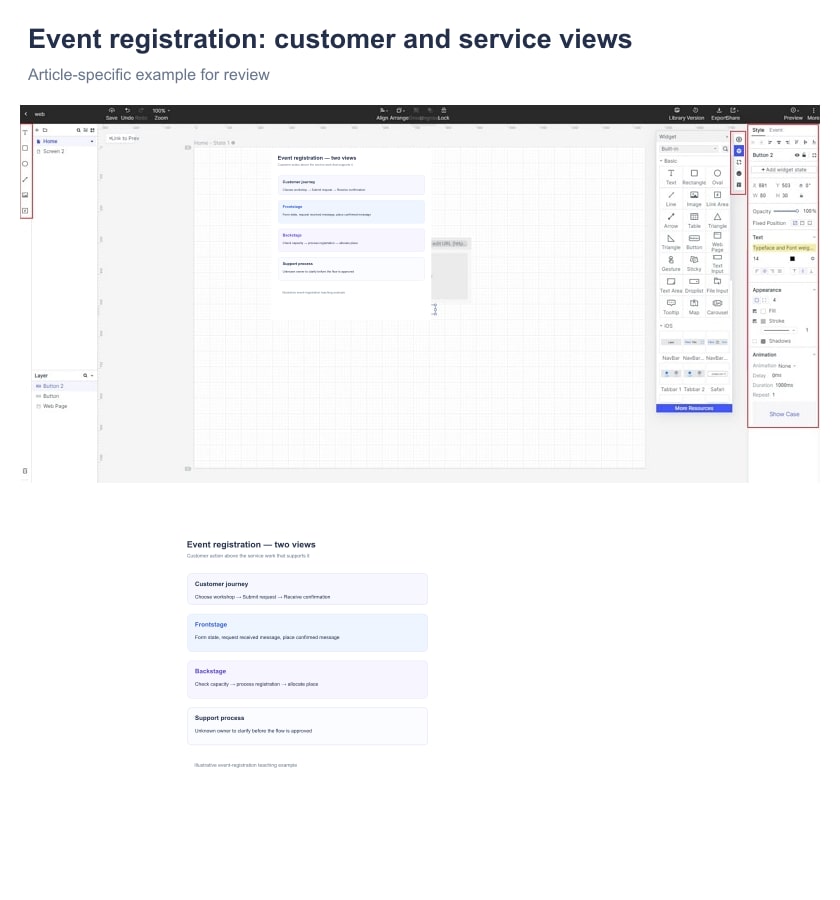
For the fictional event-registration service, the visitor searches for a suitable workshop, opens the registration form, submits their details, and waits for a confirmation. The journey view records what the visitor sees and needs to know. The blueprint view keeps that sequence but adds the work that determines the outcome.
| Event | Journey-map view | Blueprint question |
|---|---|---|
| Choose a workshop | The visitor compares date, topic, and accessibility information. | Who keeps capacity and schedule information current? |
| Submit a request | The visitor expects a clear acknowledgement and next step. | Where does the request enter the staff review queue? |
| Review capacity | The visitor cannot see this internal step but is waiting for a decision. | Which role checks availability, eligibility, or a duplicate request? |
| Confirm or decline | The visitor needs an unambiguous status and useful alternative if declined. | Which system and message owner publish the decision? |
The table is a planning example. It does not establish how any real event service works. Replace each row with evidence from the service you are studying, and mark unknown dependencies as questions. A neat row of invented backstage tasks is still an assumption.
What belongs in a journey map
Choose one actor, scenario, and goal. Then arrange the stages in time order. Typical rows include actions, thoughts or information needs, touchpoints, and opportunities. Include the channel when it changes the experience: a website, a confirmation email, a phone call, or a staffed location may each carry different constraints.
Keep the person's language close to the evidence. “I need to know whether my request is confirmed” is more useful than a generic “user frustration” label. If a statement comes from one interview or observation, keep its source reference and do not turn it into a population claim. A current-state map should not quietly mix a proposed future message with what people experience today.
Use a stage when it helps a decision. “Browse,” “Request,” “Wait,” and “Receive decision” may be enough for the event example. Add a branch for a declined request when the recovery path is part of the question. Do not add a new phase merely to make the map occupy more space.
What a service blueprint adds
A blueprint keeps the customer action at the top and places supporting layers beneath it. Frontstage actions are visible interactions, such as a registration confirmation or a staff member answering a question. Backstage actions support the experience without being visible, such as checking capacity or resolving a duplicate request. Support processes and systems explain dependencies that cross teams. Physical or digital evidence records what people encounter, such as a form, email, queue record, or event list.
Draw lines only when they clarify a relationship. A line of interaction can separate a visitor's action from a staff response. A line of visibility can separate what the visitor sees from backstage work. If the team does not agree what a line means, label it before adding more rows. A service blueprint is an operational conversation, not a decorative swimlane diagram.
The service-blueprint definition from Nielsen Norman Group describes relationships between people, props, and processes tied to touchpoints. It also distinguishes customer actions, frontstage actions, backstage actions, processes, lines, and evidence. Use those terms when they help the team identify a dependency; adapt the structure when the service has a different need.
Keep the blueprint's scope as narrow as the journey's. For the event example, the target is registration confirmation, not the entire events business. A capacity policy, staff review queue, or message template belongs in the view only when it affects the target moment or the decision that follows.
Build and review the blueprint with the right people
Bring in people who know the customer task and people who can explain the service behind it. A facilitator can keep the scenario narrow; a researcher can point to evidence; an operations owner can identify a real dependency; and a content or design partner can inspect what the visitor will understand.
Begin with the customer journey row and the evidence supporting each event. Add frontstage and backstage notes only when the group can name the source or owner. Mark a gap as “unknown” and assign a follow-up. Do not fill a blank lane with a plausible system name. That makes the blueprint appear complete while making the next investigation harder.
The service-blueprinting workshop guidance recommends preparing the scenario, research, roles, and agenda before asking people to map. During the workshop, allow independent note generation, then compare and refine the groups' views. Afterward, follow up on action items and improve the shared blueprint instead of treating the workshop artifact as final truth.
On the Whiteboard, use a concise note format: source, observation, and question or action. Keep sensitive records in their approved repository and use synthetic examples in a public or training document. Comments should resolve meaning or ownership; they should not turn an unresolved dependency into an unqualified promise.
Choose the next artifact from the gap
If the map shows that visitors cannot tell whether a request is confirmed, create a small prototype of the status states and review the wording. If staff disagree about the eligibility rule, document the rule and its owner before changing the interface. If the evidence is missing, plan the research needed to observe the event. The next artifact should answer the gap, not simply make the blueprint more polished.
A focused approval-workflow review can help when the registration decision has distinct requester, reviewer, and notification states. Keep that workflow page as an adjacent example; this comparison remains about choosing the map view and tracing the dependency that affects the service.
When a prototype is useful, connect only the states needed for the question: request received, review pending, place confirmed, and unable to confirm. A clickable demonstration can make a message and recovery path inspectable, but it cannot prove that the capacity system or notification service will execute the process.
Know when a blueprint is too much
A blueprint may add unnecessary overhead when the question is limited to the order of screens or the wording of one control. A user flow, wireframe, or short prototype review may be enough. Choose the smallest artifact that can answer the uncertainty, then expand it when a dependency crosses team or channel boundaries.
Similarly, do not turn every customer journey into an organization chart. If a backstage detail does not affect the target experience or a decision the team can change, leave it out or link to the operational record. The goal is a useful shared model, not a complete inventory of every department.
Keep the views aligned over time
Give the journey map and blueprint an owner, scenario, evidence date, and review trigger. When the registration rule, message channel, or staff process changes, update the affected row and note what evidence changed. Link the two views so a reader can move from a customer observation to the internal dependency without guessing which board is current.
Use the journey map to keep the person's goal visible and the blueprint to make service dependencies discussable. They work together when each answers a different question. If the team can say what the visitor needs, what the service must do, and what evidence is still missing, the map has earned its place in the next product decision.