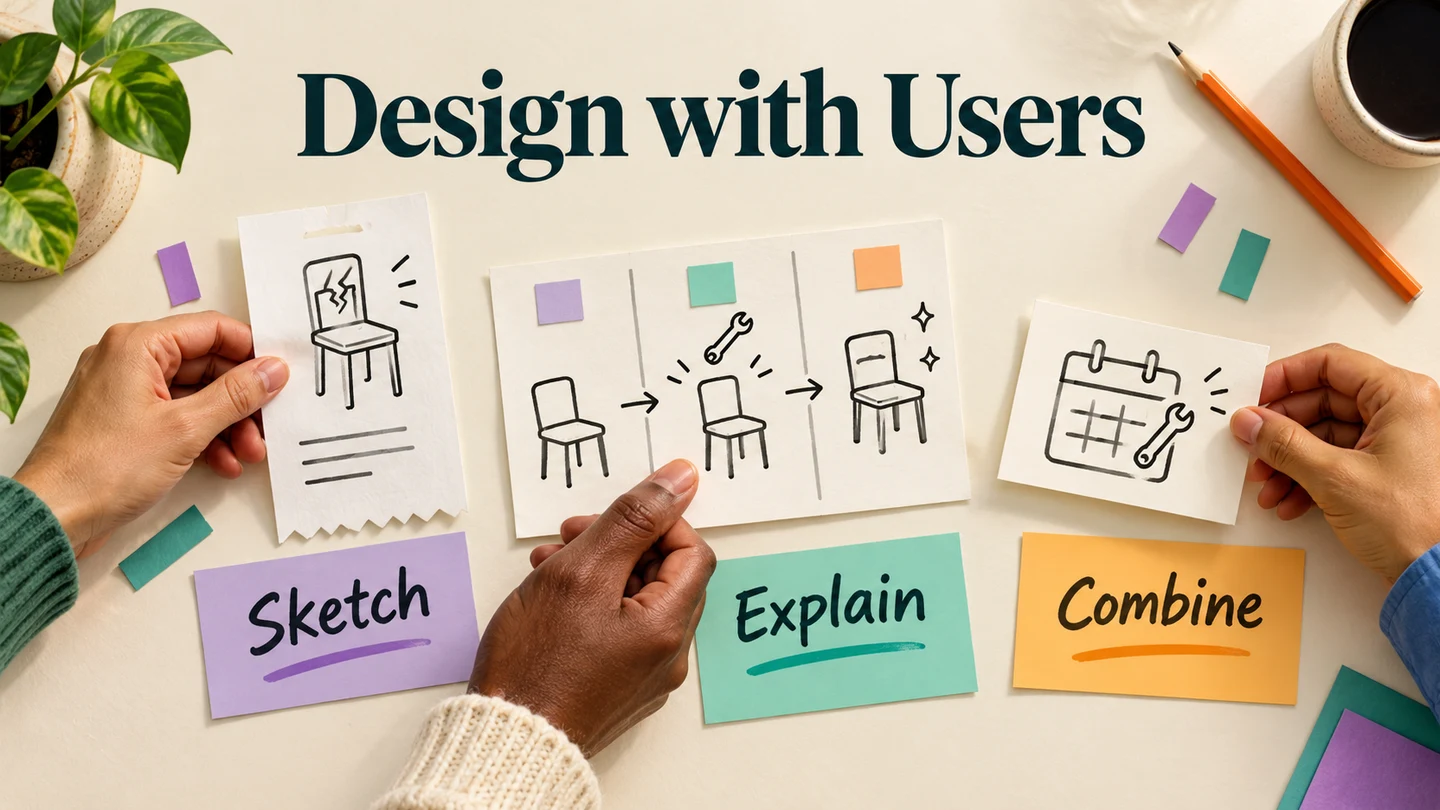
A participatory design workshop brings people affected by a product into the work of creating it. Participants make, arrange, or adapt possible solutions and explain why those choices matter. The team then carries that reasoning into design decisions and reports back. The useful outcome is a set of grounded alternatives, including differences that a single team-generated concept might hide. For the next planning step, use the dot voting workshop procedure guide.
For a remote or hybrid session, a shared Mockitt Whiteboard can hold sketches, notes, and connections in one place. Choose the materials around the participants: paper cards, spoken descriptions, or a facilitator handling the board may be more useful than asking everyone to learn a design application.
Decide what participants can actually influence
Consider a fictional community repair workshop. Volunteers repair household items in weekly sessions, and a coordinator hands unfinished jobs to the next shift. The team wants to improve that handover. Volunteers know the practical obstacles: a missing part, a half-finished repair, or uncertainty about whether it is appropriate to contact the owner.
The open question is: “What would the next volunteer need to know to continue a repair responsibly?” Participants can influence the information, its order, and the handover sequence. They cannot promise new opening hours or decide the organization’s data-sharing policy. Make these boundaries clear before inviting them.
Do not describe a workshop as co-design if all meaningful choices are already fixed. A session can still be useful as feedback or explanation, but that is a different agreement. Participants should know whether they are exploring a direction, adapting an existing proposal, or helping choose among feasible options.
IDEO.org’s co-creation method brings the people being designed for into making activities with the team. That is the central distinction here: invite contributions through artifacts and explanations, not only answers to interview questions.
Invite the right experiences, then make participation possible
For the repair handover, include volunteers with different levels of experience and a coordinator who understands the current process. A skilled repairer may know what “awaiting inspection” means; a new volunteer may need the next action spelled out. Neither person should be expected to speak for every volunteer.
Recruit for relevant experience, not enthusiasm for your product or confidence in a group discussion. Arrange compensation, timing, and access needs when inviting people. Tell them what they will make, what will be recorded, how their contribution will be used, and when they will hear about the outcome.
Prepare several ways to contribute. Someone might rearrange printed information cards, describe a sequence while the facilitator draws it, or type into a shared workspace. A participant who cannot draw should be able to explain an equally influential idea. If an online canvas is difficult to navigate with their setup, use another participation route and transfer the artifact with them.
Give each participant an uncluttered starting area. Supply a small set of blank cards and optional prompts such as “item,” “work completed,” and “next action.” Leave room for information the team has not anticipated. A ready-made form with every field filled in can quietly turn the exercise into approval of the team’s design.
Build the session around making and explanation
The following 100-minute sequence is an example for this bounded handover question, not a required duration. Adjust the pace and breaks with the group. If people need more time to understand the materials, reduce the number of ideas explored rather than rushing their explanations.
| Activity | Time | What should emerge |
|---|---|---|
| Welcome and decision boundaries | 10 minutes | Shared understanding of what can change |
| Describe a recent handover | 15 minutes | Relevant context and differences in experience |
| Make an individual handover proposal | 20 minutes | Several artifacts without a dominant first idea |
| Break | 10 minutes | Time away from the activity |
| Explain and try another person’s proposal | 25 minutes | Reasons, questions, and missing information |
| Revise and identify the next design question | 15 minutes | Promising directions with unresolved differences |
| Agree follow-up | 5 minutes | Who will share the next version and when |
Start with a recent experience: “Tell us about a repair that someone else needed to continue.” Avoid steering the account toward your proposed handover screen. Personal details about item owners are unnecessary for this exercise; use fictional job information in the artifacts.
Then give a making prompt: “Arrange what the next volunteer should see, and show what they would do first.” Let people work individually before discussing. Quiet preparation gives everyone an idea to contribute and makes it easier to distinguish independent priorities from ideas adopted during conversation.
Ask each person to explain their artifact. “Why did you put that first?” reveals more than “Do you like this layout?” If someone adds a “Call owner” card, ask what situation requires the call and what information would make it appropriate. The feature proposal may reveal an unresolved responsibility rather than a missing button.
Keep the alternatives and their reasons visible
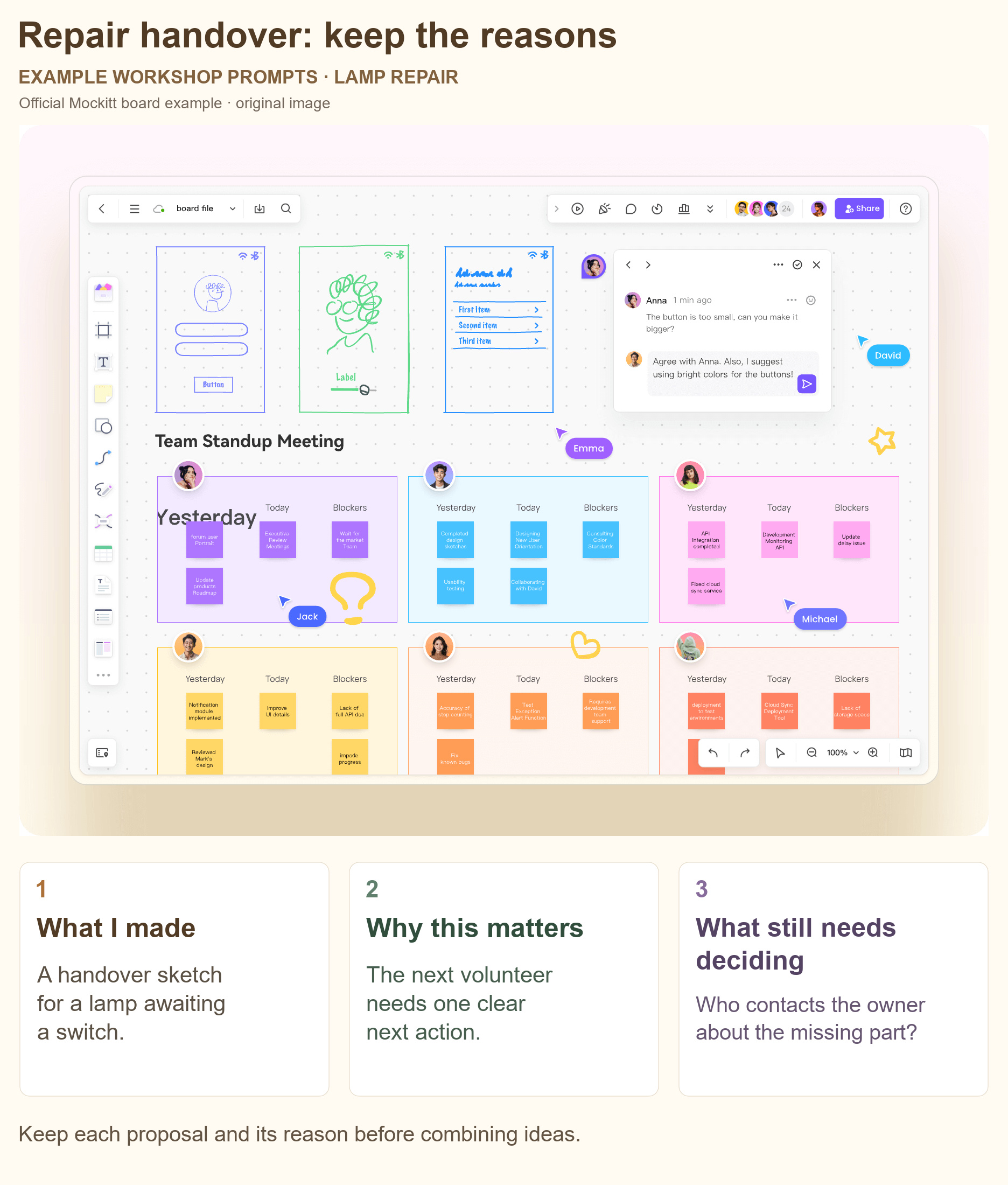
On the shared board, put each proposal beside its maker’s explanation. In the repair example, one participant might begin with the item’s current condition, while another begins with the next action and required skill. Preserve both arrangements before trying to combine them. These are possible workshop contributions, not findings from a completed study.
Use three small areas for each artifact: “What I made,” “Why this matters,” and “What still needs deciding.” A note such as “Show the last repair step” has little meaning without its reason: the next volunteer needs to avoid repeating work or undoing a temporary repair.
Have another participant use the proposal to explain what they would do with a fictional unfinished lamp repair. This is a conversation about the concept, not an independent usability test: the group has just discussed the design and may help each other interpret it. Record the questions and proposed changes without reporting a task-success rate.
If volunteers disagree, make the difference concrete. One wants a customer phone number on the handover; another wants contact to go through the coordinator. The useful output is the need for a contact route plus an unresolved access rule. A majority vote should not silently establish a permission policy.
Protect the reasoning from group pressure
The facilitator’s role is to help participants express and examine choices. Invite a quieter person to explain their artifact before asking the most senior team member to respond. Give criticism a specific object: the proposed sequence, missing information, or constraint, rather than the person who drew it.
Capture disagreement before seeking consensus. Similar-looking cards may hide different intentions; very different sketches may express the same need. Ask participants whether your summary represents their explanation accurately. If it does not, keep their correction.
Nielsen Norman Group’s guidance on including users in workshops highlights both the value of their contributions and the need to avoid treating every suggested feature as the final answer. Set expectations about implementation and preserve a balance of perspectives.
Make it safe to reject the team’s framing. A volunteer may say that no screen can fix a handover when the unfinished item has no physical label. That observation can redirect the concept toward a matched physical tag and digital record. Do not force it into the initial screen idea simply because the workshop uses a digital board.
Turn one useful direction into something people can inspect
After the session, preserve the original artifacts before refining them. For each direction, write the underlying need, the proposal, relevant constraints, and the next question. Separate a participant’s contribution from the team’s interpretation so later readers can understand how the design changed.
For the lamp repair, a proposed handover might show the item identifier, work completed, safe next step, required part, and a coordinator contact route. The open question is whether a new volunteer can recognize what they may do independently and when they need help. Keep the contact permission question assigned to its actual owner.
Use a Mockitt prototype of the proposed handover to make that sequence inspectable. The board preserves the ideas; the prototype represents the selected behavior. Include a job that is ready to continue and one that needs coordinator input so the distinction can be reviewed.
Evaluate the resulting flow separately with appropriate participants and tasks. People who helped create it can comment on whether their reasoning survived, while fresh participants may reveal problems that familiarity hides. Those are different questions and should remain distinct in the research record.
Show participants what happened to their contribution
Send the promised follow-up in an accessible form. Explain which ideas moved forward, what changed, and what could not be implemented. For example: “We kept the separate next-action section. Customer contact will go through the coordinator while the access rule is resolved.” Avoid a vague thank-you that leaves people unsure whether their work mattered.
A useful follow-up also invites correction: does the proposed handover still reflect the problem they were trying to solve? It need not promise that every preference becomes a feature. It should make the decision and the remaining uncertainty understandable.
If the team instead needs to align existing evidence and select its next experiment, use the product discovery workshop agenda. Participatory design earns its place when users can shape alternatives through their own experience and see how that contribution influences what is built next.