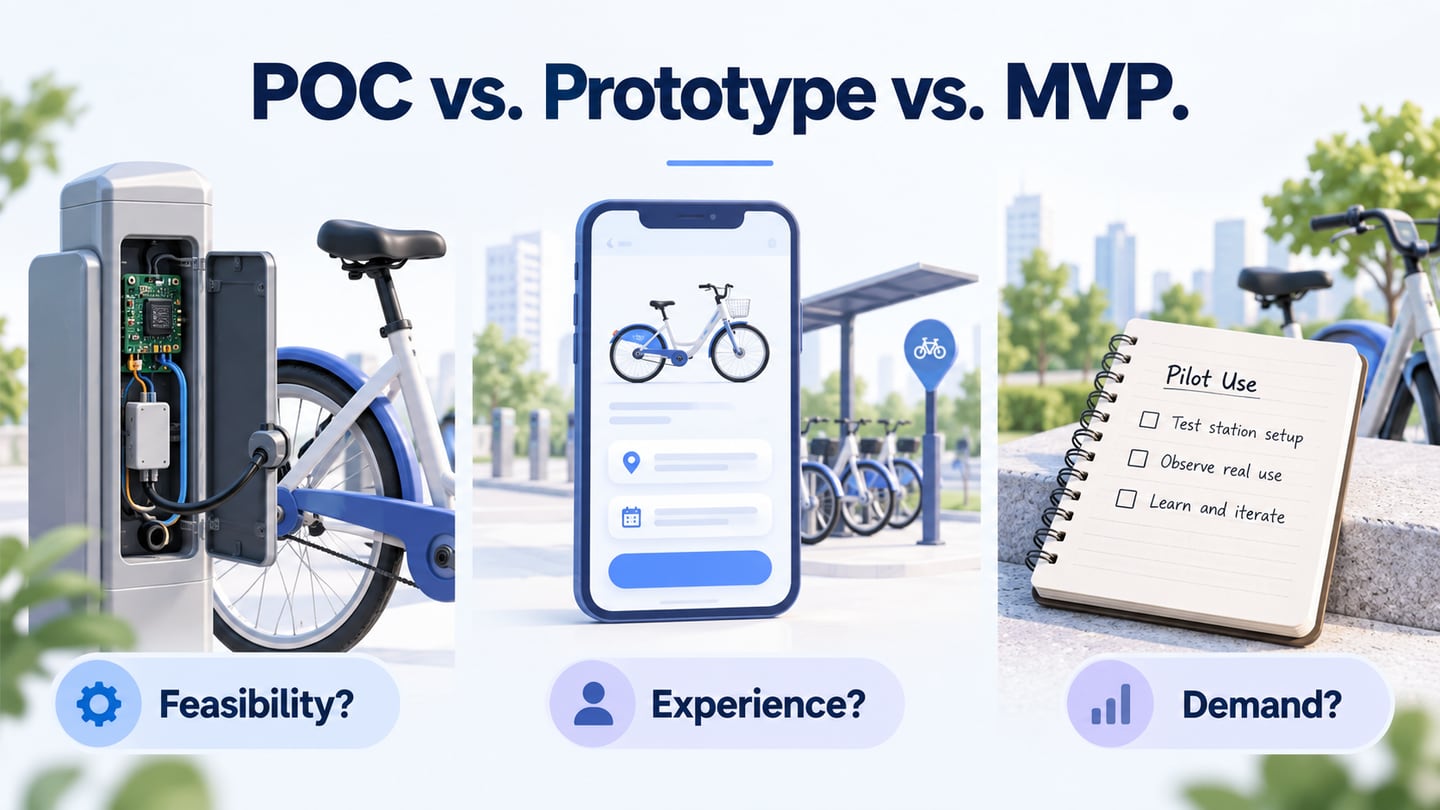
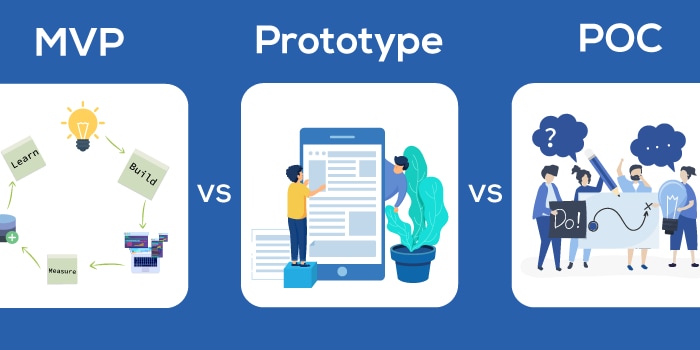
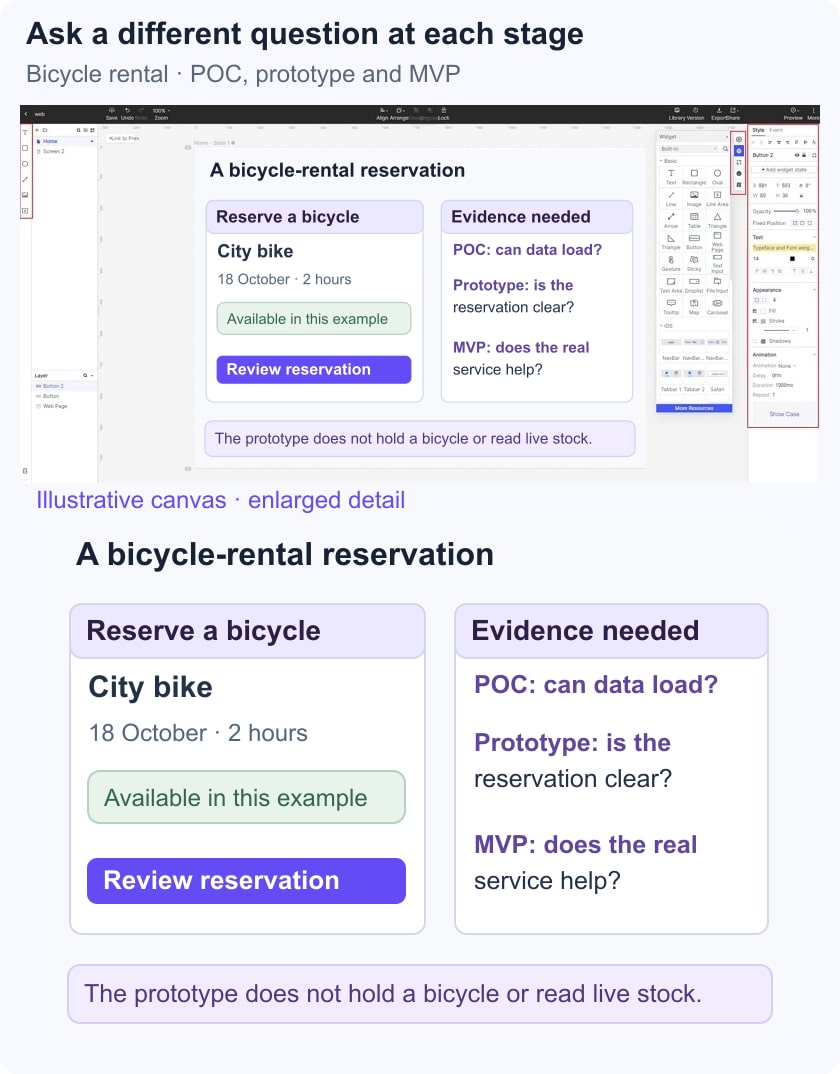
A proof of concept, prototype and minimum viable product investigate different uncertainties. A POC commonly asks whether a particular technical approach can work; a prototype explores a proposed experience or behavior; an MVP aims to produce useful learning from an early product or experiment with intended customers.
None guarantees success, funding or reduced cost. Choose the smallest responsible test that can inform the next decision, and define what result would make you continue, change direction or stop.
Use a fictional bicycle-rental service as a running example: can an availability source be integrated, can a rider understand a reservation, and will people actually use the service?
What Is POC?
A proof of concept investigates a defined feasibility question under stated conditions. For the rental example, a small technical experiment might check whether the proposed availability source returns usable station data. It would not prove that the whole service is scalable, secure or desirable.
Main POC features
- A POC can make a technical discussion more concrete, but it does not guarantee investor interest or funding.
- It can reveal constraints in a particular approach before broader development.
- Comparable experiments can help assess alternatives when they use the same requirements and conditions.
- Record the evidence, assumptions and limitations rather than treating a successful demonstration as proof of competitive advantage.
POC Use cases
- Use a POC when a technical uncertainty could change whether or how the service should be built.
- Use it to investigate an integration, algorithm or hardware dependency that cannot be answered by screen design alone.
- Use the result to identify remaining work and limits; do not infer production cost or capacity without appropriate evidence.
POC Audiences
Involve people who can judge the specific question. Depending on the experiment, they may include:
- Engineers and domain specialists who understand the integration or technical constraint.
- Product and delivery leads who need the result for a scope or sequencing decision.
- Relevant stakeholders who can assess the consequence of success or failure.
The output is a bounded finding, such as “the sample station identifiers can be matched,” with unresolved cases recorded. It is not a complete product assessment.
What is a Prototype?
A prototype represents a proposed task, screen or behavior so people can explore it. It may be paper-based, clickable or coded. It can be evaluated with intended users; “not a released service” does not mean “not for user research.”
For the rental example, show a station list, bike selection and reservation status. That can reveal whether a rider understands what is reserved, while leaving real inventory and payment unimplemented.
Main Prototype Features
- A prototype can expose confusing labels, missing information and incomplete routes.
- Observing relevant users attempt a task can inform a design decision, with the prototype’s limits taken into account.
- A concrete representation makes alternatives easier to discuss than an abstract feature description.
- Tools such as Mockitt can connect the states needed for the review. The useful comparison is what each version helps you learn, not how quickly it looks finished.
Prototype Use Cases
- Use a prototype when the uncertainty concerns a proposed task or interface.
- Include the relevant return, correction or failure route.
- Choose enough detail for the question without implying that simulated responses are real.
- Use it to gather evidence before committing to broader implementation.
Prototype Audiences
The audience depends on the question: intended users for task understanding, operational staff for service rules, and technical colleagues for implementation discussion. An investor demonstration is a separate purpose and should explain what is simulated.
Prototype Examples
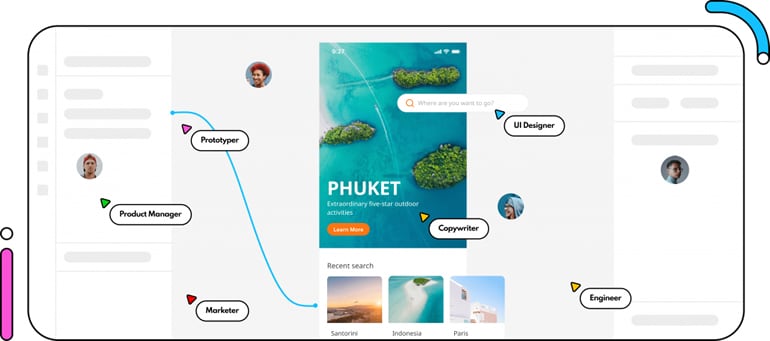
The retained collaboration illustration shows how different roles can discuss the same interface. It is an illustration of a design review, not evidence that a specific product or team achieved a measured result.
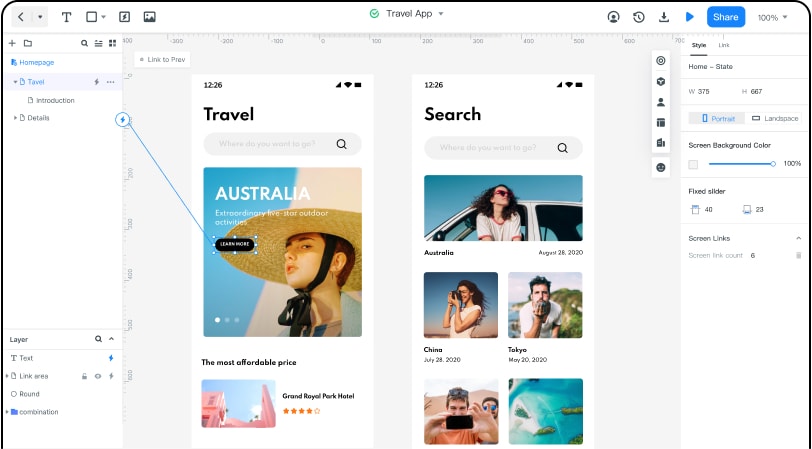
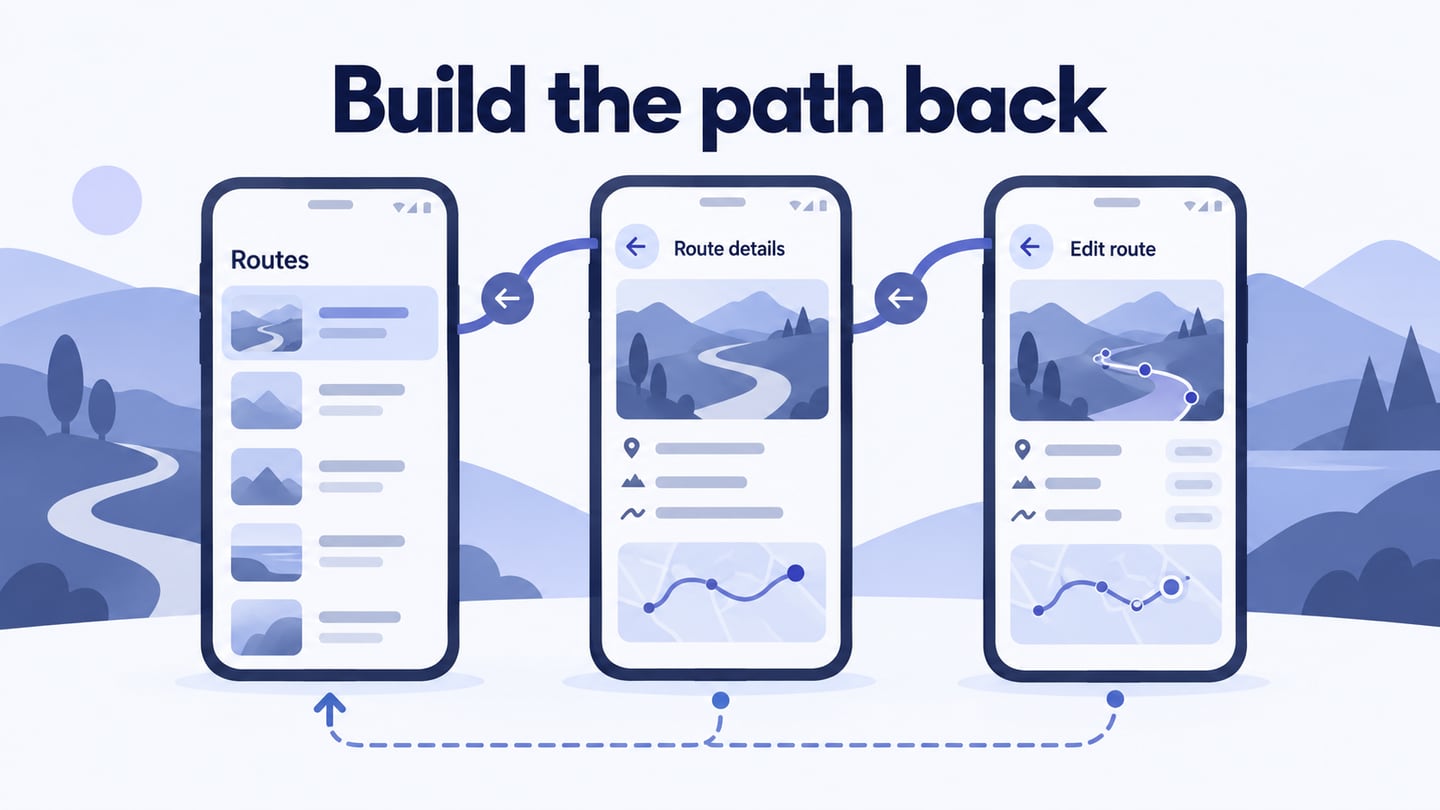
The archived travel-project screenshot shows connected screens in an editor. In the bicycle-rental example, use the same idea to connect Station list, Bike selected and Reservation unavailable. Ask what the rider believes has happened, without pretending that a real bicycle has been held.
What is MVP?
A minimum viable product focuses on learning about a product hypothesis with the least scope that can responsibly support that learning. The Lean Startup methodology emphasizes validated learning and an explicit feedback cycle. Teams use the term for different experiments; agree whether you mean a demand test or a functioning early service.
Main MVP Features
- Define the customer problem and hypothesis before deciding which features are “minimum.”
- Provide enough of the experience to make the intended learning meaningful; a broken or misleading service is not made acceptable by calling it an MVP.
- Specify the evidence you will collect and the decision it can support. Signups, completed usage and repeat usage answer different questions.
MVP Use Cases
For the rental service, a limited operating pilot might offer a small number of locations with a clearly explained reservation process and support. Evaluate whether people complete and return to the service, while documenting the operational work needed to fulfill each request.
MVP Audiences
An MVP or demand experiment involves the intended audience under clear expectations. It may be limited to a defined group; it does not have to be a public launch to everyone.
Demand Experiments and Their Limits
1. A Demonstration Is Not the Same as Product Usage
A video can explain a proposed workflow and help investigate interest in the idea. That evidence is narrower than observing someone complete the task in a functioning service.
If you use a demonstration, make its availability and simulated parts clear. Track what the response actually means, such as a request for more information, rather than calling every view a validated customer.
A demonstration cannot establish reliability, retention or willingness to keep paying. Those require evidence from an appropriate later experience.
2. Buffer’s Early Landing-Page Experiment
In its founder’s account, Buffer describes testing interest with a simple page and then adding a pricing-choice step before building its first functioning version. This is a concrete example of separating different questions rather than assuming one test settles them all.
A selected plan or submitted email is a signal of interest, not the same as a completed payment or continued use. Choose the next experiment according to the uncertainty that remains; do not copy another company’s timeline as a forecast for your own project.
Should You Choose a POC, Prototype or MVP?
Choose a POC when a technical constraint could invalidate the approach. For the rental service, that might be whether station identifiers and availability data can be integrated under the required conditions.
Choose a prototype when the question concerns the experience: can riders distinguish selecting a bicycle from confirming a reservation? Choose an MVP or defined demand experiment when you need evidence from the intended audience about the service’s value or use.
These activities are not a mandatory sequence. They may overlap or repeat as new uncertainty appears. A successful technical experiment does not remove the need to investigate the experience, and a popular concept does not prove feasibility.
Conclusion
Write down the next decision, the uncertainty preventing it, the smallest suitable test and the evidence it will produce. Keep feasibility, task understanding and demand evidence separate so one result is not stretched into three conclusions.
For the rental example, the next deliverable might be a data-integration finding, a reviewed reservation flow or an operating pilot record. Name it accurately, explain its limits and decide what must be learned next.
POC, prototype, or MVP? Use the same decision gate
Imagine a device-borrowing service. A POC answers whether the barcode, inventory lookup, and return event can work at all. A prototype answers whether a borrower can find a device, understand the deposit, and complete the handoff. An MVP answers whether a limited real service can operate with support, policy, telemetry, and a repeatable fulfilment process.
| Stage | Question | Evidence to collect | Exit signal |
|---|---|---|---|
| POC | Can the risky mechanism work? | Technical trace, sample data, failure cases | Risk is understood or ruled out |
| Prototype | Can people understand and complete the task? | Observed task path, comprehension issues, recovery points | Critical usability risks have an owner |
| MVP | Can the smallest real service deliver value? | Live operations, support load, retention or repeat use | Evidence supports a controlled rollout |
Do not call a clickable prototype an MVP simply because it looks finished. Name the decision, the evidence, and the condition that would stop the next investment.