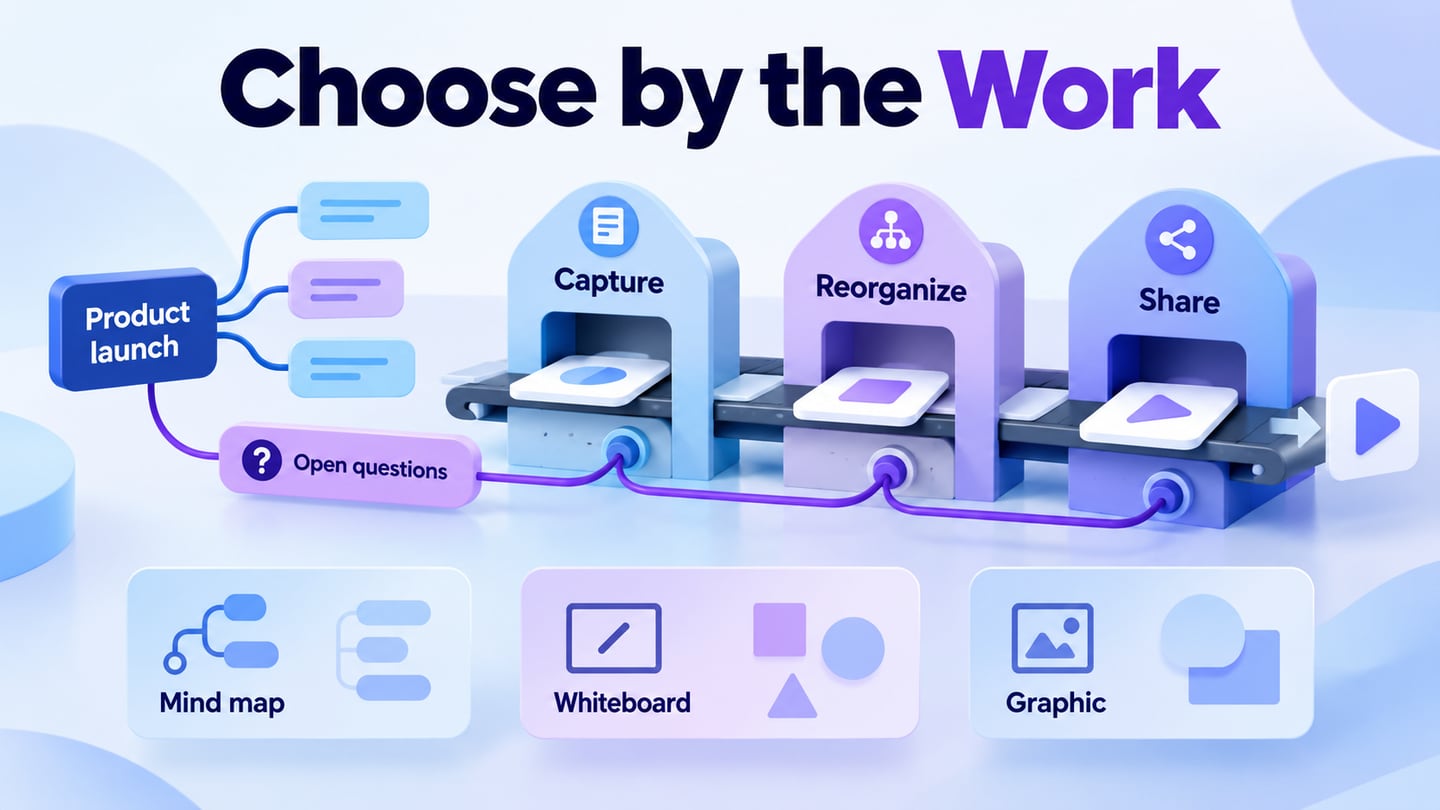
Choose a mind map when one central topic branches into a quick, readable hierarchy. Choose a concept map when you need to explain relationships among several concepts, including cross-links and labeled connections. The distinction matters because the two diagrams support different questions: a mind map expands ideas from a center, while a concept map explains how ideas relate. Mockitt’s mind-mapping workspace can support either structure when the review goal and connection types are explicit.
Definitions: center-out versus relationship-first
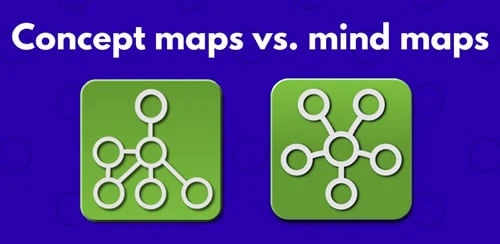
A mind map begins with one central topic. Major branches represent themes, and smaller branches add details. The layout encourages rapid recall, brainstorming, planning, and summarizing. Its hierarchy is usually visible from position and branch depth, even when the links are not labeled.
A concept map places concepts in a network. Lines can cross branches, and a linking phrase can explain the relationship: “causes,” “depends on,” “is an example of,” or “is measured by.” Concept maps are useful when a reader must understand a system, causal chain, taxonomy, or set of competing definitions rather than simply expand one idea.
Five practical differences
| Decision | Mind map | Concept map |
|---|---|---|
| Starting question | What ideas belong under this topic? | How do these concepts influence or explain one another? |
| Typical structure | One center with hierarchical branches. | Many nodes with cross-links and labeled relationships. |
| Best use | Brainstorming, notes, an agenda, or a personal plan. | Systems thinking, teaching, requirements, or causal analysis. |
| Reading pattern | Scan from the center to a branch and its details. | Follow a relationship and read the connecting phrase. |
| Failure mode | Too many branches make the hierarchy hard to scan. | Unlabeled lines make relationships ambiguous. |
Neither form is automatically better. A launch plan may begin as a mind map and later become a concept map when the team must explain dependencies between research, features, risks, and outcomes.
Choose the structure with a three-question test
- Is there one topic that everything else describes? If yes, start with a mind map.
- Do readers need to follow causes, evidence, ownership, or dependencies between separate concepts? If yes, use a concept map.
- Will a cross-link change the meaning? If yes, label the connection instead of relying on proximity.
Write the intended reader task above the canvas. “List possible onboarding improvements” points toward a mind map. “Explain why activation falls after verification and which evidence supports each cause” points toward a concept map. This sentence keeps the diagram from becoming a decorative collection of words.
Build a useful mind map
Put the topic in the center and name the first-level branches as distinct tasks or themes. Keep sibling branches at the same level when they answer the same kind of question. Add short keywords rather than paragraphs, then attach examples or evidence at the next level. If one branch grows much longer than the others, split the topic or create a linked detail map.
Review the map by asking someone to find one item without your explanation. If they cannot tell which branch owns it, rename the parent or move the item. Use color and icons as support, not as the only way to distinguish categories.
Build a defensible concept map
List the concepts first, then connect each relationship with a verb or phrase. Read every path as a sentence. “Verification” → “reduces” → “account recovery risk” is more useful than a line whose meaning depends on a legend. Use arrows only when direction matters, and add a legend when the map uses more than one relationship type.
Test the map with a “why” and “what if” question. A reader should be able to trace the evidence or dependency that answers it. Remove isolated nodes, duplicate concepts, and links that do not change the reader’s understanding.
Share the diagram with a review question
Before sharing, state the purpose, audience, and decision the diagram supports. Ask reviewers to check structure first, then labels, then visual polish. In a collaborative Mockitt file, keep the original question and revision notes near the map so a later editor can tell whether a change clarified a relationship or merely rearranged the layout.
The practical rule is simple: use a mind map to expand and organize one topic; use a concept map to explain a network of relationships. If the team needs both, keep the two views connected and preserve the question each view answers.