
As products gain features and reach different audiences, their usability needs continued attention. A task that seems straightforward to the team may be difficult for someone with different knowledge, equipment or working conditions. Usability engineering brings those conditions into requirements, design decisions and evaluation.
Usability concerns how well people can use a system to achieve their goals in a particular context. It is not simply repeated testing to keep software current. In human–computer interaction, usability testing provides evidence about how people perform tasks, while usability engineering connects that evidence with goals and design changes across the lifecycle.
Testing can reveal where a proposed or implemented design supports a task and where it causes difficulty. Usability engineering also includes understanding the intended users, defining criteria and following up on changes. It applies to products and services beyond software, although this article focuses on digital interfaces.
What Is Usability Engineering?
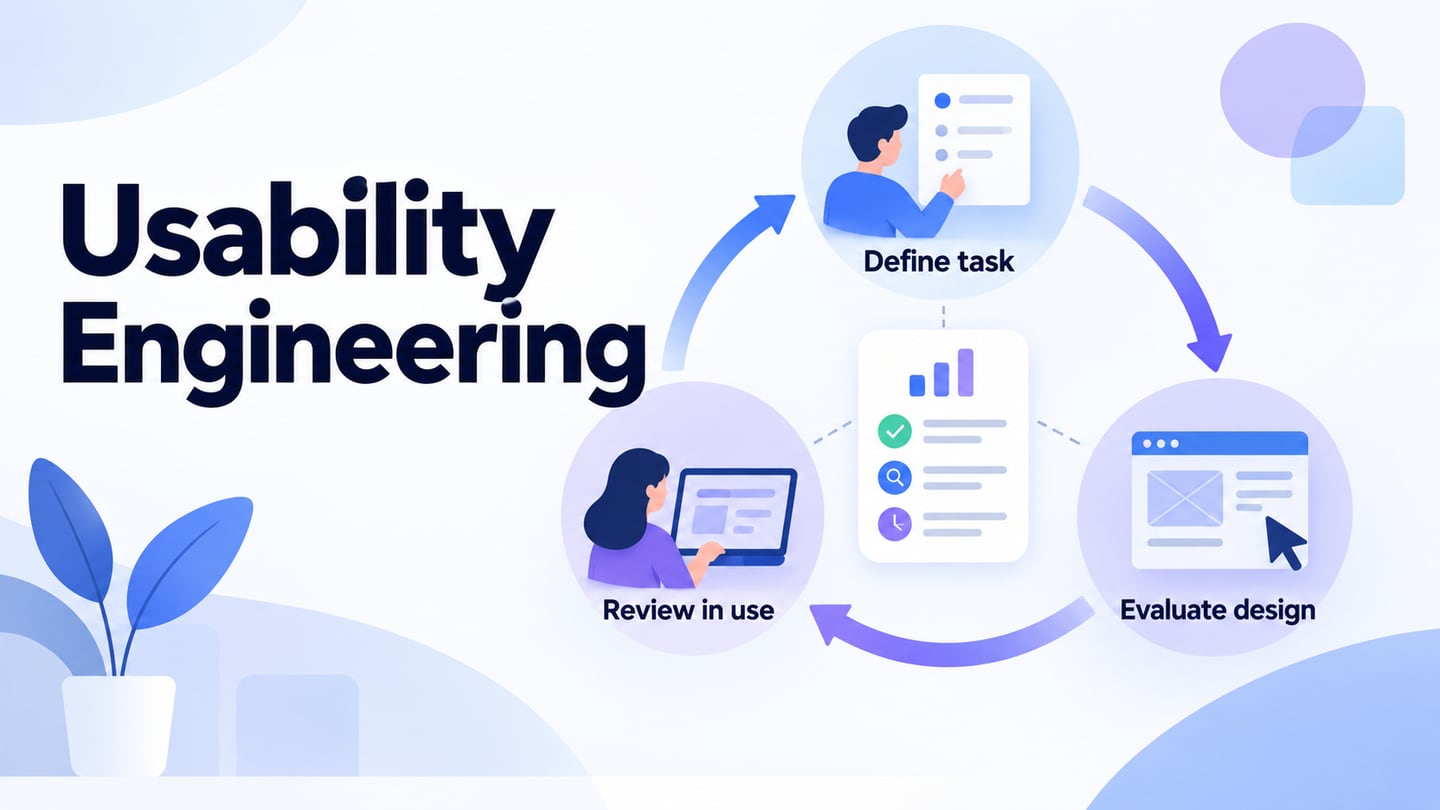
Usability engineering involves understanding user needs, setting relevant goals, designing and evaluating alternatives, and checking how the implemented product works in use. It is iterative: findings can change earlier assumptions and requirements. The public ISO 9241-11 overview describes usability as an outcome of use and provides definitions and concepts; it does not prescribe the three-stage process below.
The lifecycle can be organized into three broad stages for practical planning. These stages overlap and may repeat rather than form a one-way sequence:
- Requirements Analysis
Begin by identifying who will use the system, what they need to accomplish and the conditions in which the task takes place. Document relevant capabilities, constraints and existing problems. Define observable goals so the team can later judge whether the design supports the task, rather than relying only on whether the screen looks complete.
- Design, Testing, And Development
In design and development, make the important task states concrete and evaluate them before the implementation is difficult to change. Prototypes can expose missing information, confusing navigation or unsuccessful recovery. Record the problem, revise the relevant part and recheck it. A positive review of one prototype does not validate every function or context of the eventual product.
- Release and Feedback
Release is another evaluation point, not proof that the product is finished or universally usable. Test the implemented interactions and collect feedback from actual use. New content, devices, user groups or working conditions may expose problems that were absent from the prototype. Keep an owner for reviewing those findings and deciding what needs another iteration.
Usability goals should be stated in terms of the task and audience. The five considerations below offer useful review questions; they are not a complete certification checklist or a promise that one change will improve every measure:
- Effectiveness: can people achieve the intended goal accurately and completely? Define what counts as completion, including important mistakes or omissions.
- Efficiency: what time, effort or other resources are used to achieve the result? A shorter time is not useful if the person completes the wrong task.
- Satisfaction: how do people experience the task, including comfort and confidence? Ask about the actual interaction and distinguish reported preference from observed performance.
- Error tolerance and recovery: which mistakes occur, how serious are they and can people recover? Preventing an irreversible error may matter more than reducing a harmless extra tap.
- Learnability: can first-time users understand the task, and can returning users regain familiarity? Observe those groups rather than assuming a simple-looking screen is easy to learn.
These considerations interact. NN/g’s usability introduction also distinguishes usability from utility: a system must offer the needed function as well as make it usable. High satisfaction alone cannot show that someone completed a task accurately.
An Everyday Example of Usability Engineering
Everyday websites provide useful tasks to examine. Searching for an item, comparing options and confirming an order involve both information and interaction. A usability review should specify one such task and examine the states required to complete it, rather than describe an entire well-known website as automatically usable.
Amazon is an example of a retail website where product search, categories and product details can be studied. Ask how a shopper identifies the required product and checks relevant information before proceeding. Treat the site as an example to investigate, not as proof of perfect usability across mobile, tablet and desktop contexts.
Availability and performance matter, but they are distinct from a claim that the interface is efficient. This article does not provide uptime measurements or comparative usability results for Amazon. To evaluate a shopping flow, observe the task on the relevant device and record confusion, mistakes and successful recovery.
People arrive with expectations about what a service will help them do. Make those expectations explicit and examine whether the flow supports them. A familiar brand name or polished appearance cannot replace that evaluation.
For a smaller illustrative task, ask a reader to find the conference paper “Designing Clear Search Results,” confirm its 2025 publication year and identify the PDF download action. In a reviewable prototype, show the search result and paper details together with the relevant states. The success criteria are example planning decisions; no participant outcome is claimed.
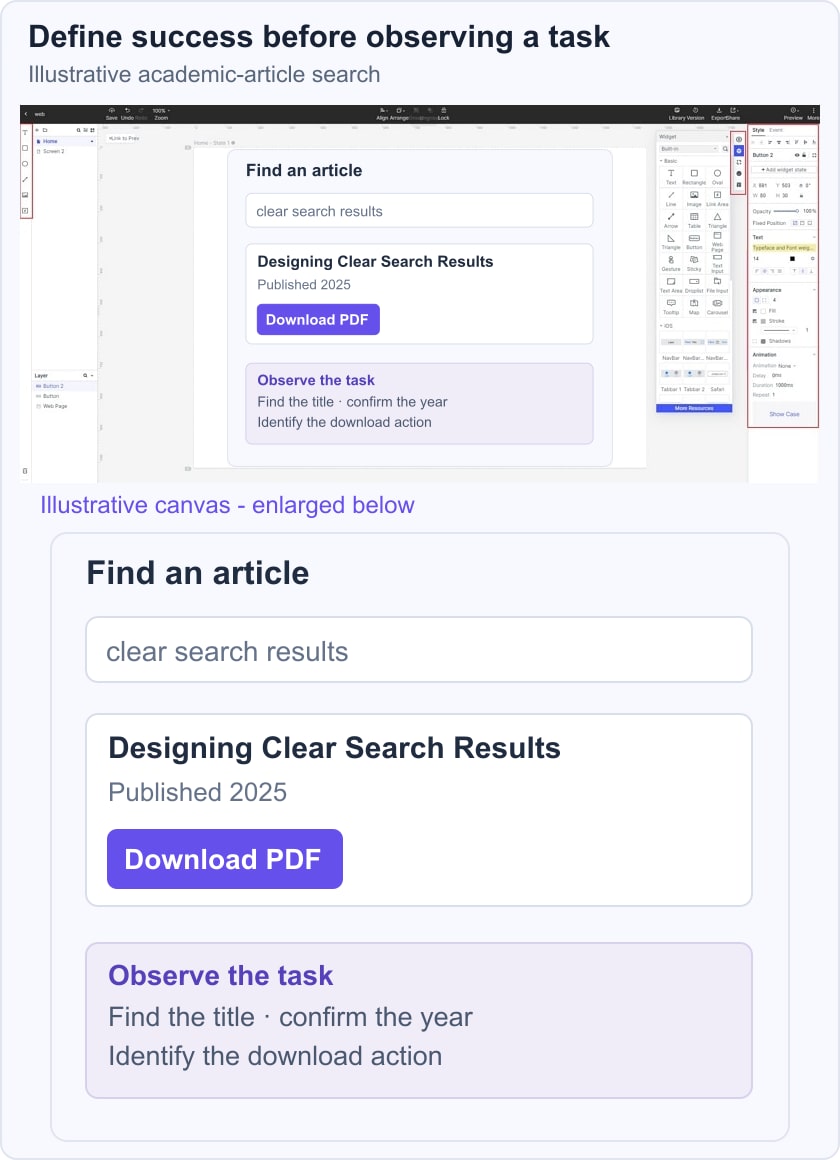
Record completion accuracy separately from time or assistance. If someone selects a similarly named paper, a fast result is still an incorrect result. A prototype usability test plan can make the task, observation method and follow-up decision explicit.

Original illustration source: Mindgyd
Common Uses for Usability Engineering
Usability engineering contributes to human–computer interaction by connecting knowledge about people with specific system decisions. Useful aims include:
- Understand how people, tasks and context affect the use of technology.
- Develop methods for evaluating whether a system meets its users’ needs.
- Support effective, efficient and safe interaction, and use findings to improve the design.
- Put people first and focus on their needs and expectations.
A usability engineer or a team sharing that responsibility can help define tasks, review design alternatives and evaluate changes. Responsibilities vary by organization. Common applications include:
- Reviewing an existing project and identifying changes supported by user evidence.
- Defining observable task goals before choosing a design solution.
- Evaluating whether a learning or game interface supports the intended activity.
- Checking mobile and web interactions across relevant devices, inputs and contexts.
The Relationship Between Usability Engineering and UX
Usability engineering and UX work overlap, but job titles and responsibilities are not interchangeable in every organization. Usability focuses on how people achieve goals with a system in context. UX also considers the broader experience before, during and after use, including expectations and perceptions.
Together, these perspectives can help the team examine functionality, effectiveness, efficiency and experience. Practical concerns include:
- Designing interactions that reduce unnecessary waiting.
- Ensuring a user-centric design that is based on the user’s needs.
- Designing a system that can manage errors smoothly.
- Offering an intuitive and easy-to-follow navigation system.
- Streamlining the complete process of operating the software or system.
Conclusion
Improving usability begins with a specific task and evidence about the people performing it. Set clear goals, inspect alternatives and evaluate the implemented result. Keep the original problem and observations available so future changes do not erase the reasoning behind a decision.
Usability engineering does not guarantee market leadership or eliminate every problem. Its value is a repeatable way to connect user needs, design choices and evaluation throughout the product lifecycle. Revisit the work when the task, audience or context changes.