Part 1: Introduction
A UX design interview gives both sides a chance to understand how the candidate approaches problems, works with others, and explains decisions. The ten questions below are preparation prompts, not a guaranteed interview script. Prepare examples from your own work, describe your contribution, and distinguish what you observed from what you only proposed. A reviewable prototype can help explain a decision when it is relevant to the case; it does not replace evidence of your reasoning.

Part 2: Ten UX Design Interview Questions
For each question, prepare a short answer and a concrete artifact you can discuss if asked for more detail. Nielsen Norman Group’s interview guidance describes structured ways to connect context, action, and outcome. Use a structure to clarify your own experience, not to memorize a fictional success story.
- What is the value of UX design?
Explain how understanding users can reduce uncertainty about a product decision. Connect the answer to the role: for example, clearer navigation may help people complete an important task, while research can expose a problem before implementation.
Support any outcome with evidence from the project. Instead of quoting a universal return-on-investment number, explain the problem, the change you helped make, and what was actually measured. If the design was not evaluated, say what you would check next.
- What is the difference between UX and other design disciplines?
Show that you understand the relationship between disciplines without treating their boundaries as fixed in every organization.
UX concerns the experience of completing a task across the product or service. UI design focuses on the interface people interact with, including its layout, controls, and visual language. Research, content design, interaction design, and engineering may contribute to the same experience. Explain how you collaborated with those roles on a real project.
- Describe your design process and what methods you follow.
Describe a process you actually used: understand the problem, learn about the users and constraints, explore options, represent a solution, and evaluate it. Explain why you chose the methods and where you changed course. A process is more credible when you can connect each activity to a decision than when you recite a standard sequence.
Journey maps, storyboards, user flows, and site maps can help organize what you learn and the screens a task requires. Low- and high-fidelity prototypes serve different review needs. Describe one method you used, what it revealed, and why another method would have been less appropriate. The UX workflow guide can help you organize those relationships without suggesting that every project needs every deliverable.
- Tell us about your most (or least) successful UX design project?
Choose a project you can explain honestly. Begin with the task and your role, then show a decision and its outcome or limitation. For an e-commerce landing-page example, distinguish a proposed sign-up flow from a measured change in conversion. Explain which fields were necessary and why. If a project was unsuccessful, describe what you learned and what you would do differently rather than hiding the result.
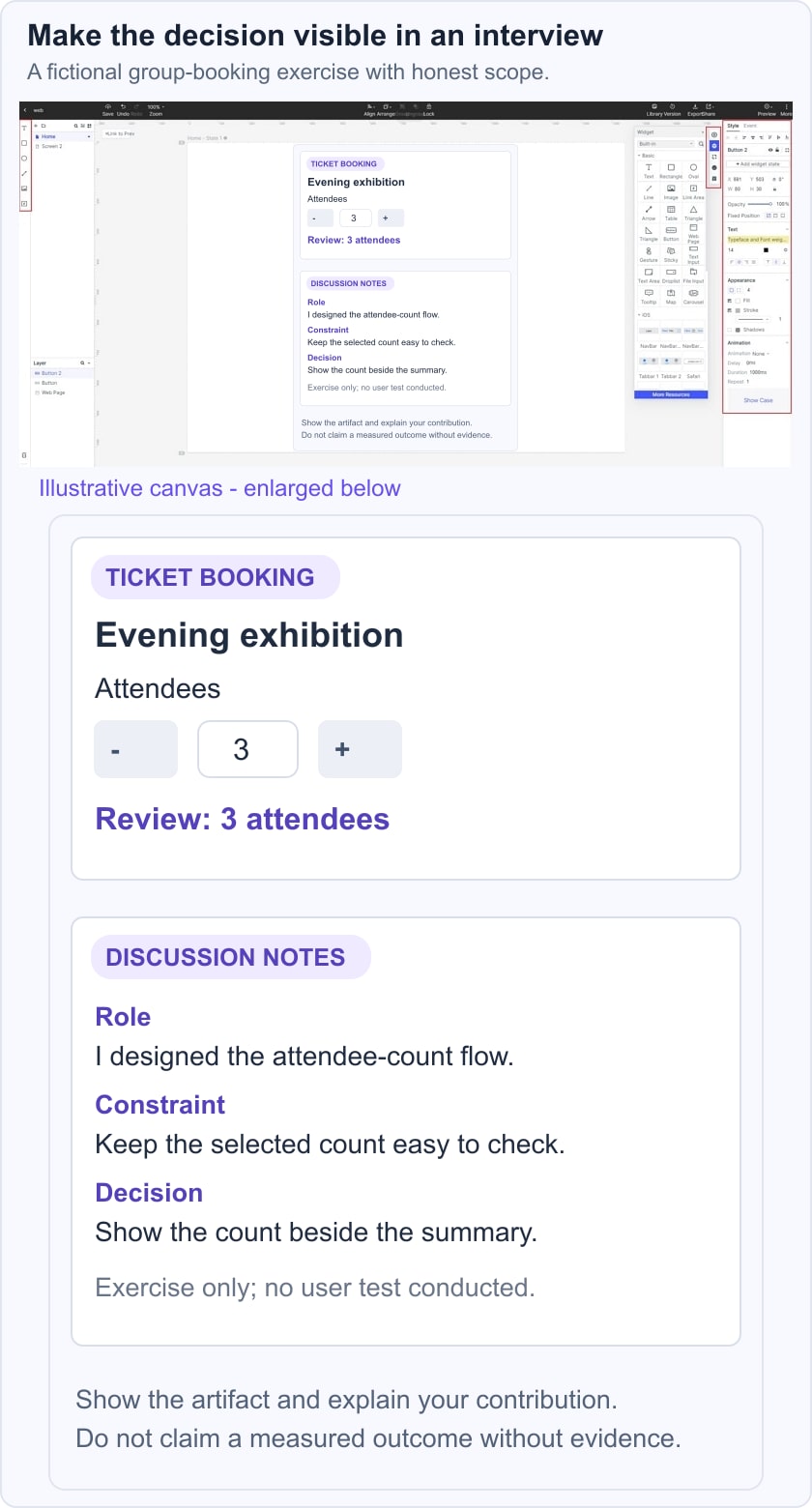
For an illustrative event-ticket case, you might show a group-booking field and explain: “My task was to make the attendee count visible before review. I kept it beside the ticket summary because the small-screen layout had limited space. This was a design exercise and has not been tested with users.” Replace that example with your own work; do not present it as professional experience.
- Describe a recent challenging project. How did you approach it?
Choose a specific constraint, such as incomplete evidence, an inherited interface, a tight deadline, or disagreement about priorities. Explain what you controlled, who you involved, and what tradeoff remained.
Redesigning an existing page is one possible example. Before changing it, inspect the task, existing behavior, technical constraints, and available evidence. Explain how you decided what to preserve and what to change. Technical knowledge can help, but asking the right questions and working with the implementation team are also part of the response.
- Please provide some examples of your experience dealing with user research and usability testing?
Name the research question, the participants or data source, the method, and your contribution. Discuss limitations such as a small sample, recruitment constraints, or a task that did not reflect realistic use.
For usability testing, describe a task participants attempted, what you observed, and how the findings affected a decision. An interview about opinions and an observation of task performance provide different evidence. Do not say that a survey or a one-to-one conversation proved usability without explaining what it measured.
- How would you improve the UX of our product?
Pause to clarify the target audience, business goal, and constraints. It is reasonable to say that an outside review cannot reveal every cause of a problem.
Choose one task you explored in the company’s product. Describe an observation, offer a tentative explanation, and propose a way to investigate it. For example, a difficult-to-find filter could motivate a discoverability question. Avoid presenting an untested redesign as an established improvement or assuming the existing team overlooked an obvious solution.
- When a client says: "I don't like this design." What do you do?
Show how you make feedback specific enough to act on while staying open to a different perspective.
Ask what feels wrong, which audience or task it affects, and what outcome the stakeholder expects. Compare the concern with agreed goals, constraints, and available evidence. A disagreement may arise from different priorities or missing context; it is not always a misunderstanding that another visual revision will solve.
Summarize the concern and agree on a next step: investigate a claim, compare alternatives, or revise a specific element. Explain how you would record the decision and revisit it. Satisfying a stakeholder does not by itself demonstrate that the design works for users.
- Who are your design heroes? What are your favorite apps for UX? Explain why.
Choose an influence or product you have genuinely studied. The useful part of the answer is the design principle you learned and how it affects your work, not whether the name is fashionable.
If you discuss someone such as Don Norman or Bill Buxton, refer to a specific idea or piece of work you can explain. Avoid relying on remembered job titles or a list of names. A thoughtful account of one influence is stronger than several unsupported biographical claims.
For a favorite app, describe one task and a particular interaction that helps it. Mention a limitation or tradeoff as well. For example, explain how a visible selection or a clear recovery path affects the task rather than declaring the entire app “good UX.”
- What do you think will be the next big thing in UX design?
Discuss a development you have investigated and why it matters for users. Be clear about what is available today and what is only a possibility.
AI-assisted interfaces, voice interaction, and spatial experiences can all raise design questions, but none is a universal next step for every product. Choose one relevant to the company and discuss a concrete issue such as error recovery, user control, accessibility, or trust. Explain what evidence would change your view.
Part 3: Conclusion
Prepare a few honest cases that can support several questions, then practice explaining them clearly. Keep your UX designer cover letter and portfolio consistent with those examples. At the end of the conversation, the questions you ask a UX employer can help you understand how the team researches, makes decisions, and supports growth.