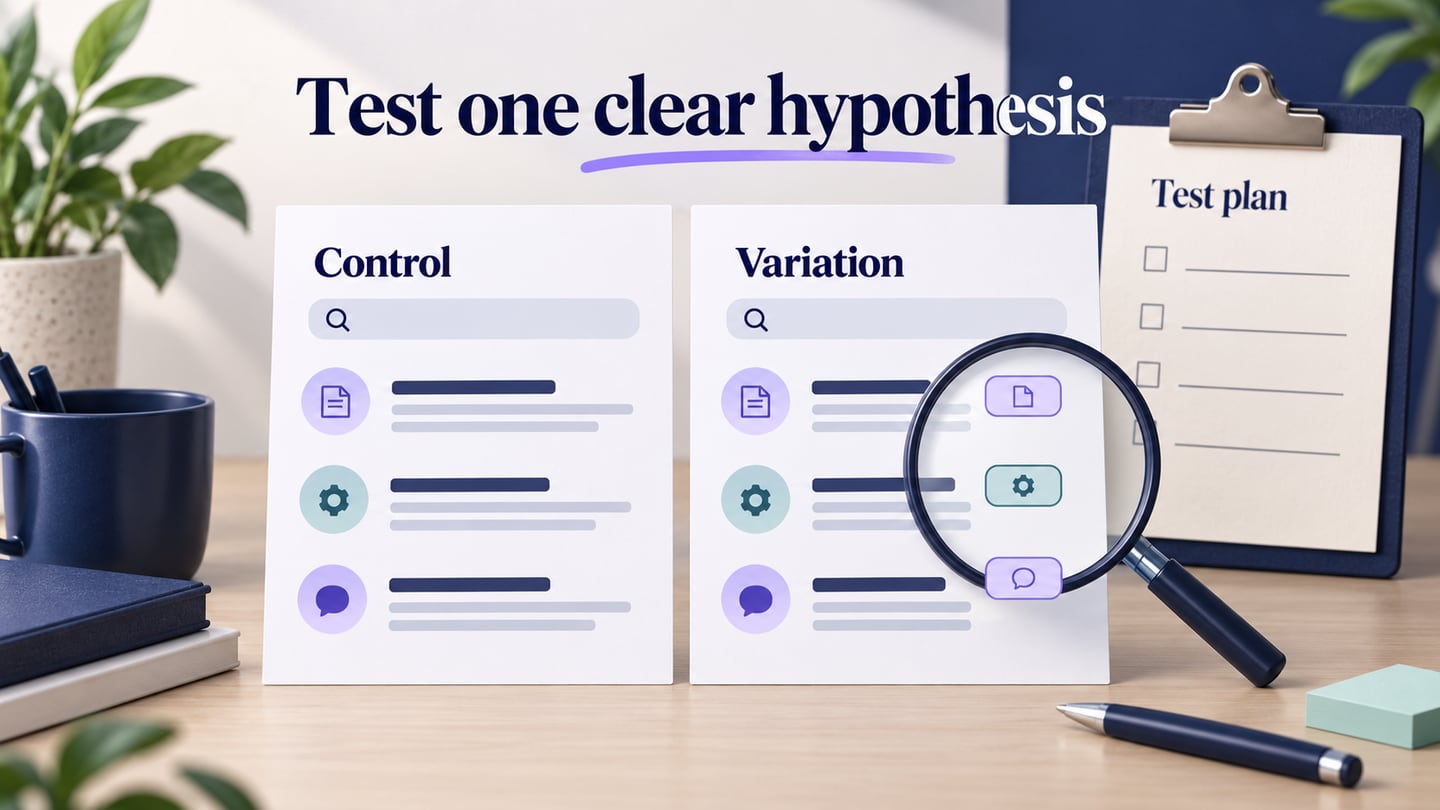
A/B testing compares versions of a live experience to investigate a specific hypothesis. Designers help define the change, its intended effect and the risks to watch. A valid experiment also needs reliable implementation, measurement and analysis; it is not simply a vote between two screens. To compare visual appeal before implementation, use a design preference study.
What Is A/B Testing in UX and UI Design?
In an A/B test, eligible users are assigned to a control or a variation so the team can compare a predefined outcome. A test with additional variants is also possible, but it requires an appropriate design and enough data. A/B testing in UX can provide evidence about an implemented change; it does not ensure a positive result or explain every reason behind the behavior.
The variation might change a label, a layout or a larger part of the experience. Keep the hypothesis specific. For example: adding category labels to help-center results may help people find the relevant article. Use a planned allocation, consistent exposure and verified events; a 50/50 split is common, but it is not a requirement for every experiment. Decide the sample, duration and decision method before interpreting an apparent difference.
Define the hypothesis and eligible audience
Write down the proposed explanation before designing the variation: “People searching the help center may struggle to distinguish billing articles from setup articles; category labels could help them choose a relevant result.” Include only the traffic for which this question applies. If the labels appear on the search-results page, someone who never reaches that page should not be counted as exposed to the change. Specify whether assignment happens per user, account or session, and keep it consistent with the task and analysis.
Choose the outcome and protect the experience
Define the primary event precisely, such as opening a relevant cancellation article after a cancellation-related search. The definition should explain which searches and articles qualify and how repeat events are handled. An article click does not prove resolution, so consider a later helpfulness response or a return to the same query as additional evidence. Decide which guardrails matter, including errors or slower result rendering, before launching the test. Avoid declaring success after searching through many unrelated metrics for a favorable difference.
Check implementation before collecting evidence
Verify both versions at the supported screen sizes and with keyboard navigation. Confirm that the assigned version persists as intended and that exposure is recorded when the variant is actually shown. Test event names, duplicate events and excluded internal traffic. The two groups should have access to the same underlying search results unless a ranking change is deliberately part of the hypothesis. Save the experiment configuration so a later reviewer can tell what was tested rather than infer it from a screenshot.
Interpret the result within its limits
Use the analysis method selected for the experiment and follow its stopping rules. A conventional fixed-duration test and a platform designed for sequential analysis do not have interchangeable rules. Review data-quality checks before the outcome, and distinguish the estimated size of a difference from the uncertainty around it. An inconclusive result may justify a different hypothesis or more research; it does not justify repeatedly extending the test until a preferred variation appears to win. Record the audience, dates, configuration and decision so the finding is not generalized beyond the experience actually tested.
What A/B Testing Can Help You Learn
The benefits below depend on the quality of the experiment. Random assignment does not repair broken tracking, unequal exposure or a poorly chosen metric.
Receive clear evidence
Compare the proportion of eligible users who complete the defined action, not just raw totals when groups differ in size. Check assignment and event quality before treating an observed difference as evidence. A result can be inconclusive, and an absence of statistical evidence is not proof that two designs are identical.
Allow testing of new ideas
An experiment can test a new idea after it is implemented for the intended audience. A design prototype is useful for reviewing the idea first, but sending two prototype links to a few colleagues is not the same as a randomized live test.
Assist you to optimize a step at a time
A focused change is often easier to interpret than several unrelated changes at once. If the help-center variation adds category labels and also changes the ranking algorithm, a result cannot isolate the contribution of the labels. A larger redesign can be tested as a whole, but the conclusion must match that scope.
Help in answering certain design questions
Choose a question linked to a user task. “Do category labels help people open a relevant support article?” is more informative than assuming that a red or green button is universally better. Pair the primary outcome with guardrails such as failed searches, timeouts or repeated returns to the result list.
Measures real behaviors
A live test records behavior in the implemented experience. Respect the product’s privacy and consent requirements, and document who is eligible. Differences between device types, new and returning users, or exposure periods can affect interpretation; the data is not automatically accurate merely because it was collected in production.
Weigh the cost of the experiment
Experimentation has implementation, analytics, maintenance and opportunity costs. A low-traffic product may not be able to detect a useful difference within a reasonable period. In that situation, interviews or a focused usability study may answer the immediate design question more effectively than a small, underpowered A/B test. For two draft interfaces, use comparative prototype testing with a planned presentation order.
Evaluate content against the task
A test can compare the behavior associated with different content, but clicks alone do not establish that the content is useful or accurate. In a help center, opening an article is only an intermediate signal; consider whether the person can resolve the issue and whether the metric can actually capture that outcome.
Help create user centered design
A/B testing complements user-centered design rather than replacing it. Use research to understand the problem and qualitative work to investigate why people struggle. Then use an experiment when you have a specific implemented change, enough eligible traffic and a reliable way to evaluate it. Do not select a “winner” simply because one dashboard number is larger during an early check.
A/B Testing Tools and a Discontinued Option
The following tools have different implementation models and commercial terms. Verify platform support, data handling, experiment analysis and developer effort before choosing one. A design editor and an experimentation platform serve different purposes.
1. Google Optimize: discontinued
Google Optimize and Optimize 360 were discontinued on September 30, 2023. Google’s sunset notice confirms that they are no longer available for new experiments. Do not build a new testing process around the discontinued service.
2. Optimizely
Optimizely Web Experimentation provides a process for configuring variations, audiences and experiment goals. Confirm the intended web or feature-experimentation product and its integration requirements. A visual editor can assist some changes, while complex behavior still needs engineering review and quality assurance.
3. Apptimize
Apptimize’s documentation covers experiments and feature management across supported platforms. For a mobile application, check the current SDK, framework support and release requirements before assuming that any implementation can be tested without code changes. Do not infer profitability from the availability of an experimentation tool.
4. AB Tasty
AB Tasty’s former homepage now points to Wingify, where the company states that AB Tasty and VWO have united. Review the current product and commercial terms for an intended implementation rather than following an older setup guide uncritically. “Affordable” and “perfect for beginners” depend on the organization’s budget, traffic and technical resources rather than being objective tool properties.
5. Adobe Target
Adobe Target A/B activities compare experiences for a defined audience and goal. Its broader personalization capabilities should not be confused with a simple fixed-allocation test. Understand the selected activity type, reporting setup and decision rules before comparing results.
Design the variants before running the experiment
Use Mockitt to make the design hypothesis concrete before engineering the live experiment. For a help-center search experiment, place the control and variation side by side in the prototype. Keep the query, article titles and ranking the same; add category labels only to the variation. Review whether the proposed labels are understandable and identify the event you would need to measure after implementation.
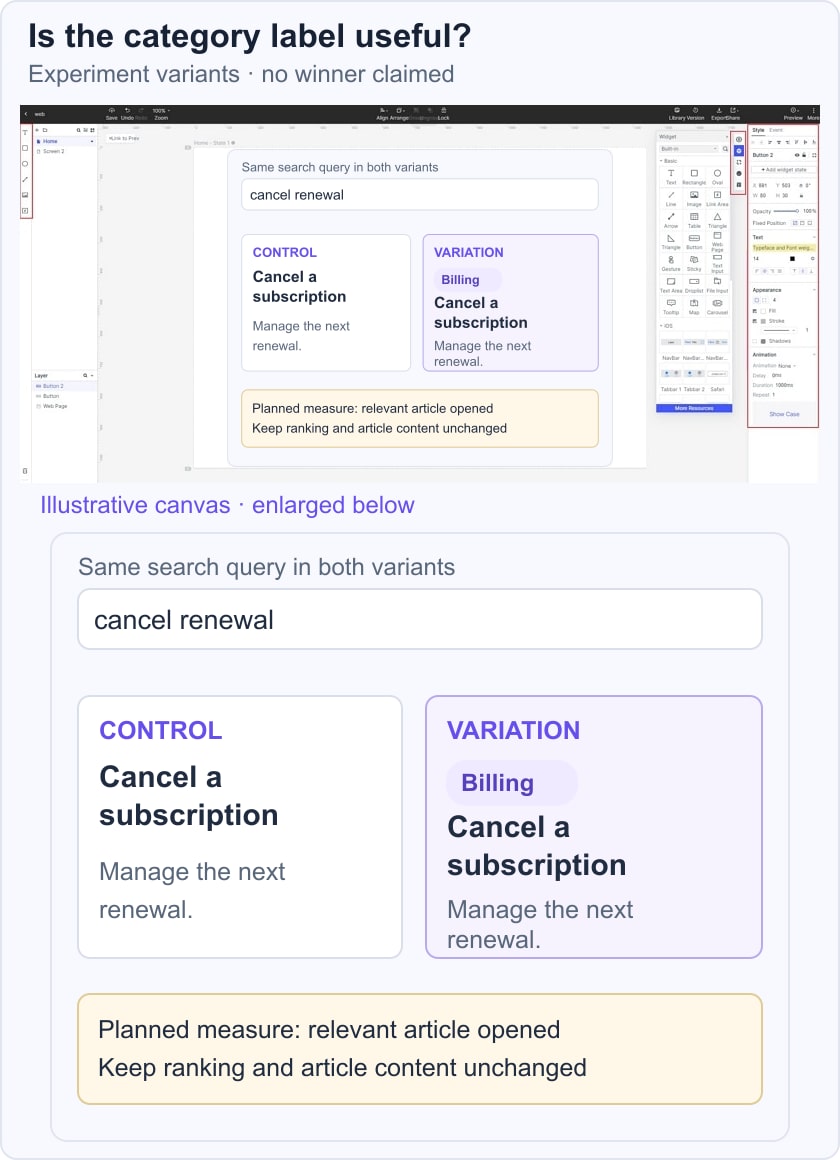
Preview the interactions and share the design for review, including loading, empty and error states. Mark the prototype as a design example, not an A/B testing engine or a record of experiment results. Before launch, the implementation team still needs to verify assignment, exposure tracking, accessibility, performance and the events used in the analysis.