What is product management? What's the product management career path? I believe you might have a lot of questions related to product manager. Product management is an organizational function that governs every stage of the product life cycle, from development to positioning and pricing, based on the interests of the product and the customer. To create the best possible product, product managers represent the client's interests in the organization and ensure that the market situation is fully considered.
By focusing on the customer, design teams create products with better designs and increased productivity. In the era of technology, when mature products are quickly replaced by new, more perfect solutions, it is more important than ever to be able to subtly feel the needs of the client and create solutions specifically for him. This is the task of product management.
- Part 1: Product manager roles and responsibilities
- Part 2: The Product Manager Career Path
- Part 3: Useful wireframe tool for the product manager
Product manager roles and responsibilities
A product manager helps a team decide which user problems to solve and which outcomes to pursue. Responsibilities can include research, prioritization, product strategy and measuring results. Pricing, marketing and delivery decisions are usually shared with other functions; the exact remit depends on the organization.
The task of the Product Manager is to manage a product or a product group across departments and to successfully position it on the market. The product manager has a strategic responsibility. He creates marketing concepts, positions the product on the market, and looks after it across all life cycles. The tasks of a product manager, therefore, range from planning to marketing to the decommissioning of products. Careful market analysis and extensive knowledge of the needs of customers and competing products are also part of the job of a product manager. The tasks of a product manager are often of a coordinative or organizational nature. Therefore, the product manager must be creative.

Source: Unsplash
In summary, we can say that product managers are usually entrusted with five major areas of responsibility:
- Support for product development
- Preparation and implementation of the market launch
- Ongoing product support (marketing plans, operational implementation)
- Market observation (trends, competition)
- Product controlling (evaluations, budgeting)
The Product Manager Career Path
Product management and project management are different career tracks. The Project Management Institute’s 2017–2027 talent-gap report describes project-oriented roles; its US job-growth figures should not be used as evidence of demand for product managers. For a concrete product-career example, the UK Government Digital and Data framework describes associate, product manager, senior, lead and head-of-product roles, with responsibility increasing across those levels.
Source: Pexels
Product Manager Career
One common path moves from an associate or junior role to product manager, senior product manager and a product leadership role. Job titles and promotion criteria vary: some organizations also offer lead or principal roles, and not every experienced product manager becomes a people manager. Compare the scope of decisions and products, not titles alone.
Entry-level Product Manager
As an Entry-Level Product Manager, you should have many skills. As an Entry-level product manager, you should have a solid understanding of the dos related to the following:
- Market research
- Product feature validation
- Feature prioritization
- Road map planning
- Conflict resolution
- Pricing and revenue modeling
If you want to be a product manager, you should have a strategical and analytical approach when you make decisions. You'll also need good communication skills because you'll need to relay ideas and collaborate with development teams, marketing, and sales teams, engineers, and stakeholders. You'll need to communicate strategic plans to executive stakeholders and keep those stakeholders informed. Additionally, you'll need to be able to coordinate and prioritize different tasks.

Source: Pexels
Junior Product Manager
A junior or associate product manager may own a feature or a small product area with support from a more experienced colleague. Research, prioritization and learning to measure outcomes are useful parts of that work; the role is not necessarily limited to administrative assistance.
Entry requirements differ by employer. Check the actual job description for required qualifications, domain knowledge and experience. Evidence that you can understand a user problem, explain a trade-off and work with a team is more useful than assuming every role requires a particular apprenticeship or marketing qualification.
Senior Product Manager
As soon as you have learned what makes a good product manager, you should be able to pass this knowledge on to colleagues and your team. As Senior Product Manager, you are now the point of contact for less experienced colleagues. You have to learn to support the entire team and management. As a Senior Product Manager, you will take on complex tasks and be responsible for product lines. Senior product managers support product developments with high strategic importance for the company.
Head of Product Management
The biggest challenge is managing product management teams and multiple product lines. You are no longer only responsible for the results of your own product range or individual product developments, but for the results of your team. As the head of product management, you have a decisive influence on the company's development. When leading a Product management team, you should leave enough creative freedom and prefer goal-oriented leadership.
Useful wireframe tool for the product manager
Every product manager dreams of a smooth and flawless product management process: from concept to release. But this is possible only in theory or in an ideal world. Experience, knowledge, or managerial acumen may not be enough. Then universal and specialized tools and services come to the rescue, which facilitates Product manager tasks, increase the effectiveness of processes, and make the product competitive. But the question is that what tools do a product manager need to feel confident in today's marketplace?
Mockitt lets a product team create interface prototypes and share them for review. A prototype can make a proposed journey easier to discuss before implementation. Check current account permissions and plan limits before assuming a project is available to every viewer or that individual use has no restrictions.
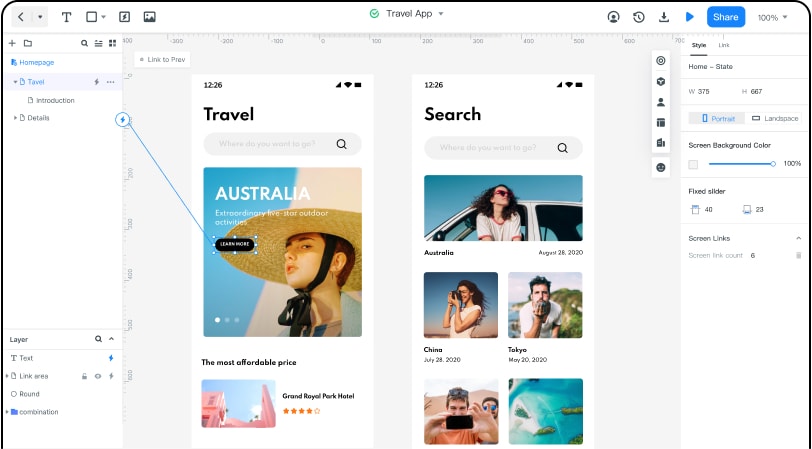
Mockitt can turn a static screen concept into a clickable prototype. Designing a layout for a device is different from supporting editing or preview on that device. Check the current workspace and sharing requirements, and test the prototype in the browser and viewport your reviewers will use.
Share the prototype with the intended reviewers using the project’s access settings. Ask them to walk through a specific task and record where the interface is unclear. That feedback can inform a product decision; the tool itself does not guarantee faster delivery.